The “Cserdi Model”

In Central and Eastern Europe, the question of social inclusion has remained a recurring policy challenge for decades. In communities facing structural disadvantage, interventions are often built around external programmes, financial support, and institutional solutions. Less often do initiatives emerge that seek to produce lasting change at the local level by relying on internal resources and community-based agency.

Read more

Forced Adaptation and Inherited Silence

The Socio-Psychological Legacy of Collectivization in Hungary (1961–1990). The end of collectivization did not bring genuine resolution: the loss of land, forced adaptation, and unspoken fears left behind a mental legacy that remains visible today through family patterns and broader forms of social behaviour.

Read more

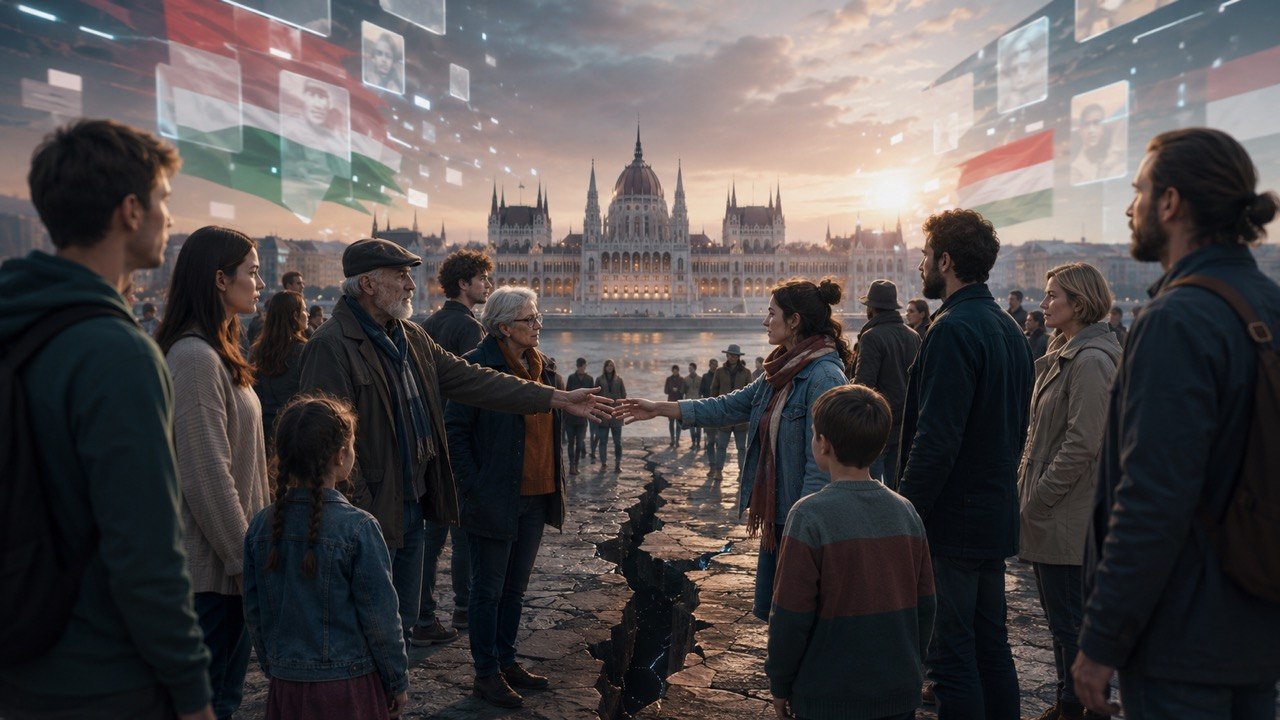
When Public Holidays Become Political Battlegrounds

How polarisation, permanent campaign rhetoric, and the logic of political warfare have transformed Hungary’s shared civic rituals.
Several holidays are approaching. March 15 marks Hungary’s national holiday, followed by Easter at the beginning of April, and, a week later, parliamentary elections. According to the governing party, Fidesz, the latter is also a “celebration of democracy.” A holiday is, by definition, a special day. It is a moment when we remember something important to an individual, a community, or a nation, or when we commemorate a person who played a significant role in the life of that community or achieved something meaningful.

Read more

Attic Sweeping – Collectivisation or how our great-grandparents became kulaks

This is the first part of a four-part series examining the practice of attic sweeping. In the following instalments, I will analyse the forced reorganisation of families’ lives, the redistribution carried out through compensation vouchers and the disappointments associated with it, and finally the opportunities that may still be found in the present. For now, we look back at how the foundations of family livelihoods were once taken away.

Read more

Roles and Power: Hungary’s Year-End Political Moment

In just a few weeks, perhaps one of the most exhausting, symbolically understood Zimbardo experiments in the history of Hungarian society will come to an end. Observing from abroad, from the United Kingdom, it increasingly feels as if the political processes of recent years have reshaped not only institutions but also roles. The question today is no longer merely who will govern, but also who will remain “prisoners” and who will become the guards of the next cycle in a system where political identity is slowly overriding the personal one.

Read more

Orbán’s New Opponent: Mr. V-Power

István Kapitány, one of Shell’s global executive vice presidents, has stormed into Hungarian politics with enormous energy, right at the peak of the campaign season. He has put a 37-year multinational career and a carefully built international reputation on the table for what he sees as a higher calling: securing victory for the Tisza Party. And it seems even the party’s leader has begun to realise that a long-running one-man show may no longer be enough.

Read more

Government Arrogance Defies Scientific Facts

The past three months have seen a surge in legislation regarding the Chinese app TikTok, mainly for security reasons; that is, the app is partly owned by the Chinese Communist Party (CCP). Starting with the United States and continuing with Canada, the European Union finally realized the apparent cybersecurity threat. From March 20, the Chinese app has been suspended from all corporate devices of the EU’s leading institutions.

Read more

Porcnik: Political turn in Slovenia

Tanja Porčnik, the President of the Slovenian  Visio Institute talks to Zoltan Kesz about the Slovenian elections.  Podcast On April 24, a parliamentary election took place in the country. The results reflected a clear message from voters that the government needs to change. The ruling party led by Janez Jansa lost to a completely new […]

Read more
Title
.