When Diplomacy Becomes a Distortion: Rethinking Hungary’s Foreign Trade Machinerys

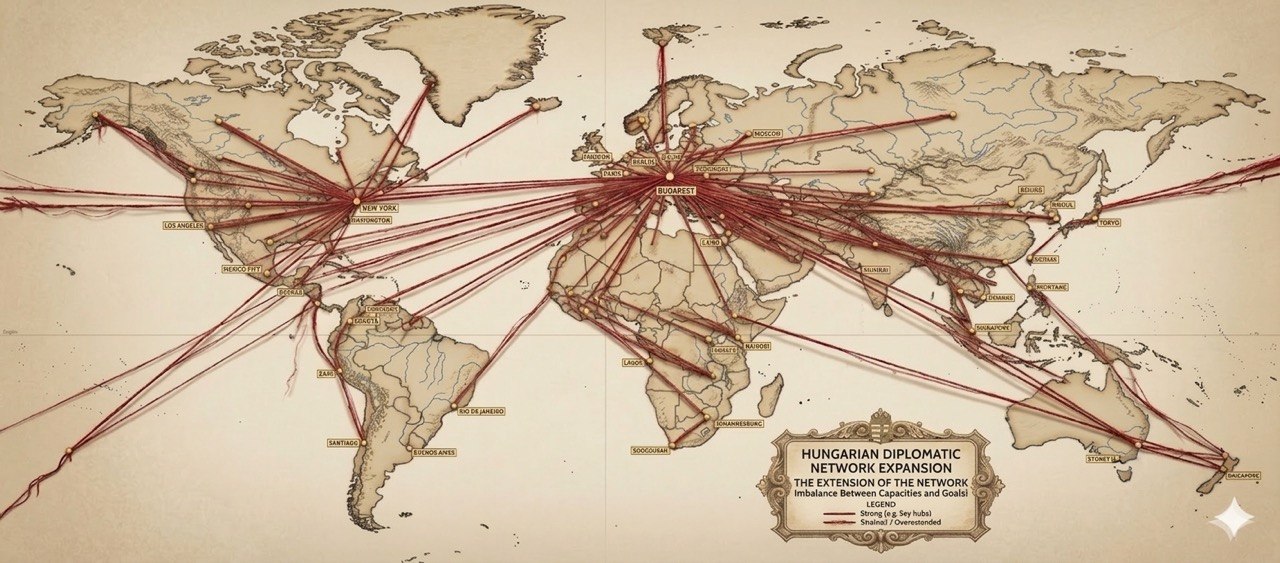
For more than a decade, Hungary has operated a parallel system within its foreign policy apparatus – a sprawling network of so-called foreign trade attachés (KGA), conceived as one of Minister Péter Szijjártó’s signature projects. Today, with 134 attachés stationed across 86 countries, the operation costs taxpayers an estimated 20 billion forints annually, a figure that invites the obvious question: what, exactly, does the Hungarian economy receive in return?
The honest answer is: very little.

Read more

The Institutional Background of Hungary’s Diplomatic Personnel Crisis

The foreign service is one of the most important state institutions of any country. Embassies and consulates do far more than perform protocol duties: they represent economic interests, facilitate strategic information exchange, carry out cultural diplomacy, provide security assessments, and manage crisis situations. Foreign policy can only function with a stable, well-trained, and professional staff. This is why it becomes particularly striking when a country’s diplomatic system gradually—almost imperceptibly—loses its professional weight and becomes increasingly politicised.

Read more

Hungary’s Faith Diplomacy: The Rise and Realities of the Hungary Helps Program

In the Ministry for Foreign Affairs and Trade (Külgazdasági és Külügyminisztérium) in Hungary there operates a State Secretariat for the Aid of Persecuted Christians and for the Hungary Helps Program.¹ According to official descriptions, no other country in the world has a state or diplomatic body with this exact name or mandate.² The budget line for this Secretariat appears in the Ministry’s chapter of the state budget under the title “Hungary Helps Program” (HHP) and at the sub-heading of that name.³ For the current year, the appropriation is approximately HUF 5.6 billion.⁴

Read more

Amb. Bonis: Sanctions are meant to cripple Russian aggression

CEA Talks host Zoltán Kész interviews the ambassador of the Netherlands to Hungary, Désirée Bonis. The topics include the two countries’ business, cultural and historical connections, and some politics. Ms Bonis talks about the NATO membership of Sweden and Finland and how she imagines the war ending. From the EU point of view, corruption is a big problem in Hungary, and populism is threatening democracy worldwide. But after all, the EU is still a unique society of liberty and freedom, which we should all be proud of.

Read more
Title
.