
A rather curious career opportunity has recently emerged in Hungarian politics for those whose parliamentary or party-political careers have come to an end. Apparently, founding a new party, standing for election or winning the confidence of voters are no longer essential requirements for continuing to regard oneself as a politician. A sufficiently large social media following, a few carefully crafted statements of political purpose and a convenient platform for collecting regular donations may now do the trick. The attempts by András Fekete-Győr (founder and former leader of Hungary’s liberal Momentum party) and András Jámbor (a former independent left-wing member of the Hungarian parliament and social activist) to reinvent their political careers, however, raise a particularly uncomfortable question. Why should the public finance the political comeback of people who, only a few months earlier, expected others to abandon their own electoral ambitions in the name of some supposedly greater political cause?
Author: Szilárd Szélpál
The Election Is Over, but the Sense of Mission Lives On
Political life once operated according to a relatively straightforward rule, although admittedly a rather inconvenient one for those on the receiving end. Parties developed programmes, nominated candidates and contested elections, while voters decided whether they had any further use for them. Electoral defeat did not, of course, amount to permanent political exile, but it did generally call for some explanation if the defeated politicians wished to carry on with undiminished confidence, offering much the same political product that voters had apparently found less than convincing. There was something refreshingly uncomplicated about this arrangement: politicians asked for a mandate, the electorate delivered its verdict, and those who failed to convince enough people were at least expected to reflect on the experience before announcing their next great political awakening.
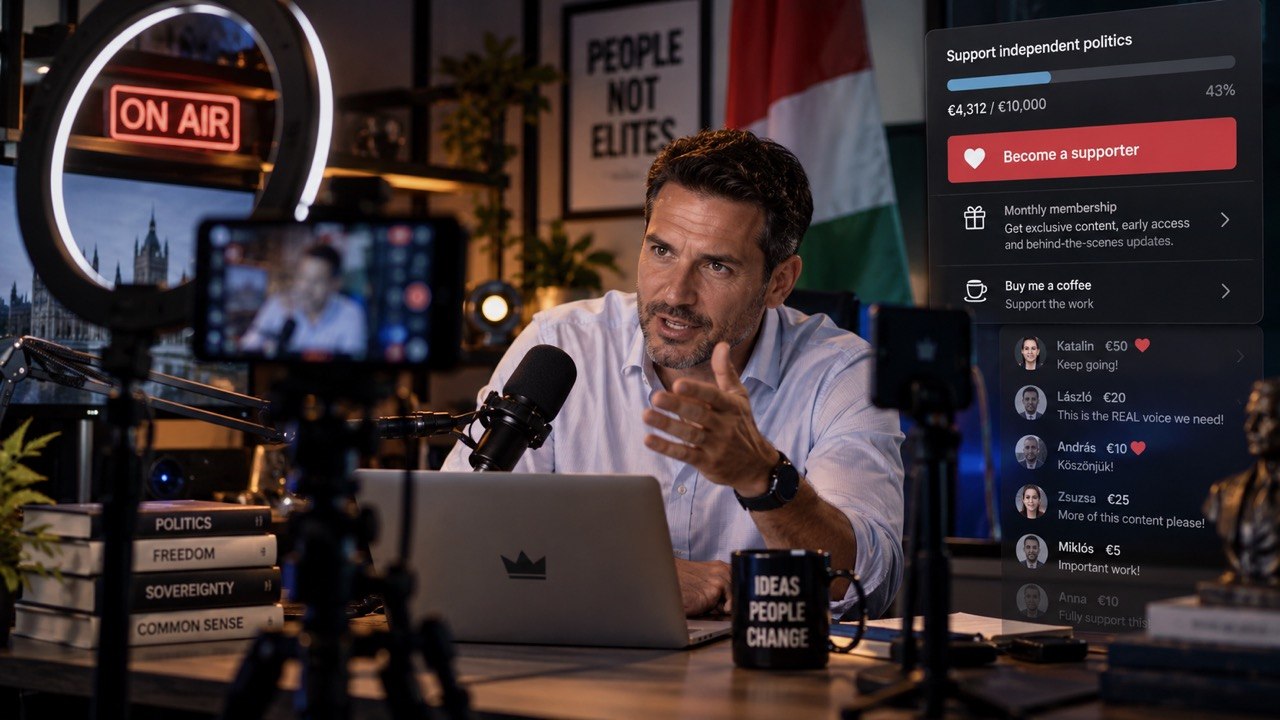
Social media has considerably simplified this somewhat old-fashioned arrangement. These days, a political presence does not necessarily require a party organisation, an electoral result or an institutional mandate. Instead, there are followers, engagement figures, shares and a steady stream of content, all conveniently displayed in numerical form and capable of creating the reassuring impression that public attention and democratic legitimacy are more or less interchangeable. And should the financial resources needed to maintain this political presence become a problem, the audience can always be invited to contribute directly. Democracy, it seems, has acquired a subscription model.
On 19 October 2026, András Fekete-Győr announced that he had closed the Momentum chapter of his political career, left the party he had founded and intended to continue his public activities as an independent politician. According to his announcement, he plans to travel around Hungary, monitor accountability and corruption-related cases, participate in constitutional and social policy debates and, in the longer term, contribute to rebuilding the country’s progressive political movement. All of this, he hopes, will be made possible through crowdfunding. The political ambition, in other words, remains intact; only the organisational structure and the source of financing are due for an upgrade.
András Jámbor has proposed a somewhat more tangible arrangement. On his website, he is looking for one thousand regular supporters willing to contribute HUF 5,000 per month towards the continuation of his political and advocacy work. If the target were reached, the initiative would receive HUF 5 million in monthly donations. His stated priorities include child protection, reform of Hungary’s debt enforcement system, workers’ rights and the development of a new left-wing, green and social-liberal political community. Unlike Fekete-Győr’s broader promises of progressive renewal, Jámbor’s proposal at least comes with a clearly defined financial target and a list of causes he intends to pursue.
There is nothing inherently unlawful or necessarily objectionable about either initiative. Indeed, the very point of a democratic public sphere is that political participation should not be the exclusive privilege of those fortunate enough to hold a parliamentary seat. Countless civil society organisations, social movements, independent public figures and political initiatives operate across Europe with the help of donations from their supporters. The question, however, is neither one of legality nor primarily one of financing, but rather what exactly transforms the activities of a former politician, still unwaveringly convinced of his own political importance, into a public good worthy of collective financial support. After all, the fact that somebody wishes to continue being a politician does not, in itself, constitute a social necessity. At most, it represents a personal ambition, which may naturally have political value. It would simply be helpful if that value could be demonstrated somehow.
In February, Stepping Aside Was the Responsible Thing to Do
The current situation becomes rather more intriguing when we look back a few months. On 11 February 2026, András Fekete-Győr and András Jámbor gave a joint interview to Válasz Online (an independent Hungarian political and current affairs publication) in which they discussed the case for withdrawing from the parliamentary election. Both explained their decision not to stand as candidates in April by referring to the need to facilitate an electoral victory for the Tisza Party (the opposition movement led by Péter Magyar, which subsequently won the April 2026 parliamentary election and ended Viktor Orbán’s sixteen years in power). Their reasoning was that the broader objective of political change should take precedence over the individual ambitions of smaller opposition parties and their representatives.
Discussing the participation of smaller parties, Fekete-Győr argued that the responsible course of action for a political force polling at three or four per cent was to step aside in the interests of broader political change. He explicitly considered Momentum’s participation in the election a decision that could jeopardise the party’s political future. Jámbor cited similar strategic considerations, arguing that standing for election himself would not have served the broader political objective he considered important. He was also remarkably candid about the failures of Hungary’s former left-wing and liberal political actors, acknowledging that their own shortcomings had contributed to the absence of a credible left-wing political alternative. The political message was reasonably clear: the old opposition had failed, the electorate wanted change, and those who had previously occupied the political stage should now make room for somebody else.
There was, of course, an electoral logic behind their arguments in February. In a political environment where many regarded replacing the previous government as the overriding objective, limiting the fragmentation of opposition votes could be a rational strategic choice. Withdrawing from an election is not necessarily an act of cowardice, just as standing for election is not automatically irresponsible. Both decisions can have perfectly defensible political justifications, depending on the circumstances and the objectives involved. Yet there was also something rather convenient about a political philosophy in which withdrawing from electoral competition could be presented not as a retreat, but as a particularly elevated form of responsibility.
Fekete-Győr made one especially interesting observation during that February interview. Referring to the decision of the Democratic Coalition (DK, a left-liberal opposition party founded by former Prime Minister Ferenc Gyurcsány) and the Hungarian Two-Tailed Dog Party to contest the election independently, he questioned why they did not trust that their political ideas would still have a place after the election. When speaking about himself and Momentum, however, he expressed precisely that confidence, insisting that the progressive political movement would need to be rebuilt after 2026. In other words, confidence in the future of his own political community was never in short supply, while the independent electoral participation of others suddenly became an obstacle to the preferred political strategy.
This is not necessarily a logical contradiction. In February, the objective may have been a change of government; in October, the rebuilding of political pluralism. In principle, the two positions are compatible, and there is nothing inherently inconsistent about supporting electoral coordination at one moment and independent political organisation at another. What is rather less obvious is why political self-restraint appeared such a self-evident requirement when expected of others, while the importance of one’s own political future seemed to require considerably less justification. Evidently, stepping aside was an admirable civic virtue, provided it did not become a permanent condition.
At Least the Two-Tailed Dog Party Sat the Exam
The Hungarian Two-Tailed Dog Party (MKKP, an anti-establishment party originally known for its satirical political campaigns, civic activism and local community projects) adopted a rather different strategy in the spring of 2026. It insisted on presenting its own national party list and maintained that democratic competition should offer voters a genuine choice between different political platforms. According to its leadership, preserving political diversity had value in its own right, and changing the government did not necessarily make the representation of other political ideas redundant. It was an argument that proved rather unpopular among those who believed that the only responsible political choice was to clear the electoral field for Tisza.
The MKKP’s position was not, of course, entirely free of strategic compromise. The party eventually withdrew three constituency candidates, arguing that doing so would facilitate a change of government in those particular districts. It was therefore not a case of rejecting every possible form of electoral cooperation. The essential difference was that the party refused to abandon its independent national political platform altogether, even at the risk of a disappointing result. In effect, it accepted that voters might reject its political offering, but insisted that they should at least be given the opportunity to do so.
The voters delivered their verdict on 12 April 2026. According to the official figures published by Hungary’s National Election Office, the MKKP received 51,965 party-list votes, representing 0.82 per cent of the total. It failed to enter parliament and suffered a substantial electoral setback at the national level. There is little point in dressing up that result: the party’s political offering failed to attract sufficient support to secure parliamentary representation. Whatever its merits as a satirical movement, local civic organisation or alternative political community, its national electoral proposition did not convince enough voters.
There is, however, an important distinction. The Two-Tailed Dog Party actually subjected itself to the electoral test, ran a campaign, accepted the political risks involved and then faced the voters’ decision. For the former opposition politicians who stayed out of the election, we have no comparable electoral result measuring their current personal support. This does not prove, of course, that Fekete-Győr or Jámbor necessarily enjoy less personal support than the Two-Tailed Dog Party; the available figures simply do not allow such a comparison. One fact, however, remains beyond dispute: voters had the opportunity to assess the MKKP’s political offering at the ballot box, while no equivalent direct electoral judgement was delivered on the others’ new political ambitions.
The MKKP’s defeat was therefore a setback with real political consequences. For those who stayed away from the election, meanwhile, the place normally occupied by an electoral result can rather conveniently be filled by a comeback narrative built around an existing online following. Democratic competition has one particularly unpleasant characteristic: every so often, it reveals that considerably fewer people support you than are merely interested in watching you. Fortunately, social media makes it rather easier to avoid this particular inconvenience, allowing political visibility to survive long after the need for actual votes has temporarily disappeared.
A Facebook Follower Is Not an Electoral Mandate
In his October announcement, Fekete-Győr also pointed to the significance of his social media presence. According to the politician, hundreds of thousands of people follow his online activities, and this attention can, under the right circumstances, be converted into genuine public mobilisation. As an example, he cited an earlier solidarity demonstration in support of Gábor Iványi (a Hungarian Methodist pastor and long-standing social activist whose charitable organisations have been involved in prolonged disputes with the Hungarian authorities). The argument was intended to demonstrate that an online audience can become a politically active community, even without the organisational infrastructure of a conventional party.
There is some substance to this reasoning. Social media can indeed mobilise people politically, and online communities are sometimes capable of generating significant activity in the real world. Digital political communication is therefore not inherently worthless, nor are the communities emerging from it necessarily confined to the virtual sphere. Yet there is a fundamental difference between the number of followers and an electoral mandate, a distinction that tends to become rather blurred when engagement statistics are presented as evidence of political relevance.
People may follow a politician because they agree with him, because they enjoy arguing with him, because they are interested in public affairs or simply because they occasionally find his pronouncements entertaining. Social media algorithms, moreover, are not democratic electoral systems. They do not check users’ voting eligibility, place of residence, political commitments or even whether they would consider voting for the person concerned. Three hundred thousand followers do not, therefore, amount to three hundred thousand voters, just as a successful video is not a referendum and the number of shares cannot reasonably be mistaken for a political mandate. If democratic legitimacy could be measured by online engagement alone, the entire electoral system could be replaced with a reasonably sophisticated analytics dashboard.
Comments require particular caution as well. Supportive or critical reactions beneath a politician’s social media posts do not provide a representative picture of public opinion, although they can reveal recurring political objections that deserve attention. Among these, the question of consistency is particularly interesting. Why does someone regard the continuation of his own political career as socially important when, only a few months earlier, he expected other political actors to refrain from putting themselves before the electorate? The fact that many people follow him online is not necessarily an adequate answer, particularly when the very nature of that following remains politically ambiguous.
Modern politics is remarkably good at creating a particular illusion. A politician remains permanently visible, comments on current events, publishes regular statements, engages in arguments and reaches a sizeable audience courtesy of the algorithms. None of this, however, automatically means that there is a political community behind him willing to entrust him with representation through a democratic election. Attracting attention and earning political trust are two quite different achievements, although the former has the considerable advantage of being easier to measure, advertise and, increasingly, monetise.
When Political Presence Becomes a Service in Its Own Right
One of the greatest advantages of crowdfunding is that a political or civic initiative need not depend on a handful of wealthy benefactors. A large number of small donors can collectively make possible activities that would otherwise struggle to find support through traditional party-financing structures. This is a legitimate form of democratic participation, and in many circumstances it can strengthen the independence of political initiatives from powerful financial interests. Yet it also raises new questions when the object of the fundraising is no longer a clearly defined campaign, policy project or civic initiative, but the general maintenance of a former politician’s public presence.
András Jámbor’s fundraising appeal identifies specific social issues. Child protection, housing, workers’ rights and problems within the debt enforcement system are genuine areas of public policy. During his parliamentary career, he proposed changes in several of these fields and, according to his own account, contributed to achieving certain results. These activities deserve acknowledgement, even by those who remain unconvinced by his political record as a whole. The question, however, is what new means he intends to use after the expiry of his parliamentary mandate, what concrete results he hopes to achieve and how these differ from the work he previously carried out. Good intentions and familiar causes may explain continued commitment, but they do not necessarily constitute a new political proposition.
Similar questions arise in Fekete-Győr’s case. Touring the country, monitoring accountability cases and rebuilding the progressive political movement are all potentially legitimate objectives. For the time being, however, they remain primarily declarations of political intent. Whether they will produce a lasting organisation, a new policy programme or measurable public achievements remains to be seen. Political renewal is, after all, a rather ambitious label for an undertaking whose immediate deliverables appear to consist largely of continued visibility, public meetings and commentary on the affairs of the day.
Crowdfunding can therefore create a rather curious arrangement. A former politician first establishes the importance of his continued participation in public life, then asks the audience to finance the operating costs of that participation. If enough people contribute, this may demonstrate genuine demand among supporters for his activities, but it does not establish that his political initiative commands a broader democratic mandate. The size of the donor base is therefore not necessarily a measure of political renewal. It may simply demonstrate that the person concerned has succeeded in developing a sustainable crowdfunding model, which can be a perfectly successful enterprise in its own right. It would merely be unwise to confuse it automatically with political rebirth.
The Uncomfortable Line Between Public Service and Making a Living from Politics
The relationship between political activity and personal livelihood has long been a sensitive subject. Politicians receive salaries for their work, parties operate with financial support, civil society organisations employ staff, and political communication has its own professional costs. None of this is inherently problematic, and political activity does not become morally objectionable simply because someone receives a salary or regular financial support for carrying it out. A credibility problem may arise, however, when preserving a political role appears to become more important than demonstrating the social value created by that role.
In Hungarian public discourse, this is often referred to as megélhetési politizálás — roughly, making a living out of politics for its own sake. The expression is hardly complimentary, but the question behind it is legitimate: does a public figure genuinely wish to maintain a political presence in order to advance the causes he represents, or has preserving his own political status become the primary purpose of his activities? A single fundraising campaign cannot settle that question. Nor is there evidence that either politician expected a future appointment or personal reward in exchange for stepping aside before the election. Such suggestions may form part of political interpretation, but they are not established facts, and the consistency of the politicians’ current positions can be examined without speculating about their supposed financial motivations.
If, in February, one of the clearest demonstrations of political responsibility was a politician’s or party’s willingness to sacrifice its own electoral ambitions, what new public achievement makes the crowdfunding of those same ambitions justifiable in October? The question becomes particularly uncomfortable when the politicians concerned had themselves referred to weak electoral prospects as a reason for withdrawing. Stepping back from politics can, of course, be a responsible decision, just as returning to it later can be perfectly justified. But something ought to happen between the two: a new insight, a new political platform, a new organisation or perhaps evidence of public support that had previously been lacking. Without that, the transition from political withdrawal to political comeback begins to resemble a change in presentation rather more than a change in substance.
Otherwise, political renewal risks becoming a rather peculiar form of recycling. The old political figures return with new communication techniques and new funding arrangements, while continuing to promote essentially the same political messages. The transformation is then more technical than substantive, with the familiar political product relaunched under slightly different packaging. In a country where political parties have repeatedly promised renewal, only to discover that their principal innovation consisted of changing the logo, this particular development is not entirely without precedent.
Not Every Comeback Is a Renewal
The transformation of Hungary’s political system in 2026 has naturally created a new environment for former opposition politicians. The end of the Orbán era, the Tisza Party’s electoral victory and the decline of the previous opposition parties have substantially changed the opportunities available in public life. Political pluralism remains important in this new environment, since a change of government does not bring political debate to an end, nor does it eliminate the need for social or policy criticism of the new administration. Former opposition politicians have every right to participate in those debates, organise new movements and request community support for their activities.
A democratic right, however, is not the same thing as political credibility. The former belongs to everyone; the latter must be earned, and earned again, by those who seek a role in public life. A former politician does not automatically become a new political figure simply by leaving his party, nor does an expired parliamentary mandate miraculously turn into a social movement. Regular donations from supporters may finance a political activity, but they cannot confer an electoral mandate. That distinction is particularly important when those seeking renewed relevance previously argued that others should suspend their own political ambitions in the interests of a supposedly greater democratic objective.
Renewal requires substance. Not necessarily a new ideological label, but political thinking capable of addressing the problems societies face today and those they are likely to face tomorrow. Hungary has no shortage of such challenges. Economic competitiveness, housing, education, healthcare, social mobility, the functioning of public institutions and the labour-market consequences of new technologies all demand serious policy work. Yet attempts by former opposition politicians to relaunch their careers frequently continue to emphasise familiar political values, accountability and a permanent presence in the daily political conversation. These may all be important matters in their own right, but if the objective is to create a new political alternative, sooner or later someone ought to explain what will actually be different about the new offering.
For those who stayed out of the election, this is a particularly demanding test. By choosing not to stand, they also gave up the opportunity for voters to assess their political platform directly. At least the Two-Tailed Dog Party subjected itself to that test, failed to secure parliamentary representation and now faces the need for serious reflection. Yet alongside the fact of its defeat stands another equally important circumstance: voters actually had the opportunity to make a decision about it. Someone who chose to stay out of the electoral contest cannot automatically establish a renewed political claim simply by reappearing once the campaign is over. The right to do so is beyond question, but the credibility of the comeback is another matter entirely.
Political Renewal for HUF 5,000 a Month
An interesting new situation is therefore emerging in Hungarian politics. The old party structures have weakened, several familiar politicians have lost their institutional positions, yet the online public sphere still offers them the opportunity to maintain a political presence. There is nothing inherently wrong with that, since a democratic society needs independent commentators, policy initiatives and civic organisations capable of scrutinising political power. But precisely because these activities are important, they should not be confused with the automatic extension of previously established political careers.
Supporters naturally have the right to finance public figures whose work they consider worthwhile, and former politicians have an equally legitimate right to speak out again, organise and build political communities. The public, however, has every right to ask what new value it is supposed to receive in return. In February, Fekete-Győr and Jámbor concluded that setting aside their electoral ambitions would best serve the public interest by facilitating political change. Now, both consider the continuation of their own political activities an important collective objective. There may be a coherent political argument connecting these two positions, but it is for them to make that argument, and to do so rather more convincingly than simply pointing out that they still have followers and remain committed to the values they have always represented.
This matters all the more because the Two-Tailed Dog Party, having actually contested the election, received a measurable answer to the question of how much support it could attract. It can draw conclusions from its defeat, reform its organisation and return with a new political programme. If it does, voters will once again have the opportunity to judge it at the next election. For politicians who previously considered electoral self-restraint desirable when applied to others, meanwhile, the test of credibility is only just beginning. It will not be determined by how many people are willing to make regular donations, but by whether they can develop new political ideas, offer meaningful social representation and deliver results for which they can be held accountable.
Because in politics, everyone has the right to make a comeback, but the justification for that comeback is not an automatic entitlement. And since we are discussing political renewal, perhaps one final question is worth asking: how is it that in February, giving up electoral ambitions was presented as the ultimate proof of responsible politics when expected of others, while by October, maintaining one’s own ambitions had somehow become a public good worthy of collective financial support? Or has democracy quietly introduced a new rule whereby other people’s political relevance must be tested at the ballot box, while our own can be conveniently verified through monthly bank transfers?
Sources
- Válasz Online – Fekete-Győr and Jámbor on opposition withdrawals, 11 February 2026
- Telex – András Fekete-Győr leaves Momentum, 19 October 2026
- András Jámbor – Become My Ally, crowdfunding appeal
- András Jámbor – Account of his previous parliamentary work
- Hungarian National Election Office – Hungarian Two-Tailed Dog Party, 2026 election results
- 444 – The Two-Tailed Dog Party maintains its commitment to contesting the election, 16 February 2026
- Telex – MKKP withdraws candidates in three constituencies, 2 April 2026
- Kontroll – András Jámbor responds to criticism from the Two-Tailed Dog Party, 15 February 2026

Szilárd Szélpál served as an environmental expert in the European Parliament from 2014, where he utilized his expertise to influence policy-making and promote sustainable practices across Europe. In addition to his environmental work, Szilárd has a deep understanding of foreign affairs, offering strategic advice and contributing to the development of policy initiatives in this field.
Cover photo: AI-generated illustration by Central European Affairs (CEA), 2026.
Support independent analysis and journalism at CEA Magazine: https://centraleuropeanaffairs.com/donation
For more insights on Central European political risk, EU institutional developments, and transatlantic relations, follow CEA Magazine and the CEA Talk podcast.
