
István Kapitány, one of Shell’s global executive vice presidents, has stormed into Hungarian politics with enormous energy, right at the peak of the campaign season. He has put a 37-year multinational career and a carefully built international reputation on the table for what he sees as a higher calling: securing victory for the Tisza Party. And it seems even the party’s leader has begun to realise that a long-running one-man show may no longer be enough.
Author: Balázs Láng
Kapitány – Captain, as his name translates – has been a leader all his life. Not a subordinate type. He brings to mind charismatic yet grounded figures: calm, authoritative, but relatable. These are traits Hungarian voters, long accustomed to the insular habits of domestic politics, have not seen in Viktor Orbán, neither in the fragmented left-wing opposition, nor even in the permanently combative, always-on-the-attack Péter Magyar. Kapitány has humour. He radiates composure. He answers tough questions without aggression, avoids labelling, and stays out of the cheap mud-wrestling that passes for political debate. In many ways, he is Magyar’s political counterpart, his pendant. And politics, at its core, is political communication: a planet of perceptions.
.
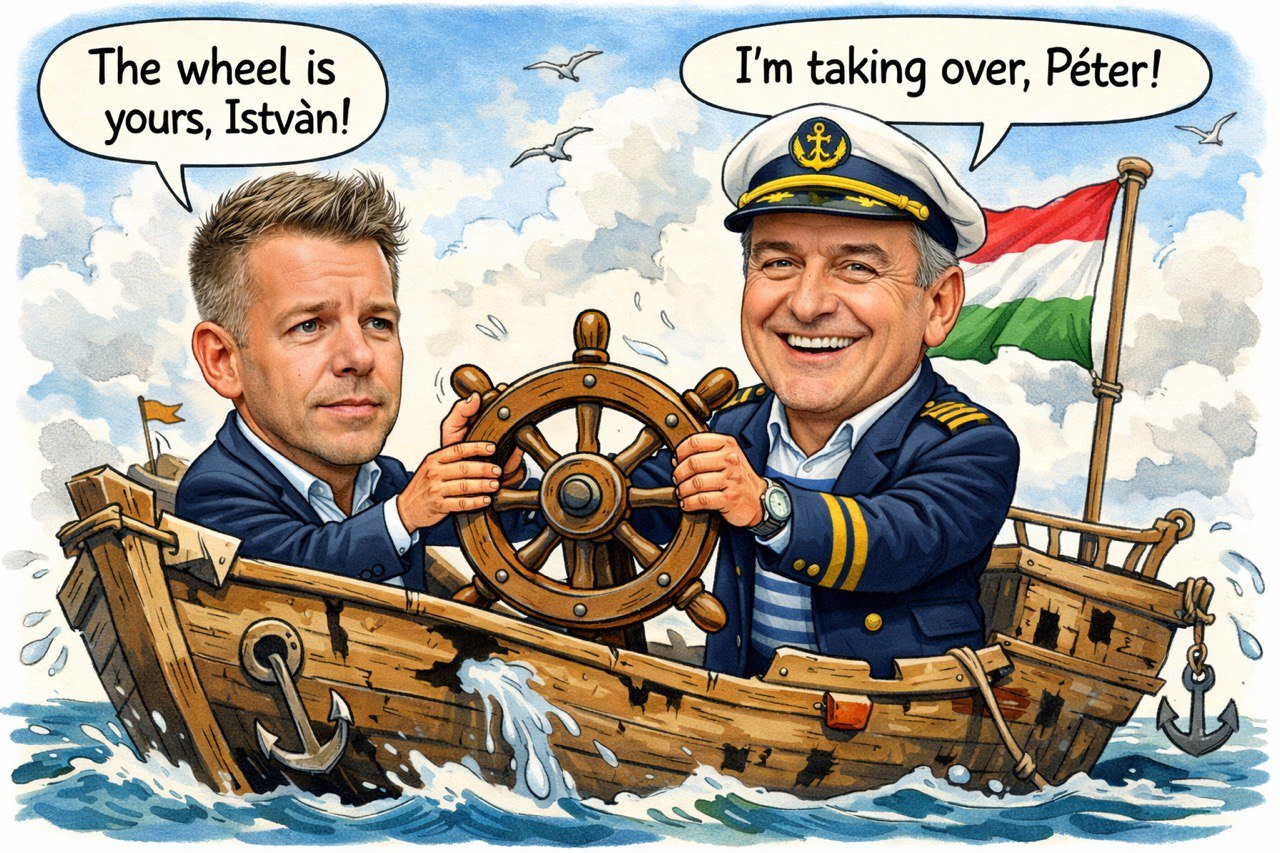
The initial magnetism of Péter Magyar is clearly fading. Two gruelling years have taken a visible toll on his nervous system. Despite his ambitions, he has been unable to transcend himself; deep down, he remains a Fidesz man, eager to bring down his former idol, Viktor Orbán. But in politics – much like in boxing – revenge and personal grievance are poor motivators.
By now, Magyar’s follower base has become just as uncritically fanatical as Orbán’s. His early bravado has curdled into arrogance, and more and more voices – both in Hungary and, according to reports, in Brussels – are questioning his suitability for the role of prime minister. This scepticism does not concern his ability to mobilise voters. On that front, he has been highly effective: waking up society and politically obliterating the old opposition. Put bluntly, he might make a better cult leader than a nation-uniting prime minister.
And yet, with Kapitány’s arrival, even potential Tisza voters have begun quietly asking themselves: might Kapitány actually be the better prime ministerial candidate?
Apart from a handful of former Fidesz insiders and complete political newcomers, Tisza has failed to build up any recognisable figures beyond Péter Magyar himself over the past two years. This is largely Magyar’s own fault. He runs the party as a tightly controlled personal structure, seemingly incapable of sharing success, spotlight, or power. Autonomous thinkers with alternative worldviews rarely survive near him. The party he has built increasingly resembles the very party he once came from: Fidesz. As a result, many now see Tisza’s struggle against Fidesz less as a genuine attempt to change the system and more as a civil war within the right, within ruling Fidesz.
What once appeared ideologically fluid has since solidified. Observing Tisza’s actions in the General Assembly of Budapest, in the European Parliament, and in Magyar’s own decisions and public statements, one conclusion emerges: Tisza is the new right-wing home for disappointed, sidelined Fidesz voters: the Fidesz 2.0. There is no real space here for liberals or left-wing voters. At best, they may briefly feel included during vote-maximising campaign speeches, only to be reminded time and again of Magyar’s unwavering Fidesz instincts.
Still, those who seek change reluctantly accept one hard truth: if they ever want to break free from Orbán’s system, voting for Tisza is currently the only viable option. And they are not wrong. This political configuration exists solely because of Péter Magyar. Even voters who personally dislike him have good reason to support his party. But success is far from guaranteed if Magyar continues to build everything around his own personal aura, suffocating everyone else. Without a genuine innovation, this path could easily lead to Fidesz’s fifth consecutive two-thirds landslide.
Which brings us to fuel. New fuel.
And who could be more fitting than a former global vice president of Shell? István Kapitány was personally involved in rolling out V-Power fuel worldwide, and now, just in time, he is supplying fresh energy to a weakening Tisza. His first public statements introduced a tone utterly unfamiliar in Hungarian politics: a new atmosphere, a breath of air that visibly affected Péter Magyar himself. Overnight, the self-styled messiah shrank into a petrol station attendant beside the confidence and authority of the Shell executive.
Kapitány’s thoughts are precise, his words are firm, his smile is importing the optimism of Western business culture into Hungary’s grim, depressive, hate-soaked political landscape. His emergence is not Magyar’s achievement: it is his stroke of luck. Perhaps internal pressure finally forced the party leader to recognise the need to present someone who can credibly guarantee that post-Orbán Hungary will value expertise and performance over blind loyalty and leader worship. Kapitány, unlike Magyar, appears to embody exactly that promise.
Analysts are already speculating: if Péter Magyar – under pressure or by his own insight – decides to step aside in favour of Kapitány, should he do so before April 12, or strictly after? What was striking, in any case, was Magyar’s unprecedented humility during his conversations with Kapitány, as if for the first time he sensed he was no longer in the same weight class as his own newly appointed economic heavyweight.
It is also unusual for Magyar to elevate a thoroughly corporate leader into the campaign. Someone Fidesz can easily attack as the embodiment of global capital. Kapitány’s father, a pilot who died tragically, was reportedly favoured by the communist regime, providing Fidesz with yet another potential line of attack. Accusations of “leftism” are usually Magyar’s greatest fear. Yet this time, he seems to have accepted the risk, finally allowing a genuinely professional figure into television studios.
Kapitány was convincing. He performs too well. Tisza supporters are already hopelessly in love with their new ‘Captain’. And he seems to be enjoying the sudden popularity – clearly not the type to be easily tamed. Which raises the inevitable question: what happens to the old leader, Péter Magyar?
At this point, some say Péter Magyar would be wise to let go of the prime-ministerial role and allow István Kapitány to step forward. Magyar could remain the Brussels-based spearhead of the anti-Orbán fight, the key mobiliser of opposition forces. And Hungary, for once, might finally gain a truly worldly, genuinely European prime minister.
Cover photo credit: ChatGPT

Balázs Láng is a journalist, a political communications expert, a former editor, producer and Budapest correspondent at the BBC World Service.
For more insights on Central European political risk, EU institutional developments, and transatlantic relations, follow CEA Magazine and the CEA Talk podcast.
Support independent analysis and journalism at CEA Magazine: https://centraleuropeanaffairs.com/donation