
While more and more countries are trying to protect children from excessive digital overstimulation, far less attention is being paid to the impact that constant online political communication may have on adults’ attention, mental well-being and, ultimately, democratic public discourse.
Digital protection should not end at eighteen
Author: Olga Nádra
In recent years, an increasing number of countries around the world have come to the same conclusion: children’s developing nervous systems need protection from excessive stimulation in the digital environment. This has led to restrictions on smartphone use in schools, age limits on social media, and tighter rules on access to certain types of online content. The aim has generally been the same: to reduce emotional manipulation, limit the constant flow of stimuli, and create an environment that supports healthy development.
Today, few people seriously dispute this approach. We have accepted that children do not yet possess the psychological defence mechanisms needed to cope adequately with the constant emotional pressure of the digital world. We have also accepted that parents, schools and the state share responsibility for protecting them. Yet there is another question that receives surprisingly little attention: what happens to us as adults? Does the nervous system suddenly become capable of unlimited strain the day someone turns eighteen? It is almost as if adulthood automatically made us immune to constant stimulation, emotional manipulation and the effects of the digital environment. Everyday experience suggests otherwise.
When we are no longer the ones looking for politics
Today, we no longer need to seek out political programmes, watch the evening news or buy a newspaper for politics to become part of our daily lives. We only need to unlock our phones. By the time we open a social media platform, we may already be surrounded by political advertisements, campaign videos, live broadcasts, comment wars and events demanding an immediate reaction. Politics often finds us even when all we want is to switch off for a while.
Interest in public affairs is not a problem in a democracy. On the contrary, it is a fundamental part of civic responsibility. A functioning democracy needs informed voters. But being informed is not the same thing as being exposed to a continuous stream of political stimuli. There is an important difference between the two. The real question, therefore, is not whether we need politics, but rather who is in control. Do we decide when and to what extent we engage with public affairs, or do the digital environment and political communication make that decision for us?
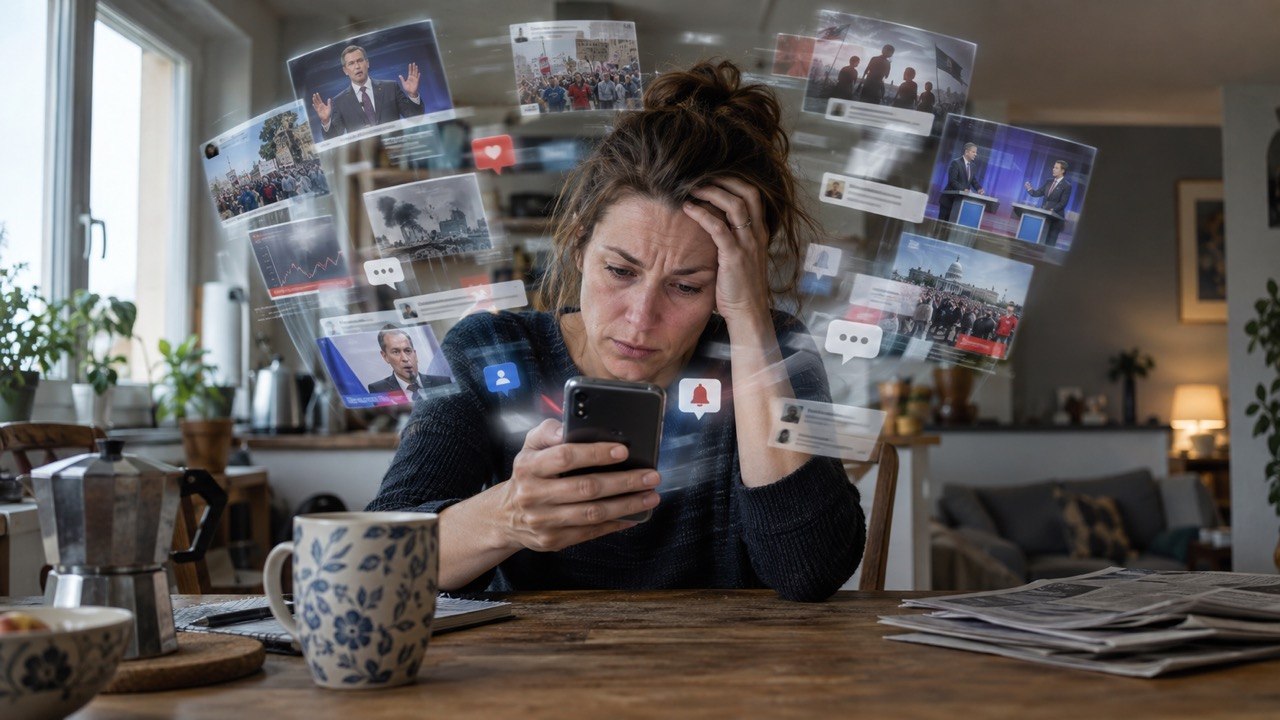
Attention is a finite resource
Human attention is a finite resource. Our nervous system constantly evaluates threats, processes conflict and responds to emotionally charged messages. If the same stimuli – fear, outrage, urgency and a sense of threat – are repeated day after day, they inevitably influence how we think, how we feel and how we relate to one another over time.
Perhaps, then, we do not need to protect ourselves from politics itself, but from politics becoming permanent background noise. From a situation in which every day brings another scandal, another conflict or another supposedly “decisive” moment demanding an immediate emotional response. In such an environment, public affairs can gradually crowd out other subjects from our shared thinking, while people begin to feel that they must remain in a permanent state of alert. If we now consider it natural to protect a thirteen-year-old from excessive digital stimulation, it is worth asking why we assume that the nervous system of a forty- or sixty-year-old can absorb hundreds of political stimuli every day without consequence.
Adults are, of course, more experienced. Their critical thinking is more developed, they have greater life experience, and they are often better able to recognise complex connections. But this does not make them immune to continuous emotional pressure. The human nervous system does not function differently according to political affiliation or age. Fear, uncertainty, anger and perceived threat activate the same biological stress mechanisms in a twenty-year-old as they do in someone who is sixty.
The responsibility of algorithms and political communication
Modern political communication understands this very well. Not necessarily because of malicious intent, but because the digital environment rewards it. Social media algorithms tend to favour content that provokes strong emotions. Outrage spreads more quickly than calm, conflict generates more engagement than consensus, and fear attracts more attention than a sense of security.
This is why the conversation should not only be about algorithms, but also about the responsibility of political communication itself. If we expect digital platforms to mitigate effects that may be harmful to mental well-being, then it is reasonable to ask whether the same ethical standard should also apply to those who consciously build their public communication around these psychological mechanisms. What is needed is not another set of prohibitions, but rather a different political culture: one in which leaders recognise that not every event requires an immediate statement, and that silence can sometimes be a sign not of uncertainty, but of responsible reflection.
Citizens also have a role to play by reclaiming control over their own attention and refusing to let algorithms or campaign logic determine what they think about from morning until night. A healthy democracy does not function well because politics is present in every minute of our lives. It functions well because politics is present when it genuinely needs to be. Perhaps it is time for us once again to decide when we allow politics into our lives, rather than allowing politics to decide for us.
I have already made my choice
This morning, I felt that it was time to take back control of my own attention. If I want to remain active on social media, I would like to decide again what deserves a place in my feed. After all, these platforms were originally created to help us stay connected with relatives who live far away and with old friends, to find inspiration for a recipe, discover a useful DIY idea or plan our next trip. They were not created to keep us in a state of political alert every hour of the day.
So today I blocked the politicians who had been appearing in my feed day after day. Not because I am no longer interested in public affairs, and not because I want to turn away from reality. I simply want to return the task of informing me to those whose profession it is: journalists. I do not believe this will make me less informed. But I hope it will make me calmer. And perhaps that is the first step towards deciding for myself again when I allow politics into my life, rather than allowing algorithms or campaign logic to decide for me.
Digital well-being is not only a child-protection issue
Perhaps it is also time for the European Union to raise a new question in its debates on regulating the digital environment. If we have already recognised that developing nervous systems need protection from excessive online stimulation, then it may also be worth considering what effect the constant stream of political stimuli has on the mental well-being of adults.
This is not an argument for bans or restrictions on freedom of expression. Rather, it is an argument that digital well-being should not end on our eighteenth birthday. Just as we now speak openly about protecting children in the digital environment, perhaps it is time to begin speaking about the mental well-being of adults as well.
Cover photo credit: CEA Magazine. AI-generated illustration created with OpenAI for CEA Magazine.

Olga Nádra is a social worker and a specialist in gerontology and mental health. She completed her studies at Kodolányi János University. She has more than fifteen years of practical experience in elderly care as well as in supporting people with psychiatric conditions. Her work is grounded in empirical insights gained in the field, through which she engages with questions related to mental health, care systems and the social welfare system. She believes strongly in lifelong learning and therefore continues to deepen her professional knowledge through ongoing training and research.
Support independent analysis and journalism at CEA Magazine: https://centraleuropeanaffairs.com/donation
For more insights on Central European political risk, EU institutional developments, and transatlantic relations, follow CEA Magazine and the CEA Talk podcast.
