
European defence procurement could open new markets for Hungarian automotive suppliers. SAFE financing, however, can support lasting industrial development only when military needs are matched with competitive corporate capabilities, appropriate technology rights and sustainable business models. For Hungary, the stakes are preserving existing engineering expertise and developing activities that generate greater value added.
Author: Szilárd Szélpál
One of the most important economic questions surrounding Europe’s defence preparations is what industrial capabilities growing procurement expenditure will leave behind. This has particular significance for Hungary. The transformation of the automotive industry is forcing companies and engineering teams to adapt, even though their expertise could also serve the defence sector with appropriate development. That opportunity will translate into lasting economic results only if a coherent strategy connects military requirements, supplier readiness and financing.
Many Hungarian automotive suppliers possess expertise whose value extends beyond the orders of a particular car manufacturer. Precision metalworking, vehicle electronics, wiring systems, software development, automation and thermal management can be applied across different industrial settings. When a company loses an order, its expertise does not necessarily become obsolete. Sometimes it is the market around which the company built its entire operation that is shrinking.
I believe that identifying these transferable capabilities should be one of the responsibilities of Hungarian industrial policy. Defence diversification could create opportunities by adding new products, customers and longer-term service relationships to existing civilian business activities. Achieving this requires considerably more than placing an automotive company on a list of potential military suppliers.
Building on existing expertise
The difficulties facing Europe’s automotive industry have several causes. Electrification, the growing importance of software, energy and investment costs, changing demand and international competition are reshaping the environment in which suppliers operate. These developments affect individual companies differently. A manufacturer of powertrain components, an engineering business serving several industries and an automotive software company may each need a different, commercially viable path towards adaptation.
The defence market cannot absorb unlimited volumes of production displaced from the civilian automotive sector. Production runs, qualification requirements, documentation obligations and product life cycles differ. For a component intended for military use, long-term repairability and spare-parts availability may be just as important as the initial manufacturing cost. Entering this market therefore also requires changes to business practices and organisational arrangements.
This is why PROSUM’s defence industry concept places particular emphasis on military mobility, life-cycle support, digital logistics and specialised technological expertise. These are areas in which Hungarian companies can build on existing capabilities. A clearly defined component, a diagnostic solution or a regional repair service can become a valuable, exportable business.
The first step in such a strategy would be a substantive assessment of companies. We need to know where spare or adaptable capacity exists, what engineering expertise is available, how large the qualification gap is and what it would cost to close it. Support should concentrate on businesses with a credible prospect of operating independently and sustainably after the transition.
Financing opportunities need concrete procurement plans
The significance of SAFE, the European defence loan instrument, should be assessed in this context. Financing eligible procurement can generate orders, while those orders can make suppliers’ investment plans more predictable. A company is better placed to bear the cost of qualification, new equipment or additional staff when it is preparing for an identifiable product, customer and delivery period.
SAFE is nevertheless a loan instrument for Member States, serving specified defence procurement objectives. General factory modernisation or corporate rescue measures do not automatically become eligible simply because the beneficiary hopes to sell to military customers in the future. The legal and financial conditions governing procurement, corporate support and companies’ own investment must be addressed separately.
I therefore favour a programme structure in which different sources of finance have clearly defined roles. SAFE can support eligible procurement; a national supplier programme can fund preparation and address verified capability gaps; research instruments can support innovation; and corporate and bank financing can underpin commercial investment. This division of responsibilities can make development both implementable and accountable.
The debate over the size of Hungary’s loan request should also focus on the substance of the programme. A larger loan does not, by itself, demonstrate greater economic benefit, just as a smaller loan does not, by itself, demonstrate better financial management. Assessing the decision requires an understanding of the military justification, domestic supplier opportunities, feasibility and whole-life costs of both the retained and abandoned projects.
The substantive question is therefore whether a comparative assessment was conducted that considered these factors together. At least its aggregate conclusions should be open to public debate, with appropriate protection for military and commercial secrets.
Domestic value added begins with the contract
A production line operating in Hungary can have considerable economic value, but its location alone tells us little about how much expertise, income and decision-making power remain in the country. The imported content of the product, the location of development work, licensing arrangements and customer relationships all shape the actual outcome.
The rights acquired by the Hungarian company are particularly important. Does it have access to the necessary technical documentation? Can it carry out repairs and modifications? Can it further develop its own results? Can it sell to other customers? These questions directly influence whether the first order creates a lasting commercial capability or a temporary manufacturing assignment.
Life-cycle support can be especially valuable in this respect. Maintenance, repair and overhaul can generate recurring demand while building engineering expertise, diagnostic capabilities and spare-parts supply networks. A regional service centre, however, can perform substantive work only if it holds appropriate access and licensing rights. The conditions for technological autonomy must be established when contracts are negotiated.
Measuring economic outcomes also requires discipline. Total procurement value, Hungarian companies’ revenue, domestic value added and government tax receipts are different quantities. Confusing them can easily lead to exaggerated claims. The same applies to employment: newly created jobs, retained jobs and workers reassigned from other production must be counted separately.
Hungarian companies can compete in a European market
The opportunities available to Hungarian suppliers are not determined exclusively by Hungarian government procurement. With the necessary eligibility and preparation, they can also participate in other countries’ programmes. Integration into European supply chains therefore remains a strategic objective even when domestic financing options are more limited.
This requires an offer that makes commercial and operational sense to partner countries and prime contractors. Competitive prices, consistent quality, reliable delivery and demonstrable technological capabilities can establish lasting relationships. Creating Hungarian jobs is an important domestic objective, but foreign purchasers make decisions according to their own military and economic needs.
The legal framework for encouraging domestic participation must also be taken seriously. A target for domestic value added cannot automatically be converted into a mandatory national supplier quota. Preparing companies, communicating requirements early, facilitating transparent partner searches and applying proportionate selection criteria are practical ways to improve Hungarian firms’ prospects.
A business model built around several customers and markets may also offer greater economic security. If a company replaces its previous automotive customer with a single government purchaser, much of its dependence remains. Diversification fulfils its purpose when both the company’s revenue base and its technological freedom expand.
Success means lasting commercial viability
The programme should begin with a small number of clearly defined projects. Supplying a vehicle component, developing a digital maintenance application and pursuing a targeted power-supply project could test different business models. Further financing should depend on documented technical and commercial results.
The ability to terminate unsuccessful projects is equally important. Public financial discipline includes recognising when development is unlikely to produce a competitive product or sustained demand. Money already spent is not, by itself, a reason to commit additional resources. Sustainment costs and loan repayments must also be planned for, even when the initial financing terms are favourable.
The programme’s effectiveness should therefore be measured by how many companies secure actual contracts, how much domestic value added they generate, what technology rights they acquire and whether they can attract additional customers. On the military side, these outcomes must be accompanied by usable capability, operational availability and security of supply.
Hungary has industrial and engineering expertise on which it can build. Turning that expertise into new opportunities requires company-level assessments, targeted preparation, financing with a sound legal basis and sustained efforts to develop European partnerships. European defence demand can become a lasting economic opportunity for Hungary if the first orders leave behind viable companies, technologies that can be developed further and business relationships spanning several markets.
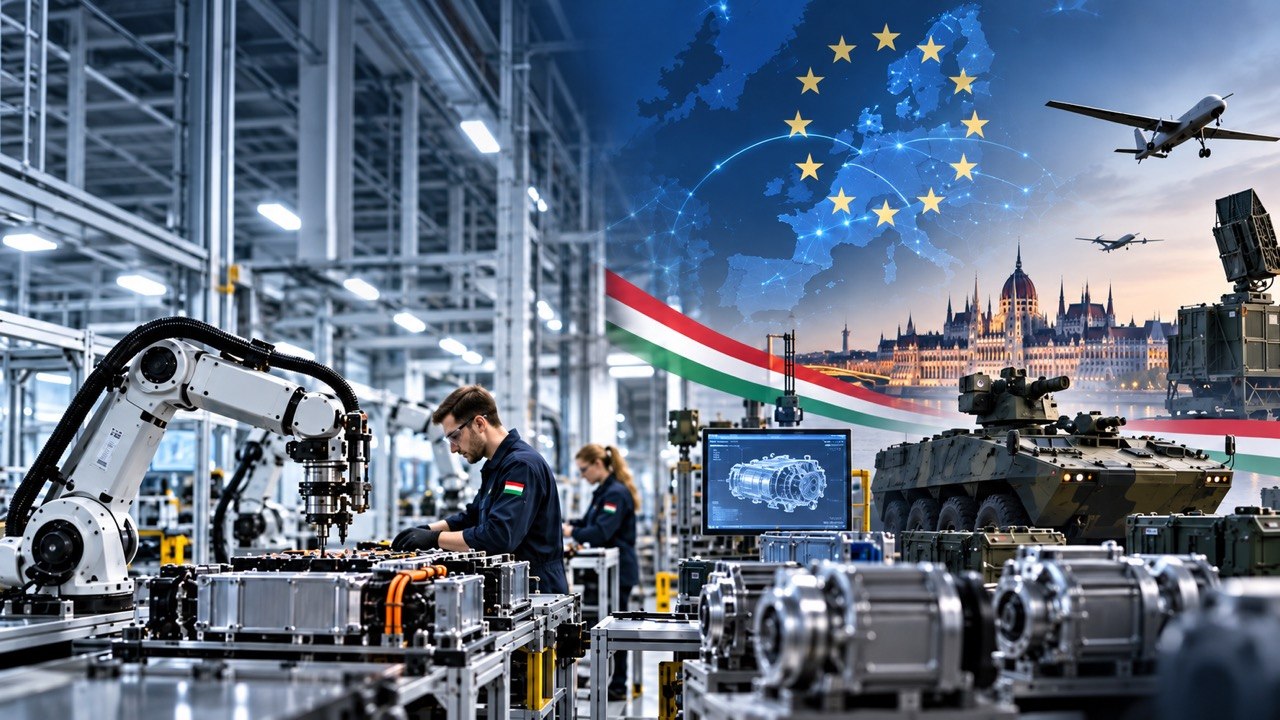
Cover photo: AI-generated illustration by Central European Affairs (CEA), 2026.

Szilárd Szélpál served as an environmental expert in the European Parliament from 2014, where he utilized his expertise to influence policy-making and promote sustainable practices across Europe. In addition to his environmental work, Szilárd has a deep understanding of foreign affairs, offering strategic advice and contributing to the development of policy initiatives in this field.
Support independent analysis and journalism at CEA Magazine: https://centraleuropeanaffairs.com/donation
For more insights on Central European political risk, EU institutional developments, and transatlantic relations, follow CEA Magazine and the CEA Talk podcast.

