
The foreign service is one of the most important state institutions of any country. Embassies and consulates do far more than perform protocol duties: they represent economic interests, facilitate strategic information exchange, carry out cultural diplomacy, provide security assessments, and manage crisis situations. Foreign policy can only function with a stable, well-trained, and professional staff. This is why it becomes particularly striking when a country’s diplomatic system gradually—almost imperceptibly—loses its professional weight and becomes increasingly politicised.
Author: Dr. Georges Suha & Szilárd Szélpál
Over the past decade, Hungary has undergone developments that several international organisations have highlighted in their annual reports. Freedom House’s most recent Nations in Transit chapter on Hungary (Freedom House, 2023), Transparency International’s accompanying analyses to the Corruption Perceptions Index (TI, 2022–2024), data from the ECFR’s EU Coalition Explorer (ECFR, 2023), and the findings of the OECD’s Public Governance Review – Hungary(OECD, 2021) all point to the same trend: political loyalty has become increasingly important within the Hungarian foreign service, while professional competence has lost ground. This is not an isolated phenomenon, but a systemic reconfiguration.
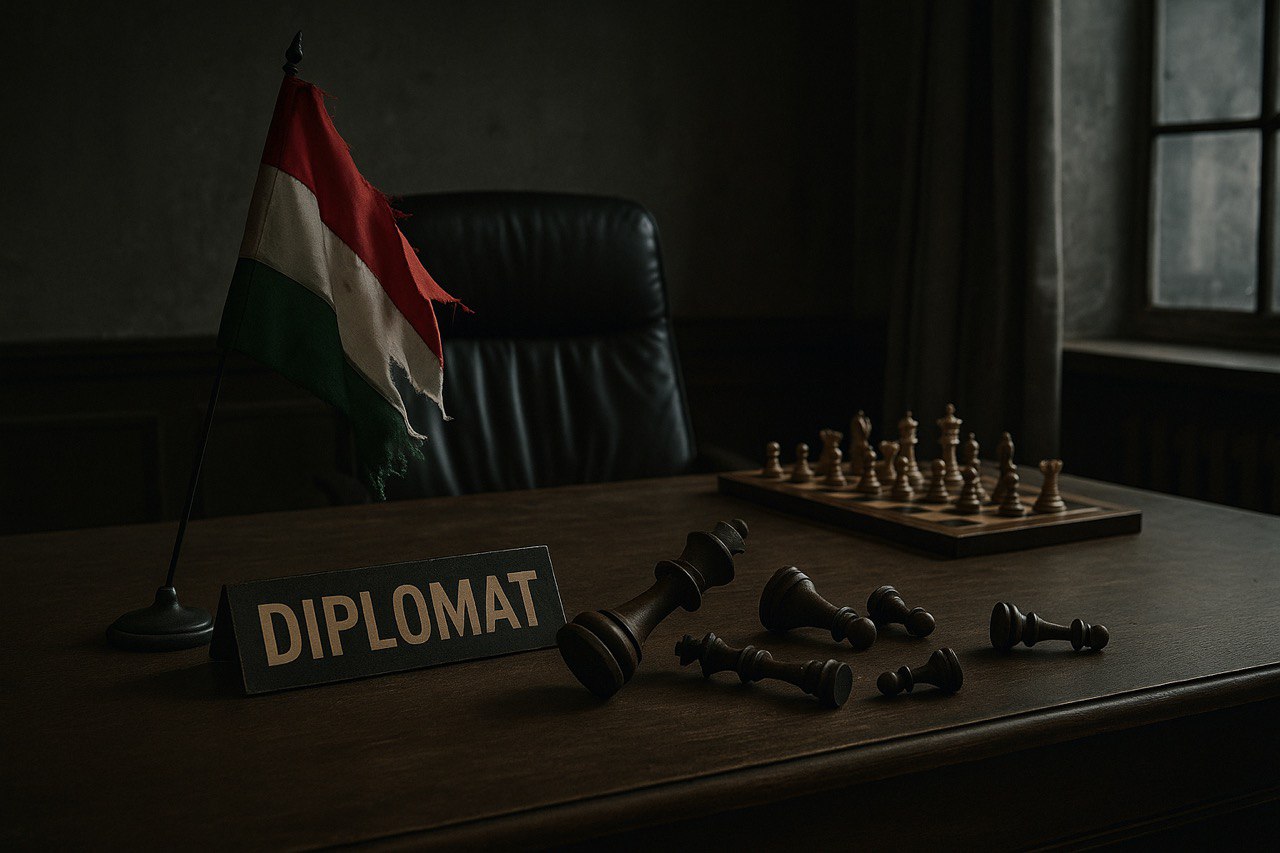
It is natural in diplomacy that certain ambassadorial positions are political appointments. This is common practice in most countries. The problem becomes systemic, however, when the proportion of political appointees is high and professional requirements are low. In Hungary, more and more heads of mission are individuals who did not come from the diplomatic corps but previously held political, municipal, media-related, or party-affiliated roles. This in itself would not necessarily be problematic—if such appointments were accompanied by appropriate professional background. But in many cases, experience shows the opposite.
International comparisons reveal a pattern in Hungary in which some diplomatic posts function as rewards, with appointments based more on political reliability than on relevant professional experience. The partial shift of diplomatic positions toward “patronage appointments” is mentioned in several OECD governance analyses, including the OECD Integrity Review – Hungary (OECD, 2022). The danger here is not ideological but professional: a country’s foreign relations cannot operate on the logic of distributing posts as rewards.
Meanwhile, the professionalism of the diplomatic corps is eroding. The UNDP’s Capacity Assessment of Public Administration in Central Europe (UNDP, 2021) and the OECD’s reviews on organisational integrity both underscore that the foreign service relies on three core components: professional selection, transparent and merit-based career progression, and stable rotation. In Hungary, all three have deteriorated in recent years. Transparency in recruitment has declined: an increasing number of diplomats and foreign policy analysts who have left the field report that professional expertise has become secondary to political conformity. This trend is confirmed by domestic and international interview-based studies, such as the European Diplomatic Practices Benchmark Study (EUPOLIS, 2022).
This tendency has produced one of the foreign service’s most serious problems: a shortage of new talent. A diplomatic career in Hungary today is less attractive, underpaid, unpredictable, and heavily politicised. Professional emigration—“brain drain in diplomacy”—is already measurable, and personnel figures indicate that the system is no longer capable of reproducing itself at an adequate level of quality. Another issue is the unpredictability of rotation: some remain in posts for excessively long periods under political protection, while others are reassigned after unjustifiably short tenures. This undermines the diplomatic system’s ability to accumulate institutional knowledge. According to the EEAS Annual Staff Rotation Analysis (EEAS, 2023), this is highly visible in regional comparison.
Hungary’s foreign policy credibility has declined in parallel with these trends. The European External Action Service (EEAS), the European Parliament’s Foreign Affairs Committee (AFET), and several NATO partnership assessments—especially the NATO Partnership Evaluation Report – Central Europe (NATO, 2022)—all note that the professional weight of Hungarian delegations has diminished. Political appointees at foreign missions often struggle to integrate into the host country’s professional working groups, find it more difficult to follow and interpret the EU’s complex decision-making processes, and build stable, expertise-based networks. Diplomacy is fundamentally about relationship-building: without professional credibility behind those relationships, national interest representation becomes visibly less effective.
The expert community—including Carnegie Europe’s analysis Europe’s Foreign Policy in Flux (Carnegie, 2023) and ECFR’s Visegrad Foreign Policy Trends (ECFR, 2024)—has been warning for years that the professional structure of Hungarian foreign policy is weakening, the implementation of strategies is deteriorating, and Hungary’s international positioning is becoming less deliberate and less coherent. This is not an ideological issue but a matter of administrative capacity.
The current state of the foreign service is not merely a blemish—it’s an inheritance: a decade of accumulated structural decline that cannot be erased with a single decision, yet cannot be ignored any longer. In Hungary today, the question is not whom to dismiss, but whether there remain enough qualified professionals to build a new foreign policy strategy upon. A nation’s diplomacy is only as strong as its diplomats—and today this idea carries particular weight.
“Clearing out” the foreign service is therefore not a witch-hunt, political retaliation, or personal vendetta, but an essential prerequisite for modernising the state. Only a transparent, competence-based career system, the reasonable limitation of political appointments, the restoration of stable rotation, and the reestablishment of professional recruitment can restore Hungary’s diplomatic weight. The question is no longer how much cleaning is needed—but who is still left to build upon.
Bibliography
- Freedom House. (2023). Nations in Transit 2023: Hungary Country Report. Retrieved from https://freedomhouse.org/sites/default/files/2023-05/NIT_2023_Digital.pdf Freedom House+1
- OECD. (2021). Hungary: Indicators of Regulatory Policy and Governance 2021. Paris: OECD Publishing. Retrieved from https://www.oecd.org/gov/regulatory-policy/hungary-country-profile-regulatory-policy-2021.pdf sgi-network.org+1
- OECD. (2023). Government at a Glance 2023: Hungary. Retrieved from https://www.oecd.org/en/publications/government-at-a-glance-2023_c4200b14-en/hungary_dacc7f00-en.html OECD
- OECD. (2024, October 15). OECD scraps anti-bribery mission to Hungary in unprecedented move. Reuters. Retrieved from https://www.reuters.com/world/europe/oecd-scraps-anti-bribery-mission-hungary-unprecedented-move-2024-10-15/ Reuters
- ECFR. (2024, January 9). Visegrad | ECFR. Retrieved from https://ecfr.eu/topic/visegrad/ European Council on Foreign Relations
- Nyilas, L. (2024). Features of the foreign policy of Hungary and the Visegrad countries. Medzinarodne vzťahy (Journal of International Relations), 22(2), 145-161. Retrieved from https://ideas.repec.org/a/brv/journl/v22y2024i2p145-161.htmlIDEAS/RePEc
- UNDP. (2021). Capacity Assessment of Public Administration in Central Europe. United Nations Development Programme. (Report)
- — [PDF document accessible via UNDP website]
Support independent analysis and journalism at CEA Magazine: https://centraleuropeanaffairs.com/donation
Cover photo credit: Gemini

Dr. Georges Suha is an international relations specialist, former ambassador, and expert in consular affairs with deep expertise in Sub-Saharan Africa. He has held senior diplomatic positions and continues to contribute to academic and policy discourse as a university lecturer. With extensive political networks and first-hand regional experience, he offers a nuanced perspective on African affairs, diplomacy, and consular practice. A dual citizen of Hungary and France, he engages fluently across European and African contexts.

Szilárd Szélpál served as an environmental expert in the European Parliament from 2014, where he utilized his expertise to influence policy-making and promote sustainable practices across Europe. In addition to his environmental work, Szilárd has a deep understanding of foreign affairs, offering strategic advice and contributing to the development of policy initiatives in this field.

