
Two days after Marco Rubio invoked European values against the backdrop of the Acropolis, a U.S.–Russian diesel agreement presented Europe with a very different reality. Beyond the immediate consequences for Ukraine, the episode raises a broader question about Europe’s economic vulnerability, strategic autonomy and its ability to deal with Russia from a position of strength.
Author: Mihály Barcza
A Speech on European Values
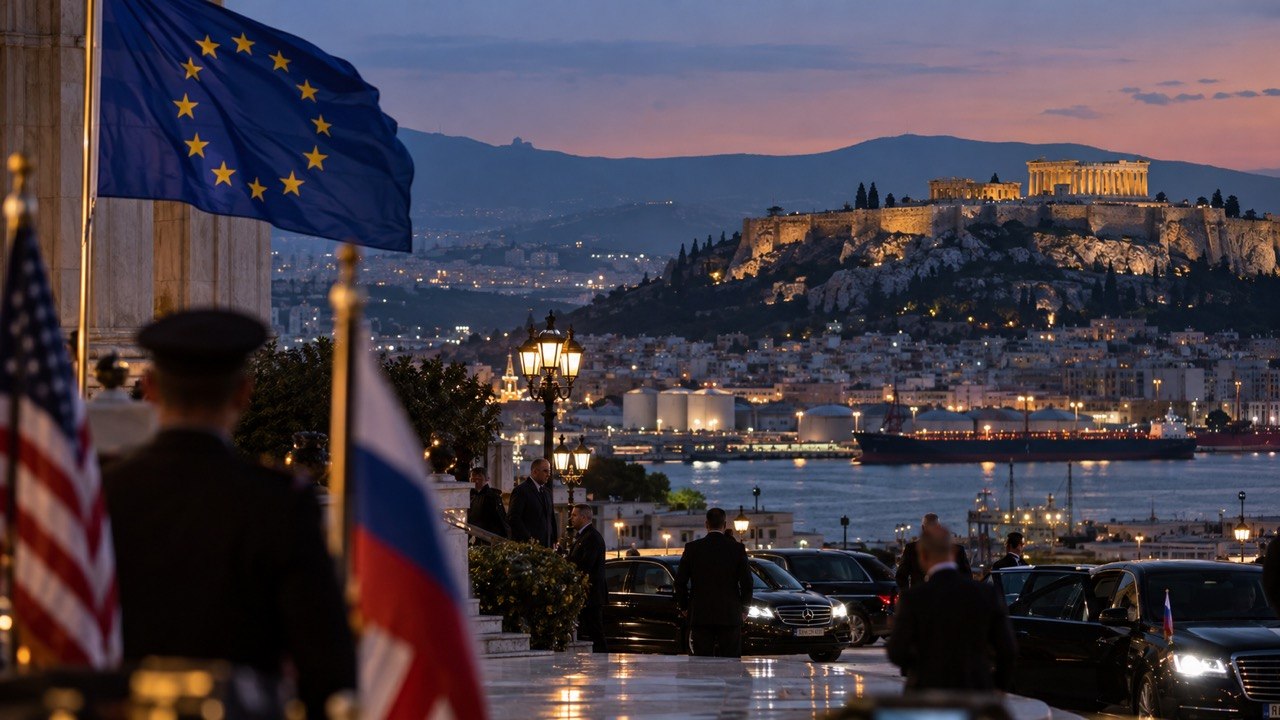
On October 7 in Athens, with the Acropolis—one of the symbols of European democracy and culture—behind him, Marco Rubio delivered a grand speech on European values.
A speech that left some on the Old Continent in a state of rapture.
Those who are blind. And who still don’t get what’s going on.
I don’t mean to pat myself on the back, but this is what I posted on my Facebook page shortly after Rubio’s speech:
“Marco Rubio … fed on and used Greece—one of the EU’s countries in the most dire straits—to deliver the most sanctimonious and cynical speech yet from the U.S. deep state, in which—turning partly against the EU—he now covers the U.S.’s hoof with Greek philosophy’s sock on one foot and Jesus’s on the other.”
What surprised me two days later was that the Trump administration is capable of putting together a scenario as deliberate and precisely crafted as Rubio’s glass beads, followed by the oil deal.
The Deal That Changed the Picture
It’s not my intention to cause panic, but if the Trump-Putin oil deal is true (and it seems it is), then today the EU—including Poland and all of Central Europe—suffered one severe blows again, since World War II, bringing Poland and us closer to Yalta.
And this is particularly worrying because I don’t see any politician of that caliber on the European stage right now who could handle this situation.
Donald Trump’s and Benjamin Netanyahu’s war has so far failed in Iran. This war has put the global economy at risk, and in this war, in my view, Iran is playing to keep oil prices at unbearably high levels until the U.S. midterm elections. Now Trump’s response was to reach an agreement with Russia.
Russia is channeling oil into the U.S. and the global economy. This may help Trump in the U.S. midterm election and this might be a good thing insofar as it eases Russia’s dependence on China somewhat; however, in doing so, it has effectively financed Putin’s war in Ukraine—on Russia’s side.
And it’s not the quantity of the oil deal that matters, but the mere fact of the deal. Because the scope is “bagatelle.” And in light of this, it becomes even more troubling: why was this needed?
Europe’s Strategic Vulnerability
And this amounts to a kind of betrayal of Europe and Central Europe, including Poland and us, again.
Europe will not be able to finance Ukraine on its own when it needs to finance itself in the face of lagging competitiveness, a 10% U.S. tariff, increased NATO contributions, and the flood of Chinese dumping products that are overwhelming us—a flood against which Germany and the German auto industry cannot compete with Chinese manufacturing.
The Shadow of Yalta
Donald Trump’s war with Iran and the oil deal struck with Vladimir Putin bring Germany one step closer to seriously considering a shift in its economic paradigm. And it is bringing us one step closer to the Russian sphere of influence—something Vladimir Putin requested in Switzerland in January 2022.
Only no one responded to him then.
At that time, he asked that NATO withdraw from those countries that joined the Alliance after 1997.
The Question Europe Must Answer
This is the big picture, guys. It’s no coincidence that Marco Rubio was preaching in Athens about European values and Jesus just two days before the deal was announced.
And you were rejoicing over this.
That we have at most five years left before we’re up to our necks in weapons. Or that we’re closer to Yalta than ever before.
Because the Russians really do need to be Europe’s economic partners, but the Russians understand nothing but force, and that’s the only way to negotiate with them.
Where do we have that strength now? And where will it come from? That is the question Europe must answer urgently right now.
Cover photo credit: AI-generated visual created with OpenAI for CEA Magazine.
Mihály Barcza is an attorney and founding partner of Oppenheim Attorneys-at-Law, specialising in international mergers and acquisitions. Throughout his career, he has advised leading European, American and Asian companies on major cross-border transactions. He also served as an arbitrator in money and capital market disputes for 17 years and chaired the Supervisory Board of MKB Bank between 2015 and 2017. His work has been recognised by leading international legal rankings, including Chambers Global and The Legal 500.
Support independent analysis and journalism at CEA Magazine: https://centraleuropeanaffairs.com/donation
For more insights on Central European political risk, EU institutional developments, and transatlantic relations, follow CEA Magazine and the CEA Talk podcast.
