
Donald Trump, the president of the United States, who, from certain angle seems to work to dismantle the EU—and who, on the two most critical issues of his presidency to date, China and the Middle East, has done the exact opposite of what he promised, and what was expected, thereby setting the stage for profound political changes in the U.S.—met with Xi Jinping. In the United States. On home turf.
Author: Mihály Barcza
Watching and reading the news reports, one doesn’t get the impression that Donald Trump has made America greater again since their last meeting.
China—which, according to Pentagon reports, provides satellite support to Iran and has at least as good, if not better, insight into Iran’s internal affairs—clearly sees the self-destructive course the U.S. has embarked upon in Iran and its consequences.
China, as a buyer of U.S. Treasury bonds, also sees that the war has driven U.S. bond yields to unprecedented heights. One reason for this is the declining willingness of Gulf states to lend, as they are spending their resources to mitigate their own war-related losses and view the U.S.’s reputation as diminished in light of the experiences of the Iran war.
If we add to this the astronomical bond yields promised by U.S. AI and tech companies—which, even if true, amount to little more than gambling—the math already adds up to over 5%. The rate has jumped to this level by September 2026, which is a 19-year high, meaning it’s approaching peaks seen during the credit crunch. Only this time, it’s on a much larger debt base. And as if that weren’t enough, the U.S. has fallen behind China in its rare-earth metals strategy, so in the short term it faces a dependency where China holds the upper hand.
If we add to this the fact that the U.S. wasted the bulk of its stockpile of strategic interceptor missiles—worth billions and exorbitantly expensive—in Iran because of slingshots, i.e., drones costing a few thousand dollars, then what we saw in Washington is more than understandable.
The Symbolism of the Washington Meeting
Firstly, Trump went to the airport to greet his guest—a gesture that, to my knowledge, the U.S. president has previously reserved only for the Pope. And the Chinese emperor acknowledged with a broad smile that the United States, too, had come to realize that there is only one sensible thing it can do with China: admit it as naturally as the waves of the sea.
Xi Jinping publicly and extremely subtly took a jab at Trump in such a way that Trump didn’t even notice it. This is also a sign to us of what Chinese diplomacy is like. Xi, for example, congratulated the beautiful country of the United States on its 250 years of independence, even stating the exact number.
Just imagine: the head of a culture and civilization as unbroken and 5,000 years old as Chinese culture and civilization congratulating the U.S. on its 250 years of independence. Happy Birthday, bro! Happy birthday, buddy! That’s what it means.
The Thucydides Trap
Xi also spoke about the Thucydides Trap—and how to avoid it. Of course, there was no substantive response. The trap refers to a historical geostrategic dilemma. And it was named after Thucydides because he was the first to describe it.
And it was named after Thucydides because he was the first to describe this in antiquity—in the context of the rivalry between Athens and Sparta—in his work The Peloponnesian War. He concluded that war is inevitable between a declining and a rising power, and that the declining power is the one that attacks. The experience of world history has so far tended to confirm rather than refute Thucydides.
When Xi uses such analogies to speak publicly in the U.S. in the presence of the president, he is, on foreign soil, labeling his host as a declining entity. Moreover, he does all this using the semantics and cultural analogies of the “white (european) man.” To which Trump, too, had no response. This means that Xi presented himself as the cultured, peace-loving ruler of a millennia-old culture—one who, lo and behold, is even familiar with the cultural language and historical examples of Europeans—and in that very language told Trump, “Little bro, your shelf life is running out.”
Taiwan and the Future of Pax Americana
And Xi took another step regarding Taiwan as well. Within the same framework as before. So that only one question remains regarding Taiwan: when. Trump listened to all this on home turf. Thucydides. From Xi. And he didn’t even mention Bitcoin. Even though we know this instrument he understands or he has heard about at least.
Indeed. Sic transit gloria mundi. Thus passes the glory of the world. And the post-World War II world order. And its episode of Pax Americana. Belli Americana has been around for a long time. At least since the Twin Towers. And it looks like America might just let it slip away.
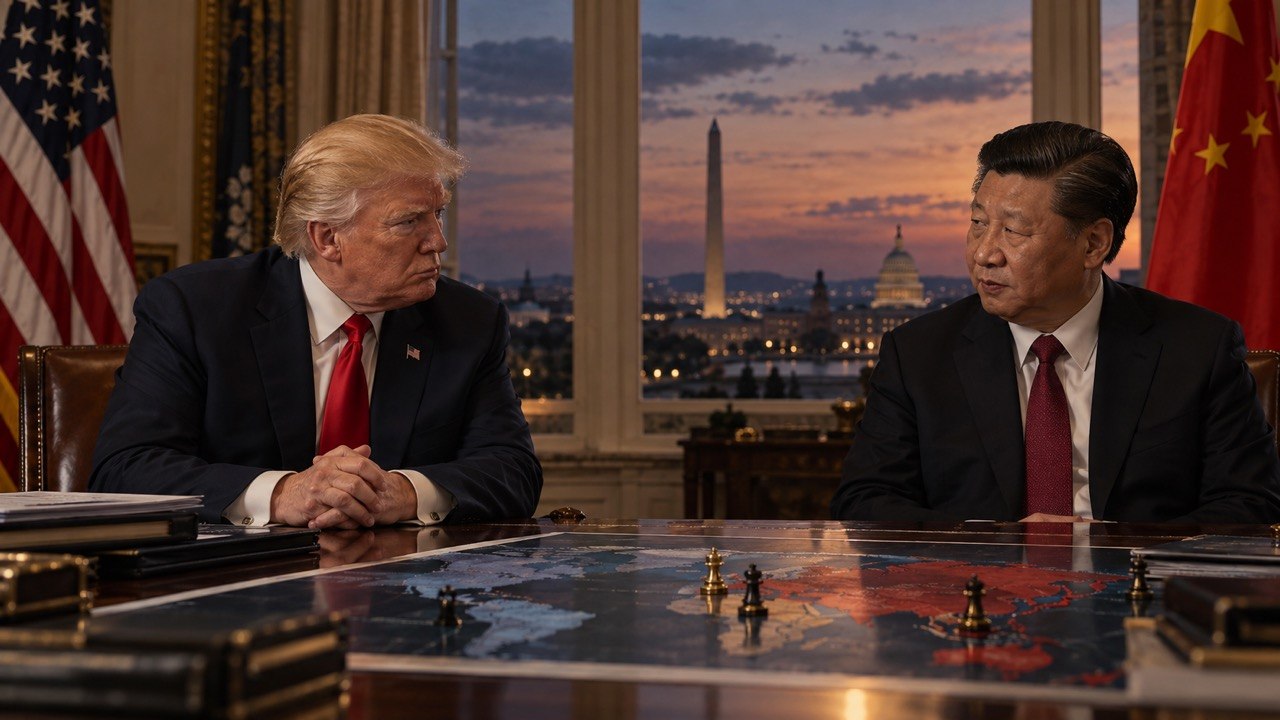
Cover photo credit: AI-generated visual created with OpenAI for CEA Magazine.

Mihály Barcza is an attorney and founding partner of Oppenheim Attorneys-at-Law, specialising in international mergers and acquisitions. Throughout his career, he has advised leading European, American and Asian companies on major cross-border transactions. He also served as an arbitrator in money and capital market disputes for 17 years and chaired the Supervisory Board of MKB Bank between 2015 and 2017. His work has been recognised by leading international legal rankings, including Chambers Global and The Legal 500.
Support independent analysis and journalism at CEA Magazine: https://centraleuropeanaffairs.com/donation
For more insights on Central European political risk, EU institutional developments, and transatlantic relations, follow CEA Magazine and the CEA Talk podcast.

The Thucydides Trap captures the structural pressure produced by a shifting balance of power, but it does not by itself explain why that pressure turns into war—or why Taiwan could become the point of collision. Thucydides’ narrative offers another mechanism. A great power may enter a crisis through an initially limited commitment to a smaller partner, only to discover that the reputational and strategic costs of abandonment increase once that commitment is tested. I describe this as the Corcyra Dilemma. In the Taiwan case, the decisive danger may therefore be not simply American decline or China’s rise, but a sequence in which restraint becomes progressively more costly for Washington after deterrence has already begun to fail.