
The idea of Canada becoming the European Union’s first “associate member” could signal more than another upgrade of transatlantic cooperation. With trade, research, defence, economic security and strategic technologies already drawing the two sides closer together, the proposal raises a broader question: could the EU develop a new form of integration for close partners that falls short of membership but goes significantly beyond a conventional strategic partnership?
Author: Szilárd Szélpál
One of the most striking foreign-policy elements of Ursula von der Leyen’s 2026 State of the Union address was the prospect of Canada becoming an “associate member” of the European Union. At first glance, the idea may appear more like a political vision than a concrete institutional project. Yet existing EU law already provides instruments through which EU–Canada relations could evolve into a far deeper and more permanently institutionalised partnership than exists today. In her State of the Union address, the President of the European Commission did not merely suggest expanding the Comprehensive Economic and Trade Agreement, or CETA. She outlined the prospect of a shared area of prosperity and economic security, a technology alliance, closer integration of defence industrial bases, and deeper cooperation in energy, critical raw materials, batteries, artificial intelligence, quantum technologies, cybersecurity and the Arctic.
This was followed by a politically much more ambitious proposition: opening the way for Canada to become the Union’s first “associate member”. The significance of the expression lies precisely in the fact that no clearly defined category of “associate EU membership” currently exists under the Union’s founding treaties. The EU has long maintained association agreements with third countries, but these do not constitute a form of secondary or partial EU membership. The potential innovation would therefore not simply lie in the word “association”, but in the possible creation of a new political and institutional category. The underlying legal analysis suggests that an especially close Canadian association could be constructed within the existing treaties. Granting Canada actual membership rights within the EU’s constitutional institutions, however, would represent a fundamentally different legal step.
Integration would not start from zero
Canada is particularly well suited to testing such a model because EU–Canada relations already extend far beyond a traditional free-trade partnership. Large parts of CETA have been provisionally applied since 2017, while the two sides also operate under a separate Strategic Partnership Agreement. Economic relations have expanded significantly under this framework, but cooperation has increasingly acquired political, regulatory and security dimensions as well. In parallel, research cooperation has become another important pillar. Since July 2024, Canada has been associated with Pillar II of Horizon Europe, allowing Canadian research organisations and companies to participate in relevant international consortia and access funding under conditions comparable in many respects to those available to participants from EU member states.
Defence and security cooperation has also deepened rapidly. In June 2026, the Council of the European Union concluded an agreement enabling Canadian companies and Canadian-origin products to participate in procurement under the EU’s SAFE defence instrument. Canada consequently became the first non-European country to obtain this form of access. An associate status would therefore not create an entirely new relationship. Its potential added value would instead be to bring what is currently a collection of separate agreements and sectoral arrangements under a more coherent political and legal framework. In practical terms, the significance of the proposal may lie less in inventing new areas of cooperation than in connecting existing ones through a more stable institutional architecture and a clearer long-term political logic.
What could “associate membership” mean in legal terms?
The most obvious legal starting point is Article 217 of the Treaty on the Functioning of the European Union. Article 217 allows the EU to conclude association agreements with third countries that establish reciprocal rights and obligations, common action and special procedures. Importantly, the provision is not restricted to European countries, nor does association have to serve as preparation for eventual EU membership. This distinction is particularly relevant in the Canadian case. Canada could not pursue conventional EU accession under Article 49 of the Treaty on European Union, which refers to European states. A framework built around Article 217, by contrast, could allow Canada to remain a third country while integrating exceptionally closely with selected EU policies.
Such an agreement could establish regular political consultation, deeper regulatory cooperation, joint economic-security mechanisms, stable participation in selected research and industrial programmes, and more integrated defence-industrial cooperation. It could potentially also expand mechanisms for recognising professional qualifications, improve researcher and professional mobility, and simplify certain conditions for economic activity. What it would not automatically create is participation in the EU’s constitutional decision-making structures. Canada would not obtain a vote in the Council of the European Union simply by becoming an associated country, it would not send elected representatives to the European Parliament, nominate a European Commissioner, or turn Canadian citizens into EU citizens.
This distinction between political language and legal substance is essential. The term “associate member” may carry powerful symbolic weight, but the actual rights and obligations attached to it would ultimately depend on the agreement negotiated between the two sides. Nor could such a status be created by political declaration alone. Under Article 218 TFEU, concluding an association agreement would require unanimous approval in the Council and the consent of the European Parliament. Depending on the final content of the agreement and the division of competences between the EU and its member states, national ratification procedures could also become relevant.
More than CETA 2.0
It would therefore be misleading to understand the potential associate status simply as an expanded free-trade agreement. CETA is primarily designed to reduce barriers to trade and investment between the Canadian and European economies, whereas a comprehensive association could go significantly further by creating a political and strategic framework around the economic relationship. Economic security would likely become one of its central elements. Over recent years, the EU has placed growing emphasis on resilient supply chains, access to critical raw materials, strategic technologies and reducing excessive economic dependencies, and Canada occupies a particularly interesting position in this context.
It is simultaneously an advanced G7 economy, an important producer of energy and critical raw materials, a NATO ally, and a country whose economy is deeply integrated with that of the United States. For the EU, deeper integration with Canada could therefore represent not only an opportunity to expand trade, but also a means of diversifying European economic and technological dependencies. From Canada’s perspective, the same logic works in the opposite direction. A more institutionalised and predictable relationship with Europe could provide greater strategic room for manoeuvre at a time when trade, technology and security policy are becoming increasingly interconnected.
The most interesting part of an association agreement might therefore not concern tariffs at all. Instead, it could focus on connecting the two regulatory and strategic spaces: reducing duplicate conformity procedures, coordinating standards in selected sectors, facilitating the movement of professionals, jointly financing research and technological projects, and creating more integrated defence-industrial supply chains. In this sense, the real shift would be from a primarily trade-oriented relationship towards a model in which economic integration, technological cooperation and strategic security increasingly reinforce one another.
The real challenge is participation in decision-making
The deeper integration becomes, however, the more clearly a classic problem emerges: who makes the rules that the associated partner is expected to follow? For the EU, it would be difficult to accept a model under which a third country gained veto powers over internal European legislation. For Canada, on the other hand, accepting an increasingly large body of EU rules without meaningful participation in their development could become politically difficult to sustain. Any ambitious association would therefore need to find a balance between preserving the autonomy of the EU legal order and giving Canada sufficient influence over rules that would directly affect its economic actors and public authorities.
A workable compromise could involve not full decision-making rights, but institutionalised upstream participation. Canadian experts could be included in the preparatory phases of certain regulatory processes, Canada could receive formal consultation rights in areas covered by the association, while joint EU–Canada bodies could assess the impact of new legislation affecting sectors included in the agreement. Such a system would go considerably further than conventional diplomatic consultation, while remaining clearly distinct from EU membership.
This may ultimately prove to be one of the most important aspects of any future associate status. The credibility of the model would depend not only on which EU programmes Canada could access, but also on whether it could participate meaningfully in shaping the regulatory environment it would increasingly share with Europe. Without such mechanisms, deeper integration could easily become politically asymmetrical; with them, association could develop into a more balanced model of structured participation without crossing the line into full membership.
The beginning of a new model of external integration?
The Canadian proposal may therefore have implications that reach beyond Canada itself, even if the immediate discussion concerns only one country. The EU has long operated with different categories of external relationships: trade partners, strategic partners, associated countries, members of the European Economic Area, candidate countries and full member states. What has been less clearly developed is a permanent and autonomous category of deep integration that is neither simply a strategic partnership nor a waiting room for full membership.
Canada makes an especially interesting test case precisely because there is no need to choose between association and eventual EU membership. The objective could be a long-term form of deep integration designed specifically for a third country. Much of the legal architecture needed to build such a relationship already exists. Article 217 TFEU gives the Union considerable flexibility in designing an ambitious association agreement, and the existing EU–Canada relationship already contains many of the building blocks from which such a model could be constructed. The more difficult question is how much political substance the EU and Canada would ultimately be prepared to place behind the concept of “associate membership”.
If the existing CETA, Horizon Europe, defence and political cooperation arrangements were simply gathered under a new label, the change would remain largely symbolic. If, however, the initiative led to a permanent institutional structure, predictable regulatory cooperation, wider programme participation, deeper economic-security coordination and new mobility arrangements, it could mark the emergence of an entirely new form of EU external integration. The distinction between these two outcomes will depend less on terminology than on the actual rights, obligations and institutions created by the future relationship.
Von der Leyen’s proposal should therefore currently be understood primarily as a political direction rather than a fully defined legal status. Yet it is not a legal fantasy. The existing treaties provide sufficient room to construct an EU–Canada association that would qualitatively exceed the current strategic partnership without turning Canada into an EU member state. The central question is consequently no longer whether such a structure is legally conceivable, but how far the European Union and Canada would be willing to go in creating common rules, institutions, financial commitments and reciprocal rights. Those choices will ultimately determine whether “associate membership” becomes a historically significant new model of European integration — or merely a new name for an already exceptionally close partnership.
This article draws on one section of a broader forthcoming study examining the political and legal dimensions of creating a new EU associate status, its possible institutional architecture, and the extent to which such a model could be applied to other partner countries.
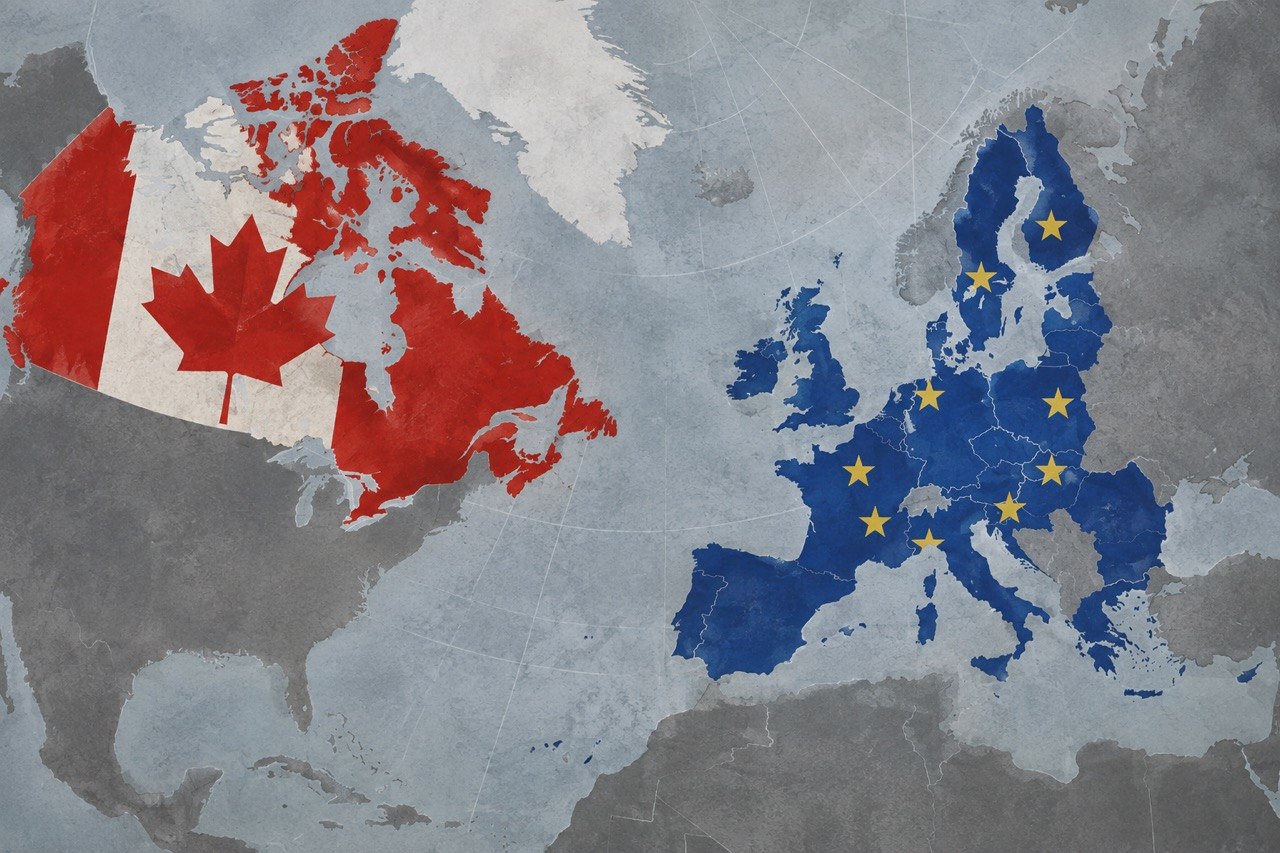
Cover photo: AI-generated illustration by Central European Affairs (CEA), 2026.

Szilárd Szélpál served as an environmental expert in the European Parliament from 2014, where he utilized his expertise to influence policy-making and promote sustainable practices across Europe. In addition to his environmental work, Szilárd has a deep understanding of foreign affairs, offering strategic advice and contributing to the development of policy initiatives in this field.
Support independent analysis and journalism at CEA Magazine: https://centraleuropeanaffairs.com/donation
For more insights on Central European political risk, EU institutional developments, and transatlantic relations, follow CEA Magazine and the CEA Talk podcast.
