
Why REEV technology may become one of the most practical architectures for long-range electrified driving
Author’s note:
This article is a technology and policy analysis. It does not disclose or rely on confidential manufacturing know-how. The iCAUR V27 Golden REEV system is discussed as a contemporary reference point for range-extended electric vehicle architecture, based on publicly communicable product information provided in the source material.
Author: Szilárd Szélpál
The transition to electric mobility is often presented as a binary choice: either the internal combustion engine or the fully battery-electric vehicle. In reality, the engineering landscape is more complex. Between the conventional petrol vehicle and the pure BEV sits a group of technologies designed to reduce emissions, preserve driving flexibility and support consumers through the infrastructure gaps of the transition.
One of the most interesting among them is the REEV, or Range-Extended Electric Vehicle.
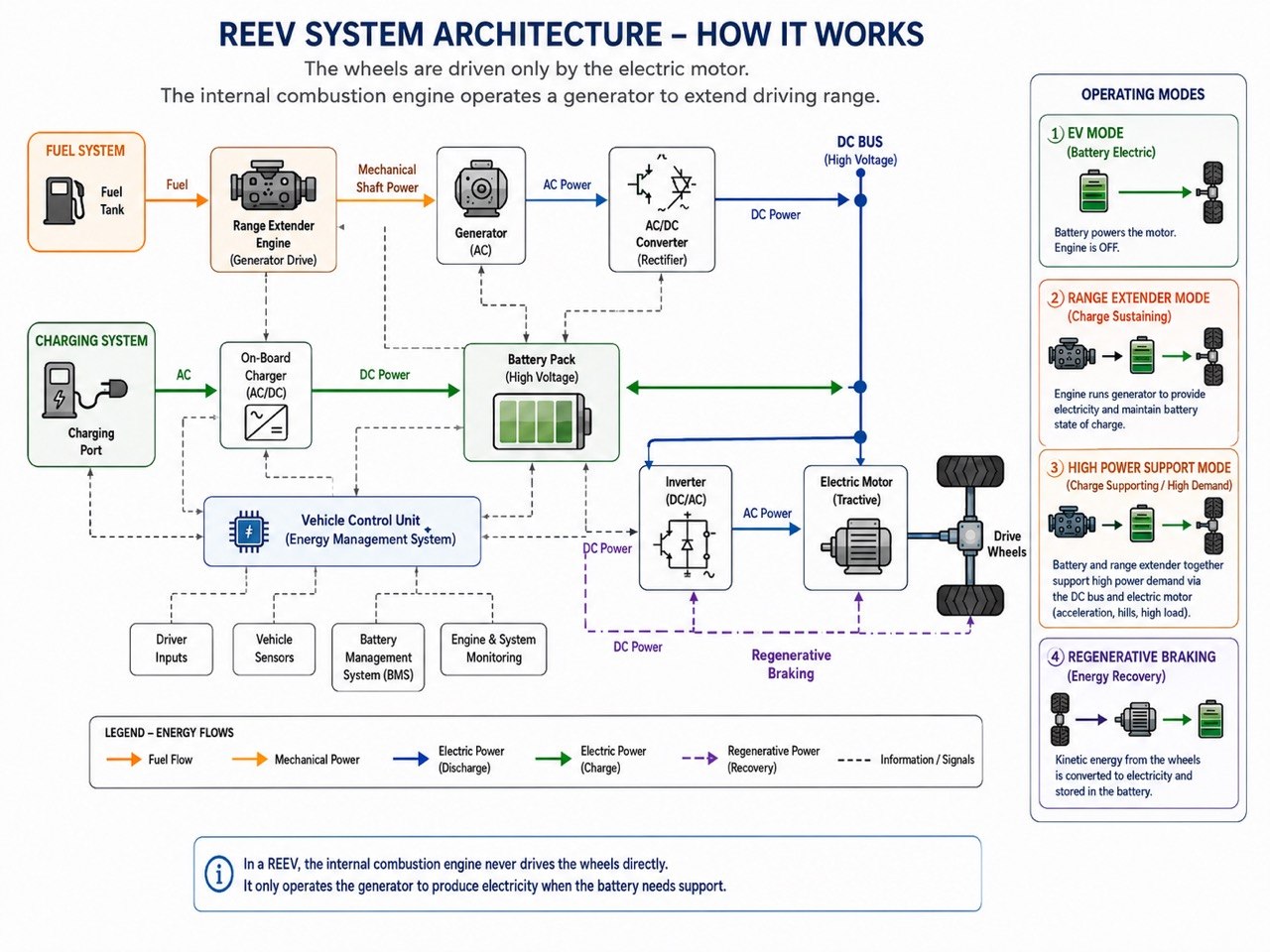
A REEV is not a conventional hybrid. Nor is it simply an electric vehicle with a small petrol engine added as an afterthought. It is better understood as an electric-drive vehicle with an onboard energy-generation system. The wheels are driven by electric motors, while the internal combustion engine functions primarily as a generator. This distinguishes the REEV from many parallel or series-parallel hybrids, where the combustion engine may directly contribute mechanical torque to the wheels. Series-hybrid and range-extender architectures are generally defined by the fact that electric propulsion remains the primary traction path, while the auxiliary power unit generates electricity when needed.
That architectural distinction matters. It changes not only the driving experience, but also the energy-management logic, the battery-sizing problem, the taxation profile and the role such vehicles can play in Europe’s mobility transition.
The REEV as an energy system, not a compromise
The basic energy flow of a REEV can be described through two pathways.
The first is the electric pathway:
grid charging → battery → inverter → electric motor → driven wheels
This is the everyday mode. For commuting, urban travel and short-distance use, the vehicle behaves much like a battery-electric car. The driver experiences instant torque, quiet operation, regenerative braking and a linear acceleration profile.
The second is the range-extension pathway:
fuel tank → generator engine → generator → electrical energy → battery / DC bus → electric motor
In this pathway, the internal combustion engine is not asked to behave like a traditional traction engine. Its function is not to follow every acceleration request, every gradient change and every transient load. Instead, it is used as a controlled energy converter.
This is where the REEV becomes technically interesting. A conventional combustion engine in a normal car operates across a wide and often inefficient range of speeds and loads. Urban driving is particularly unfavourable: cold starts, stop-start traffic, idling, partial-load operation and repeated accelerations all move the engine away from its most efficient operating zone.
A range-extender engine can be calibrated differently. Since traction is handled electrically, the generator engine can operate closer to a narrower, more efficient region of its brake-specific fuel consumption map. In engineering terms, the system separates traction demand from energy-generation demand. The electric motor deals with torque and responsiveness. The generator engine deals with sustaining the energy balance.
That separation is the essence of the technology.
Energy management: the hidden intelligence of the system
The true complexity of a REEV lies not in the presence of a generator engine, but in the control strategy that governs when and how it operates.
The vehicle’s supervisory controller must constantly manage the battery’s state of charge, the expected power demand, the driver’s torque request, road conditions, temperature, battery health, fuel efficiency and acoustic comfort. Research on series-hybrid energy management shows that the central challenge is not merely splitting power between two sources, but maintaining an optimal charge-sustaining strategy while minimising fuel consumption and avoiding inefficient engine restarts.
A well-designed REEV therefore behaves like an energy-optimisation problem on wheels.
At high state of charge, the vehicle should maximise electric driving. At lower state of charge, the range extender may enter a charge-sustaining or charge-supporting mode. During high transient power demand, such as overtaking, climbing or off-road use, the battery can buffer peak loads while the generator provides a steadier average power contribution. This is one of the reasons why a relatively modest generator engine can support a much larger and more capable vehicle.
The battery does not have to be sized to cover every rare long-distance scenario. The generator does not have to be sized for every short-term peak acceleration event. Each subsystem can be optimised for its real task.
That is why calling a REEV a “compromise” understates the concept. At its best, it is a system optimisation strategy.
Why battery size is a policy and engineering question
Large battery-electric SUVs face a structural problem: range requires battery capacity, but battery capacity adds weight, cost and material demand. In smaller city vehicles, this trade-off is easier to manage. In larger SUVs and off-road-capable vehicles, it becomes more difficult.
A heavy vehicle with a large frontal area, all-wheel-drive capability and long-distance expectations needs substantial stored energy. If the answer is simply “add more battery,” the result can be expensive, heavy and resource-intensive. That does not mean BEVs are the wrong direction. They remain the core long-term decarbonisation pathway, particularly as electricity generation becomes cleaner. But in some vehicle segments, especially large SUVs and utility-oriented vehicles, a purely battery-based solution may not be the most efficient way to solve every use case today.
REEV technology addresses this through a different logic.
It allows the vehicle to carry enough battery capacity for meaningful daily electric driving, while avoiding the need to oversize the battery for occasional long-distance trips. This is particularly relevant for users who drive short distances most days but still require confidence for cross-country travel, rural routes, mountain roads, winter conditions or infrastructure-poor regions.
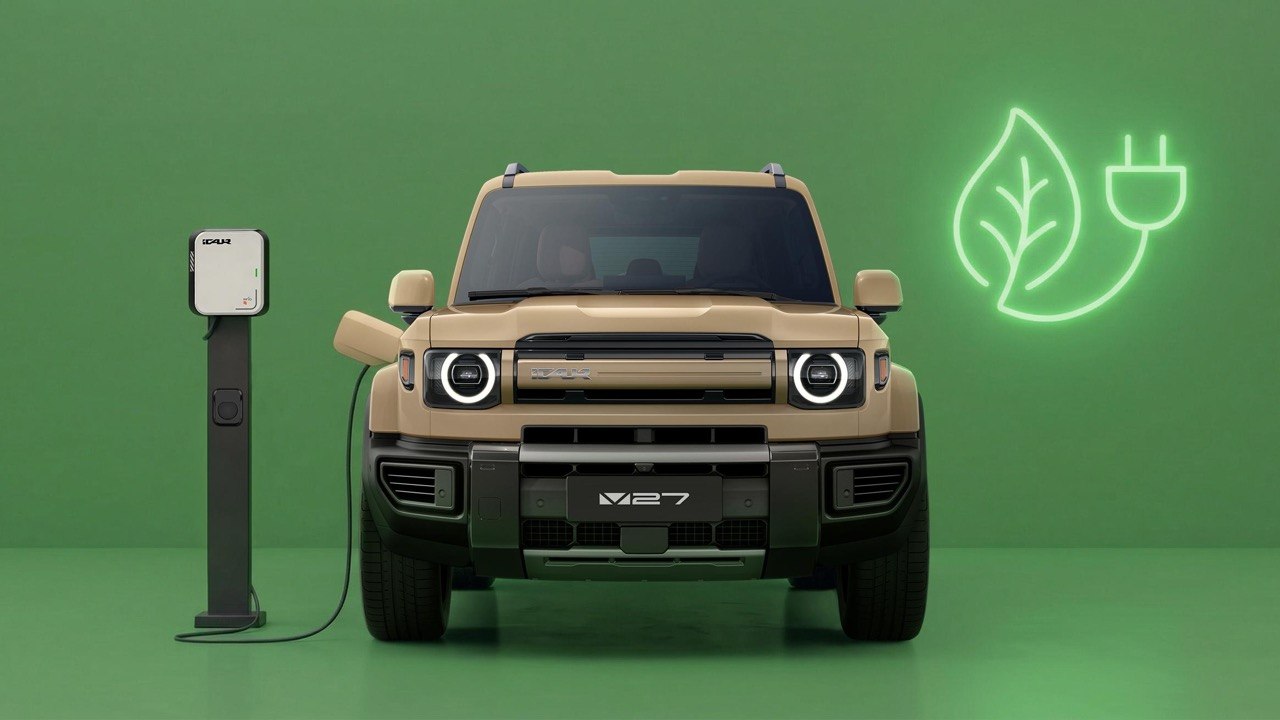
The iCAUR V27 Golden REEV system is positioned precisely in this space. According to the provided material, it offers more than 150 km of all-electric range and more than 1,000 km of combined range, supported by fast charging from 30% to 80% in 13 minutes. These figures should be treated as manufacturer-provided product communication, but they illustrate the market logic clearly: daily electric use, long-distance flexibility and reduced range anxiety in one architecture.
Why a 1.5-litre generator engine can make sense in an SUV
At first glance, the idea of a 1.5-litre engine in an SUV or off-road-oriented vehicle may seem counterintuitive. Traditional SUVs often relied on larger combustion engines because the engine had to provide both peak performance and sustained propulsion. A 2.0-litre, 2.5-litre or 3.0-litre engine was often justified by mass, towing expectations, acceleration and all-terrain use.
A REEV changes that logic.
In a range-extended electric SUV, the generator engine is not the main traction unit. It does not need to deliver peak wheel torque directly. The electric motors provide the immediate driving force, while the battery supplies transient power. The 1.5-litre generator engine can instead be sized around sustained energy-generation needs.
This distinction is crucial. Peak power and average power are not the same engineering problem.
Acceleration, hill starts, off-road torque modulation and low-speed control are handled exceptionally well by electric motors. They deliver high torque from low speed, require no conventional multi-speed gearbox in the same way as an internal combustion vehicle, and can support precise traction control. The generator engine, meanwhile, can operate in a controlled range to maintain the battery’s usable energy window.
For an off-road-capable REEV, this is a strong engineering fit. Difficult terrain, cold weather, auxiliary loads, gradients and remote routes can increase energy demand and reduce BEV predictability. A range extender provides a secondary energy path without sacrificing the electric-drive character of the vehicle.
That is why a 1.5-litre generator engine in a REEV SUV should not be evaluated like a 1.5-litre engine in a conventional SUV. Its role is different. It is not the vehicle’s mechanical heart. It is the onboard energy stabiliser.
From hybridisation to electrification
Conventional hybrids reduce fuel consumption by recovering energy, assisting the combustion engine and enabling limited electric operation. They are mature, reliable and useful. But in many cases, they do not fundamentally change the user’s relationship with propulsion. The driver still lives primarily in the combustion-engine paradigm.
A REEV goes further.
Because the vehicle is electrically driven, the primary driving experience is closer to a BEV than to a conventional hybrid. The combustion engine is pushed into the background. Its role is no longer to define acceleration, transmission behaviour or everyday responsiveness. It exists to extend range when the battery alone is not enough.
This matters for the adoption curve. Many consumers are not opposed to electric driving. They are opposed to uncertainty. They worry about long trips, public chargers, winter range, rural mobility and family travel logistics. A REEV gives them electric driving without requiring immediate full dependence on the charging ecosystem.
In that sense, REEVs may accelerate rather than delay electrification. They familiarise users with charging, regenerative braking, electric torque and battery-first mobility, while reducing the psychological barrier created by range anxiety.
The policy relevance is clear: technologies that shift real-world kilometres from combustion to electric propulsion can support the transition even before charging networks are fully mature everywhere.
Vehicle taxation in the EU: why architecture matters
There is no single EU-wide passenger-car tax system. Vehicle taxation remains largely national and, in some cases, regional or municipal. Across the EU27, Member States use different combinations of registration taxes, annual circulation taxes, ownership taxes, company-car taxes and local charges. The tax base may include CO₂ emissions, engine displacement, power output, vehicle weight, fuel type, environmental classification, age, value or combinations of these factors.
The broad direction, however, is increasingly environmental. CO₂-based taxation has become a major policy tool in several European markets. Ireland’s Vehicle Registration Tax, for example, is structured around CO₂ bands. Germany combines displacement and CO₂ elements in its motor vehicle tax. Spain applies a CO₂-based registration tax alongside municipal circulation taxation. Latvia uses a combination of vehicle weight, engine volume and engine power in its operating tax logic. France has used strong CO₂-based malus mechanisms, and high-emission SUVs can face very significant acquisition penalties compared with lower-emission alternatives.
This makes REEV architecture strategically relevant.
A 1.5-litre generator engine can be more favourable than a large-displacement conventional SUV engine in jurisdictions where displacement matters. A long electric range can improve the vehicle’s positioning in jurisdictions where homologated CO₂ emissions shape taxation. And compared with a large BEV SUV, a REEV may avoid some of the material and weight implications of simply increasing battery size to achieve rare long-distance use cases.
The exact tax result would always depend on national rules, homologated CO₂ values, vehicle mass, power rating and local classification. But at the architecture level, a REEV SUV with a modest generator engine and substantial electric range fits many of the incentives embedded in European tax systems: lower measured emissions, reduced reliance on large combustion engines, and stronger alignment with electrified driving.
EU climate policy and the role of transitional technologies
The European Union’s long-term direction remains decarbonisation of road transport. Regulation (EU) 2019/631 sets CO₂ performance standards for new passenger cars and vans, and the EU has maintained the 2035 zero-emission trajectory for new cars and vans, while also introducing flexibility around intermediate compliance periods.
This creates a dual challenge.
On one hand, the industry must move decisively toward zero-emission mobility. On the other, consumers, infrastructure and affordability do not move at the same pace in every region or vehicle segment. Charging availability, housing type, income, geography and vehicle-use patterns differ sharply across Europe.
That is where REEV technology can play a constructive role. It is not a substitute for full decarbonisation. It is not a claim that combustion should remain central indefinitely. Rather, it can be understood as a transitional architecture that reduces combustion use while increasing the share of electric kilometres.
For policy, this is important. A technology that encourages users to drive electrically most of the time, while preserving long-distance confidence, can be more effective in the short and medium term than an ideal technology that some consumers refuse to adopt.
The iCAUR V27 Golden REEV as a modern reference
The iCAUR V27 Golden REEV system illustrates why the segment is gaining attention. The provided material presents the system around three core claims: high-efficiency energy conversion, more than 150 km of electric range and a combined range beyond 1,000 km. It also highlights a 44.5% thermal efficiency figure and 3.71 kWh of electric energy generated per litre of fuel. These claims should be treated as manufacturer-provided data, but they are directly relevant to the REEV value proposition.
The important point is not merely the numerical specification. It is the system philosophy.
The V27 is positioned as a vehicle that can operate electrically for daily life, while retaining the long-distance autonomy expected from a larger adventure-oriented SUV. In practical terms, that means the driver can use grid electricity for normal commuting and urban travel, while relying on the range extender when charging is inconvenient, unavailable or too slow for the journey.
This is exactly the use case in which REEV technology becomes persuasive: not as a laboratory-perfect solution, but as a real-world bridge between electric ambition and infrastructure reality.
Conclusion: a serious architecture for a non-uniform transition
Europe’s mobility transition will not be solved by a single drivetrain in every segment at the same speed. Small urban vehicles, company fleets, long-distance family cars, rural users and off-road-capable SUVs all face different constraints.
The REEV deserves attention because it addresses those constraints with a coherent engineering architecture.
Compared with a conventional hybrid, it is more electric, more battery-first and more capable of shifting everyday kilometres into electric operation. Compared with a BEV, it is less dependent on charging infrastructure and can offer long-distance confidence without relying solely on very large battery packs. Compared with a traditional large-engine SUV, a REEV with a 1.5-litre generator engine can reduce the combustion engine to a targeted auxiliary function while preserving electric propulsion as the core driving experience.
This is not the end point of electrification. But it may be one of its most practical bridges.
The strongest argument for REEV technology is not that it avoids compromise. All mobility technologies involve trade-offs. The stronger argument is that it chooses its trade-offs intelligently: electricity for propulsion, a battery sized for real daily use, and a compact generator engine for the moments when infrastructure or journey length still demands energy flexibility.
In the European context, where vehicle taxation, emissions regulation and consumer adoption are all moving toward electrification but not always at the same speed, this architecture may prove especially relevant.
The iCAUR V27 Golden REEV is one example of how manufacturers are now rethinking the role of the combustion engine. Not as the centre of the vehicle, but as a supporting component in an increasingly electric system.
That may be the most important point: REEV technology does not pull the industry back toward the past. Properly designed, it can help move more drivers toward an electric future.
Cover photo: iCAUR

Szilárd Szélpál served as an environmental expert in the European Parliament from 2014, where he utilized his expertise to influence policy-making and promote sustainable practices across Europe. In addition to his environmental work, Szilárd has a deep understanding of foreign affairs, offering strategic advice and contributing to the development of policy initiatives in this field.
Support independent analysis and journalism at CEA Magazine: https://centraleuropeanaffairs.com/donation
For more insights on Central European political risk, EU institutional developments, and transatlantic relations, follow CEA Magazine and the CEA Talk podcast.
