
Highlights the Growing Technical Maturity of Chinese Automakers
At Auto China 2026, Chery Group’s iCAUR provided a clear example of how Chinese brands are combining electrification, global product planning, intelligent mobility and user-focused design.
Author: Szilárd Szélpál
The 2026 Beijing Auto Show, also known as Auto China 2026, offered a clear indication of how rapidly China’s automotive industry is evolving from scale-driven manufacturing toward technology-led global competition. Held from April 24 to May 3, the event brought together more than 2,000 companies from 21 countries and regions, with 1,451 vehicles on display, including 181 world premieres and 71 concept cars. The scale of the exhibition alone reflected China’s growing centrality within the global automotive sector.
While electrification remained the dominant theme, the broader message extended well beyond battery-powered mobility. Chinese automakers are increasingly competing through software-defined vehicle architectures, intelligent cockpit ecosystems, advanced driver-assistance systems, fast-charging battery technologies, range-extended electric drivetrains and flexible vehicle platforms designed for multiple global markets. Rather than following established trends, many Chinese manufacturers are now helping shape them.
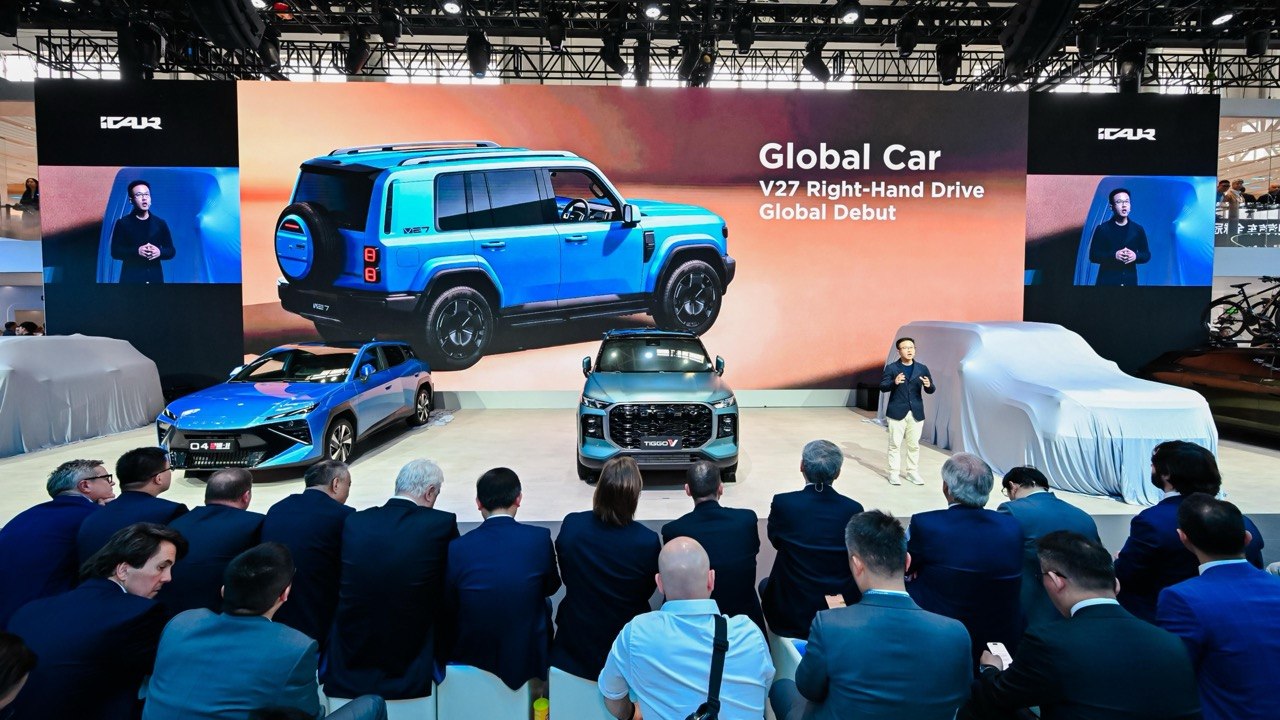
A strong example of this transition was Chery Group’s iCAUR brand. During the show, iCAUR presented two major highlights: the ROBOX concept car and the right-hand-drive version of the V27, both introduced by Dr. Su Jun, CEO of iCAUR.
The ROBOX concept car demonstrated a more advanced approach to electric vehicle packaging and future mobility design. Combining the words “robot” and “box,” the concept adopts a OneBox silhouette paired with a high-clearance structure, suggesting a balance between aerodynamic efficiency, spacious interior packaging and off-road capability. Clean modular surfaces, distinctive lighting signatures and a reimagined cabin layout indicate how Chinese brands are increasingly developing their own design languages rather than relying on legacy market conventions.
From an engineering perspective, the concept also reflects the advantages of dedicated EV architecture. Without the packaging constraints of a traditional combustion powertrain, designers gain greater freedom in wheelbase optimization, cabin volume, floor height management and overall space efficiency. These factors are becoming critical as consumers increasingly evaluate EVs on usability and digital experience rather than engine displacement or drivetrain tradition.
The V27 right-hand-drive model highlighted another important capability: global product engineering. Developing a right-hand-drive derivative requires significantly more than relocating the steering wheel. It often involves dashboard redesign, steering-system repositioning, HVAC rerouting, pedal box reconfiguration, revised wiring harnesses, calibration changes for ADAS systems and additional homologation work for regional markets. iCAUR stated that the V27 has been developed to meet five-star safety standards in both China and Europe, while also targeting right-hand-drive markets in Southeast Asia and Oceania.

This is a notable indicator of maturity. In earlier phases of Chinese automotive exports, many products were primarily domestic-market vehicles adapted later for overseas use. Increasingly, however, Chinese manufacturers are designing models from the outset with multi-market compatibility in mind. That shortens launch timelines, improves economies of scale and supports faster international expansion.
The V27’s range-extended electric direction is also relevant in today’s market environment. Range-extended EV systems combine electric propulsion with an onboard generator that recharges the battery, helping reduce range anxiety and infrastructure dependency while preserving the smooth driving characteristics of an EV. For emerging markets or regions with uneven charging networks, such systems can represent a practical bridge between conventional hybrids and full battery-electric vehicles.
Beyond the vehicle lineup itself, iCAUR also used the Beijing show to present a broader mobility ecosystem. The AIMOGA robot appeared as an interactive element at the stand, illustrating the company’s interest in the convergence of automotive technology, robotics, AI and user interaction. This reflects a wider shift within the Chinese industry, where carmakers increasingly position themselves not only as OEMs, but as technology companies operating across software, services and connected mobility platforms.
That broader transformation was one of the clearest messages of Auto China 2026. Chinese manufacturers are no longer competing solely through pricing or production volume. They are investing in platform engineering, user-interface innovation, intelligent systems, rapid development cycles and internationally scalable product strategies.
In that context, Chery Group’s iCAUR stood out as a relevant case study. Through the simultaneous presentation of a future-focused concept vehicle, a globally engineered production model and AI-led ecosystem elements, the brand demonstrated how far Chinese automotive development has progressed.
The Beijing Auto Show therefore served not only as a venue for new model launches, but also as evidence that China’s automotive sector has entered a more advanced competitive phase-one defined by engineering capability, software integration and increasing global ambition.
Cover photo and all photos credit: iCAUR

Szilárd Szélpál served as an environmental expert in the European Parliament from 2014, where he utilized his expertise to influence policy-making and promote sustainable practices across Europe. In addition to his environmental work, Szilárd has a deep understanding of foreign affairs, offering strategic advice and contributing to the development of policy initiatives in this field.
Support independent analysis and journalism at CEA Magazine: https://centraleuropeanaffairs.com/donation
For more insights on Central European political risk, EU institutional developments, and transatlantic relations, follow CEA Magazine and the CEA Talk podcast.
