
How Machinery Guide Is Scaling Precision Farming
When multinationals dominate precision agriculture with deep capital reserves and aggressive R&D cycles, a small Hungarian firm would seem an unlikely contender on the world stage. Yet Machinery Guide, a Szeged-based developer of agricultural guidance software and mobile-based control systems, has quietly expanded into more than 20 markets across Europe, South America and Australia. Its story shows how Central European engineering can gain global relevance even in one of the most competitive technology sectors.
Author: Szilvia Kecsmar
In an interview for CEA Talk, Árpád Tóth, the company’s export manager, offers a rare look into what it takes for a mid-sized Eastern European technology developer to build international resilience amid volatile commodity markets, shifting geopolitical landscapes and rapidly changing farm-level expectations.
A global strategy born of a small domestic market
Hungary’s agricultural sector is technologically capable yet structurally modest. For a niche developer like Machinery Guide, scale must come from abroad. Tóth makes clear that the company’s internationalisation was driven not by grand design, but by necessity: a small domestic market, seasonal demand patterns and the need for year-round revenue.
“In Europe you effectively have two sales seasons,” Tóth explains, noting that spring and autumn determine the rhythm of the business. Latin America and Australia, by contrast, mirror Europe’s off-seasons. This geographical spread allows the company to stabilise a revenue curve that would otherwise remain highly volatile.
The result is a business whose exports now define its identity, forcing Machinery Guide to develop not only products for global use, but a genuinely international operational mindset.
Europe: one market, but two speeds
Despite the EU’s promise of a single market, Tóth argues that Europe remains divided by purchasing power, risk perception and brand conservatism.
Eastern European customers are highly price-sensitive and often hesitant to invest even in cost-saving technologies when crop prices fall. Western European buyers, on the other hand, prioritise reliability and expect clear proof of technological maturity, especially when dealing with a lesser-known Eastern European brand.
The rise of ultra-low-cost Chinese autosteering systems has further reshaped the landscape. After Machinery Guide invested years in developing its own autosteer technology, Chinese competitors undercut the market almost overnight with aggressive pricing. The company eventually withdrew from that segment, highlighting the vulnerability of smaller innovators in regulatory environments where enforcement lags behind import flows.
Opportunities nonetheless remain. Poland stands out as one of the most promising markets, combining large farms, strong agronomic literacy and a growing appetite for digital tools, even if brand loyalty still presents a barrier. Germany, meanwhile, offers fertile ground but is technologically saturated, forcing exporters to demonstrate value in an exceptionally crowded field.
South America and Australia: scale brings both opportunity and challenge
Brazil, South America’s agricultural giant, offers scale unmatched in Europe, but the environment is structurally demanding. High tariffs and taxes inflate the cost of imported devices, while weak mobile internet coverage in rural areas undermines RTK-based precision systems that depend on constant data connectivity.
Australia presents a different set of challenges. Farms there often span 3,000 to 5,000 hectares, fundamentally changing farmers’ functional needs and requiring Machinery Guide either to adapt its product lines or to exclude certain devices altogether. Distance also plays a role. “A farmer with a software issue may call us from the field,” Tóth says, “but it may be 2 a.m. in Hungary.”
Even so, Australian distributors and end users appear well accustomed to operating at the edge of global time zones, easing some of the pressure on European suppliers.
Markets the company won’t pursue – for now
Not every region fits Machinery Guide’s profile. Middle Eastern agriculture focuses largely on horticulture rather than broadacre crops, demanding technologies outside the company’s core expertise. India, despite its vast size, remains too fragmented, with average farm sizes of one to two hectares and widespread reliance on manual labour or small tractors incompatible with the firm’s hardware environment.
Much of Africa also remains outside the company’s current focus, though Tóth acknowledges its long-term potential. This disciplined targeting reflects a company keenly aware of its limits in a sector often dazzled by sheer scale.
The invisible skill behind export success: intercultural fluency
Tóth speaks candidly about the art of adapting to foreign negotiation cultures. A Turkish distributor may require extended personal conversations before trust forms. South American partners might postpone meetings repeatedly. Some Asian clients engage only through brief transactional exchanges before unexpectedly placing substantial orders.
In such an environment, the export manager’s most valuable tools are not dashboards or spreadsheets, but intuition and the ability to observe, adapt and remain patient. Personal trust is especially critical in agriculture, where the demographic is older and digital interfaces can be intimidating. When technology fails, and software inevitably does, trust is often what keeps partnerships intact.
Hungarian innovation: talent abundant, mindset still evolving
Tóth views Hungarian engineering talent as globally competitive, yet constrained by two persistent factors. Linguistic isolation remains a challenge, as Hungarian differs radically from other major languages. In addition, a limited global mindset can hold firms back, particularly when small domestic markets fail to push companies beyond their borders.
Still, he points to Hungarian technology successes that quietly dominate global niches, from seeder-control systems to biotech soil innovations. “We can do it if we shift our mindset,” he says.
The role of state export promotion
Hungary’s export-promotion agency, HEPA, has played a meaningful role in opening doors by facilitating introductions to embassies, commercial attachés and international exhibitions. Yet, Tóth stresses, agencies can only create opportunities. “They can open the door,” he says, “but the company must walk through it.”
For further progress, he suggests expanding resources dedicated to export support and involving more professionals with hands-on business experience.
Lessons for SMEs: innovate, travel, and above all, network
The strongest message Tóth offers to aspiring exporters is deceptively simple: leave the office. Travel, meet people, attend fairs and start conversations, even if they begin with small talk. Hungarian founders abroad often cluster together, he observes, missing the essence of networking: serendipity.
Connections open markets. Conversations spark innovation. Global exposure breaks the intellectual insularity that limits many promising SMEs.
Looking ahead: consolidation and focus
Agriculture is undergoing profound structural change through farm consolidation, digitalisation and climate-related volatility. Tóth expects Machinery Guide’s future to rest on two or three high-performing niche products rather than a broad portfolio.
He envisions deeper engagement with farmers, stronger positioning in selected markets and a role as a major player within specific segments of precision agriculture. One innovation he believes will reshape the next decade is drone technology, with far-reaching implications for fertilisation, crop monitoring and beyond.
His personal motto captures the pace of the sector: “Technology is not sleeping.”
For Machinery Guide, a small Hungarian challenger navigating the fault lines of global agriculture, staying awake is not optional.
For more insights on Central European political risk, EU institutional developments, and transatlantic relations, follow CEA Magazine and the CEA Talk podcast.
Support independent analysis and journalism at CEA Magazine: https://centraleuropeanaffairs.com/donation
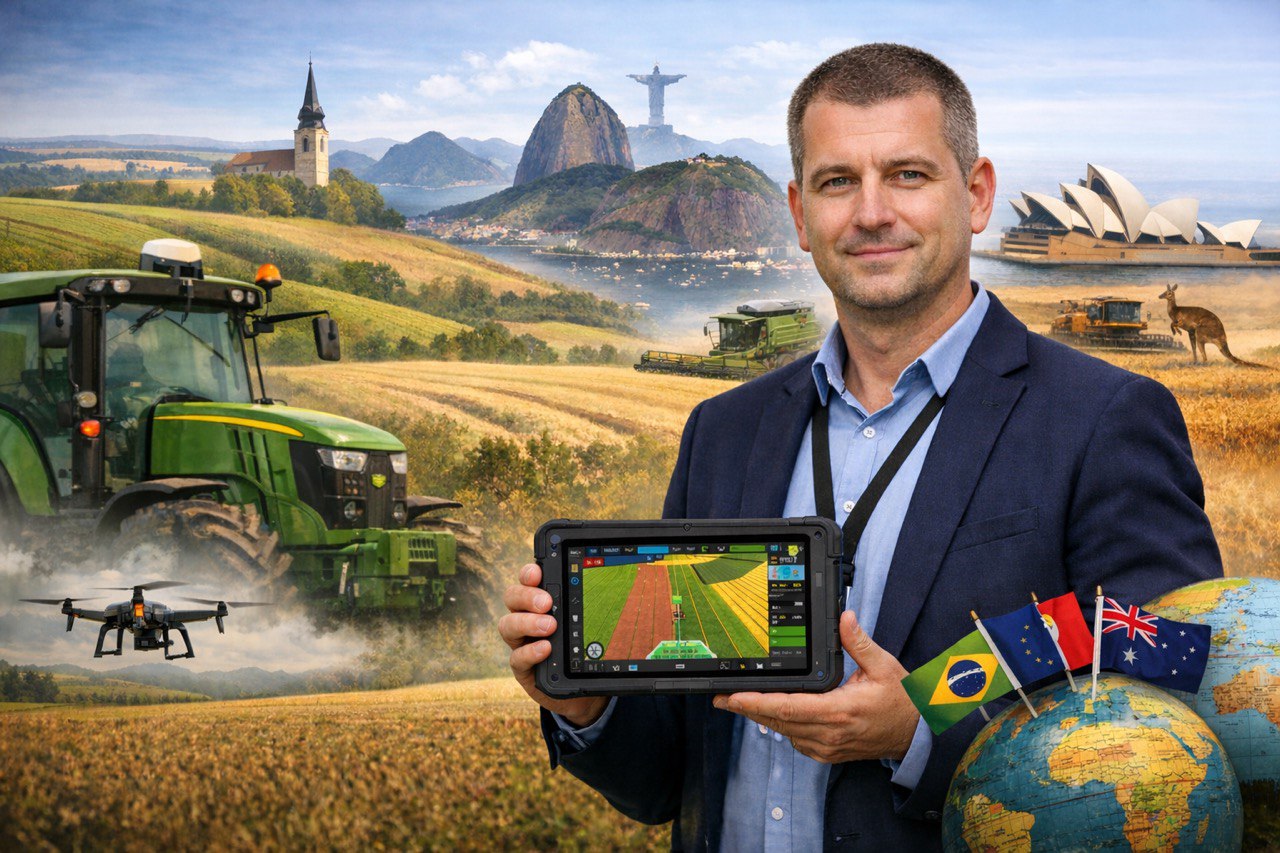
Cover photo credit: ChatGPT

Szilvia Kecsmar is a coach, writer, journalist, and media informatics specialist, serving as the editor-in-chief of CEA Magazine.