
While Western Europe’s automotive markets face mounting competitive pressures, Central and Eastern Europe presents a different picture. Ageing vehicle fleets, growing demand in key markets, the expansion of Chinese automotive brands and the transition to electric mobility are creating both challenges and opportunities for manufacturers and distributors.
This article is the second instalment in our series examining the key insights from the AutoWallis Investor Conference.
Author: David R. Hohl
Europe’s automotive industry is undergoing a profound transformation, but its effects are far from uniform across the continent. As highlighted during the AutoWallis investor conference, Central and Eastern Europe is following a distinct development trajectory, shaped by purchasing power, vehicle replacement cycles, consumer preferences and the growing importance of new market entrants.
Poland offers a particularly telling example of how strong domestic demand can distinguish individual Central European markets from broader European trends. Yet the region’s potential extends beyond rising sales figures. Its ageing vehicle fleets, reliance on imported used cars and evolving distribution networks raise a broader question: could Central and Eastern Europe become one of the most important battlegrounds in the next phase of Europe’s automotive transformation?
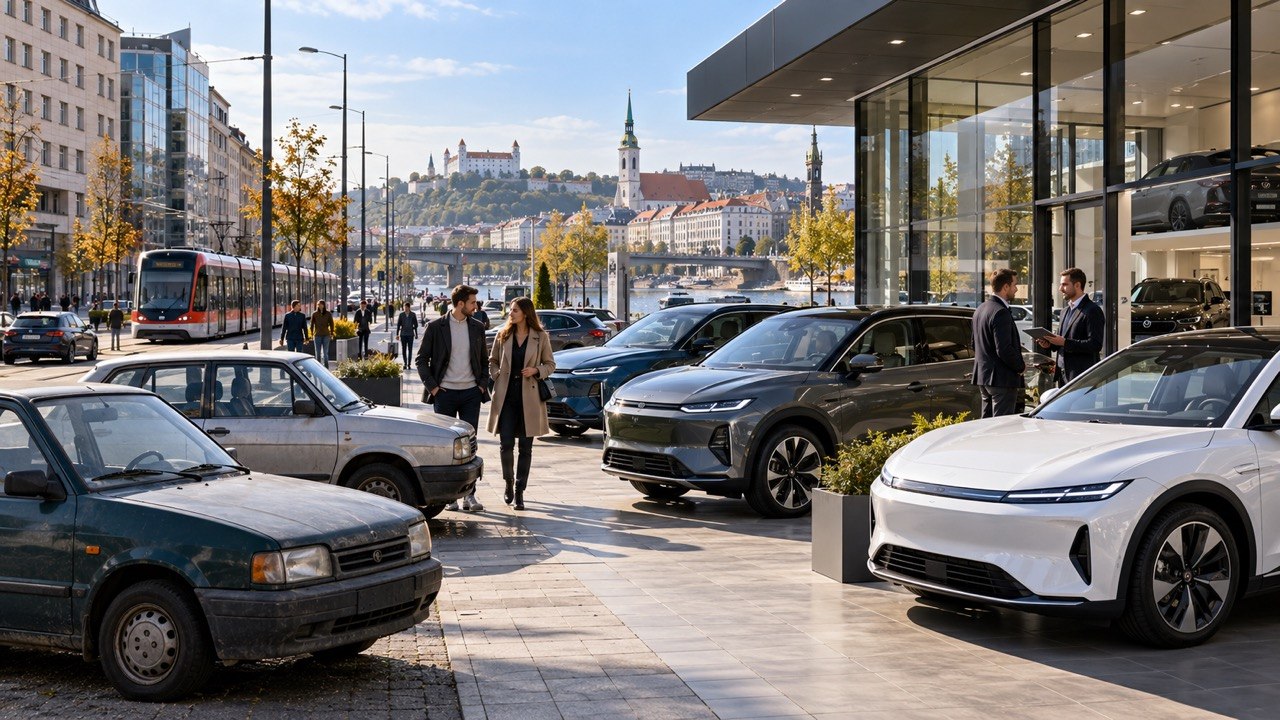
The older car stock is both a problem and a market opportunity
Vehicle age is one of the clearest structural differences between Central and Western Europe. According to ACEA data for 2023, passenger cars averaged 15.1 years in Poland and 15.0 years in Hungary, compared with 10.3 years in Germany and an EU average of 12.5 years.
The older stock can create a significant demand for replacement in the longer term. However, this does not automatically mean that consumers will switch to new cars. Imported used cars continue to play an important role and are one of the factors that determine the development of the region’s new car market. During the conversation, it was also mentioned that the price of certain imported used cars can be so close to that of new models that the buyer’s decision becomes less and less self-evident.
The electric transition has started, but not at the same pace
Electrification has also started in Central European markets. Based on what was said in the panel, the future role of electric cars was not fundamentally questioned, but at the same time, the pace and duration of the transition are still unclear. The region’s economic and market characteristics differ from those of Western European countries.
This gap is also reflected in new-car registrations. In 2025, battery-electric vehicles accounted for just 7.3% of new passenger car registrations in Poland, compared with 17.4% across the European Union. The figures illustrate how electrification is progressing at markedly different speeds across European markets.
The price of cars, the purchasing power of consumers, the existing car stock and the import market all influence how quickly new drive technologies can spread. This creates a growing challenge for manufacturers and distributors, who must reconcile rapidly evolving global vehicle portfolios with regional markets where affordability remains a decisive factor in purchasing decisions.
Poland’s Growing Importance
During the panel discussion, Poland was repeatedly highlighted as a significant regional example. This assessment is supported by market data. According to PZPM and KPMG, Poland recorded approximately 597,400 new passenger car registrations in 2025, representing an 8.3% increase year-on-year. By comparison, new car registrations across the European Union grew by just 1.8% during the same period.
This makes the Polish market particularly valuable at a time when the automotive industry is facing intense pressure in many other areas.
The Arrival of Chinese Players
The rise of the Chinese automotive industry is not merely an issue—or an opportunity—for Western Europe. As noted during the panel, Chinese automotive brands are expanding their presence in European markets, challenging established manufacturers and distributors to reconsider their competitive strategies.
This is particularly relevant in Central and Eastern Europe. The region’s more price-sensitive consumer market, older vehicle fleet, and growth potential create an environment where new entrants can rapidly establish a foothold. However, the question is not simply which car brand can sell the most vehicles. The entire structure of automotive retail is undergoing a transformation.
Automotive Retail Must Also Adapt
Beyond technological shifts, the retail model itself is also being reshaped. Digitalization, marketing, competition between brands, and networking are becoming increasingly important. In a market where new players are emerging, it is no longer sufficient for traditional car dealerships to rely on the same methods that worked in the past.
Reaching younger consumer generations, developing digital sales and communication capabilities, and focusing on brand building are playing an ever-greater role. This is particularly significant in countries where the market itself is evolving rapidly.
A region undergoing multiple transitions
Central and Eastern Europe’s automotive market is entering a new phase in which ageing vehicle fleets, electrification, Chinese competition and changing consumer expectations are reshaping the opportunities available to manufacturers and distributors. However, the region’s growth potential should not be confused with guaranteed demand. Converting an ageing vehicle fleet into new-car sales will depend increasingly on affordability, financing solutions and the ability of automotive companies to respond to local market conditions.
The real economic opportunity lies not merely in selling more cars, but in securing a stronger position within Europe’s evolving automotive value chain. Manufacturers and distributors capable of combining competitive pricing, effective retail networks and reliable after-sales services could gain a lasting advantage. For established European brands and emerging Chinese competitors alike, Central and Eastern Europe is becoming more than a secondary sales market: it is an increasingly important arena for investment, market expansion and strategic competition.
Cover photo: AI-generated illustration for CEA Magazine.

David R. Hohl is an economic historian and researcher focused on Central European economic transformation, innovation, and regional development. His work combines historical insight with contemporary economic analysis, supported by international research collaborations across Europe.
Support independent analysis and journalism at CEA Magazine: https://centraleuropeanaffairs.com/donation
For more insights on Central European political risk, EU institutional developments, and transatlantic relations, follow CEA Magazine and the CEA Talk podcast.
