
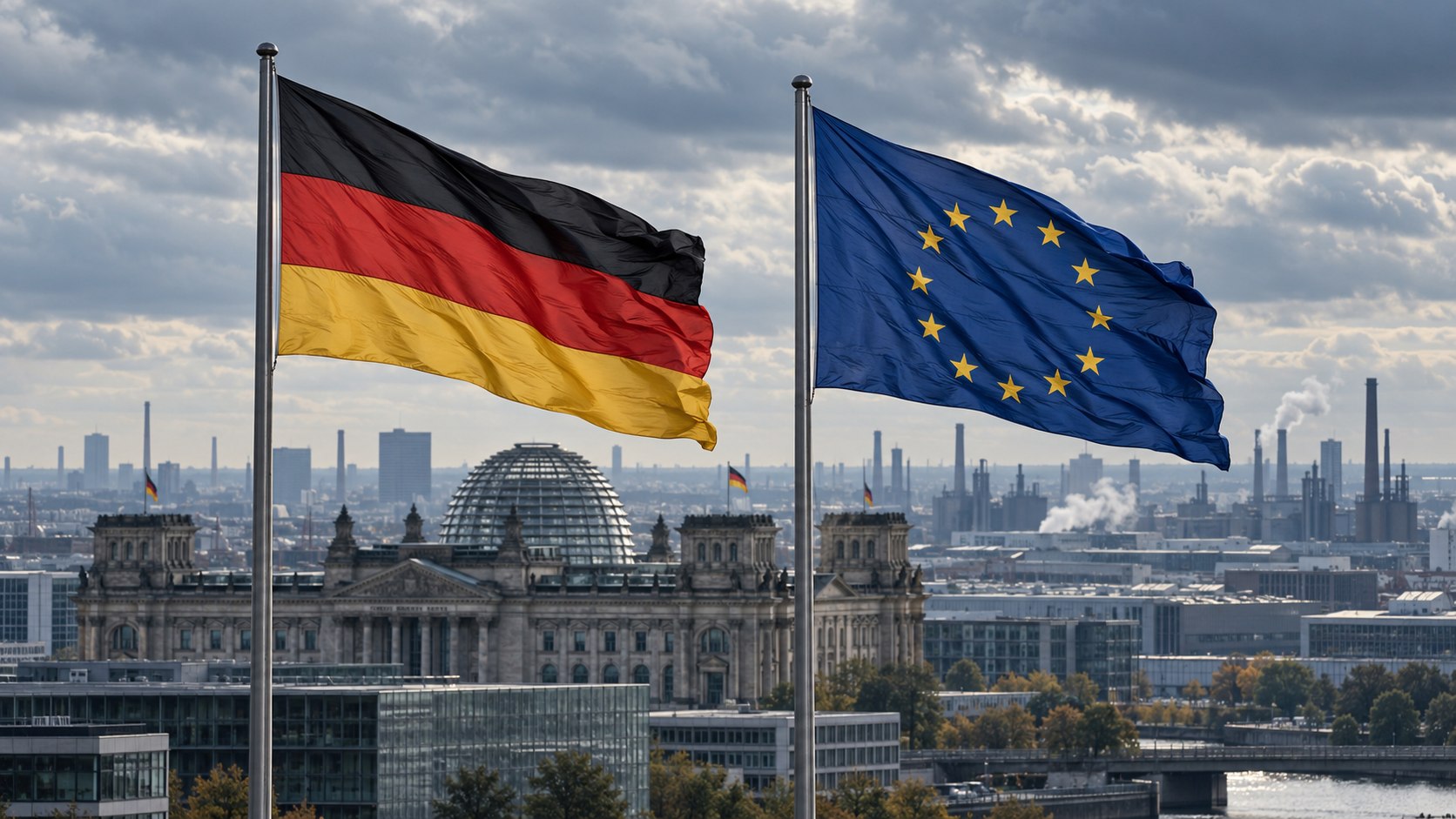
The social and economic problems left unanswered by Germany’s political elite have become a matter concerning the future of the entire European Union. Yet the AfD’s rise may also expose conflicts of interest that the party’s Central European supporters scarcely seem to anticipate.
Author: Mihály Barcza
The AfD’s victory on Sunday is the responsibility of Europe’s mainstream elites, but above all of Germany’s mainstream political elite. More precisely, it is a consequence of their irresponsibility. The AfD won decisively in Saxony-Anhalt, while the CDU suffered a sharp decline, because Germany’s leading political figures have spent years sidestepping and fudging serious social questions, effectively turning certain issues into taboos. Yet voters’ dissatisfaction cannot be eliminated by refusing to discuss its causes. What is excluded from mainstream political debate does not disappear from everyday life: sooner or later, it seeks political representation.
Germany is, for now, one of the biggest losers in the emerging world order. Its export-oriented economy has taken heavy blows from several directions at once: a right hook from the loss of cheap, readily available Russian gas, Donald Trump’s tariffs and the burden of financing the war in Ukraine, and a left hook from China’s seemingly unbeatable, brutally cheap mass-produced goods. The economic model that underpinned German prosperity for so long now faces a series of interconnected external challenges. For voters, this is not an abstract geopolitical realignment, but a question affecting their livelihoods and their expectations for the future.
For the average German, the European Union increasingly means living on less money while supporting more people. Within their own country, they also find themselves living alongside growing numbers of people whose backgrounds differ fundamentally from German cultural characteristics and traditions, and who, in their view, enjoy a standard of living beyond what they deserve. This perception may be considered justified or unfair, but its political consequences cannot be ignored. When voters feel that their burdens are increasing while their own problems receive insufficient attention, their trust in those who represent them begins to erode.
Added to this is the destruction of Nord Stream. We are talking about industrial and energy infrastructure of critical importance to the economy of a NATO member state, yet an almost complete silence surrounds the criminal proceedings concerning its destruction. In the debate over German industry, energy supplies and the country’s economic room for manoeuvre, the significance of this issue can hardly be separated from the broader loss of trust. Who seriously believes that all this is sustainable in Germany over the long term, or that voters’ dissatisfaction can be managed with yet another change in political messaging?
It is easy to invoke Putin, but invoking Putin alone is a shallow explanation. Russia occupies a different place in German historical memory than it does in Polish historical memory: German–Russian relations rest on centuries of economic, dynastic and geopolitical connections. For centuries, Russia was a key trading partner for Prussia, with the fur trade exceeding even the trade in alcohol and timber in volume. One of Russia’s greatest rulers, Catherine the Great, was born a princess of Anhalt-Zerbst, the daughter of a Prussian prince and general. The AfD’s relationship with Russia is also rooted in this deeper historical past; understanding it therefore requires more than references to Russia’s current leadership.
One characteristic of dysfunctional societies is that buffoons rise to power. Not necessarily because everything they say is persuasive, but because, out of ten claims they make, three are things that only they are prepared to say—and those three are genuinely incisive observations that resonate with many people’s experiences. The other seven, however, are downright dangerous. The responsibility of the mainstream elite lies precisely in its failure to offer substantive answers to those three valid points, allowing their credibility to create political space for the other seven as well. Suppressing discussion of real problems therefore does not weaken the radicals. It weakens those who should be offering democratic and workable solutions.
Unless Germany’s mainstream political elite can provide meaningful answers very soon to the issues that matter most to voters—above all migration and the relationship Germany should maintain with Russia—it risks the disintegration of the European Union. The rise of the AfD, Germany’s MAGA, could mean that Germany attempts to respond on its own to the challenges arising from the changing world order. Such a shift would be more than a change of direction in German domestic politics: German economic isolationism could bring an end to the European Union as we know it. Central Europe, in particular, would do well to consider the consequences.
Many of the AfD’s Central European admirers regard globalism and global capital as the embodiment of Satan, and foreign capital as nothing but harmful. German AfD supporters, however, approach the same issue from a different angle: they believe German companies spend too much in Mexico and Hungary, and too little at home. They want Mercedes and Audi to manufacture expensive German cars with well-paid German workers, in Germany. Their objective is therefore not to improve the terms of German companies’ presence in Central Europe, but to bring production—and the income associated with it—back home.
This could even benefit Germany. It might mean selling fewer cars, but at much higher prices, while “Made in Germany” could once again stand for what it once did: high quality. Yet what looks like economic renewal from a German perspective could mean the loss of German industry located in our region for us Central Europeans. The same decision would be a story of jobs regained in one country and jobs lost in another. Shared political sympathies do not resolve this fundamental conflict of economic interests.
German AfD supporters also want a German ChatGPT, a German Palantir and a German Apple: German technology companies capable of playing a leading role in the digital economy. That, however, requires enormous amounts of money, because Germany has fallen behind in this field. Even the Germans cannot afford everything: financing their own technological catch-up and funding European redistribution compete for the same limited resources. Viewed in these terms, a German Apple means less EU funding, while giving precedence to German national priorities means less money for cohesion policy.
This is where the contradiction between Central European and German AfD sympathisers becomes particularly clear. The Central European admirer wants Audi to pay a Hungarian or Polish worker as much as it pays a German worker in Germany, while also wanting Hungary to have CBA rather than Aldi. The German AfD voter, by contrast, wants Hungary to have no Audi—only Aldi. What a consensus, isn’t it? One side wants German wages and industrial investment to remain in its own country; the other wants to bring precisely those investments and jobs back home. Behind similar political slogans lie economic expectations that are difficult to reconcile.
Yet they do not think through this contradiction, just as they do not consider that, neither in Germany nor in Central Europe, are AfD supporters having enough children to ensure generational replacement. More important to them is the insistence that every migrant is a criminal and that “we all know who” is responsible for everything that goes wrong. This is what binds them together, rather than a shared, carefully considered vision of their economic or social future. A common enemy conceals their conflicting interests; it does not eliminate them.
Such a tenuous bond cannot hold together 27 member states with divergent interests—or even more following a future enlargement. The AfD’s victory is therefore not merely a warning about German domestic politics: it raises the question of political responsibility for the European Union as a whole. If the mainstream elite continues to leave real problems unanswered, Europe’s future will be shaped by those who offer seven dangerous claims alongside three incisive ones. What is at stake is not simply who wins the next election, but what will remain of European cooperation after that victory.
Cover photo credit: CEA Magazine. Edited with AI assistance using ChatGPT
Mihály Barcza is an attorney and founding partner of Oppenheim Attorneys-at-Law, specialising in international mergers and acquisitions. Throughout his career, he has advised leading European, American and Asian companies on major cross-border transactions. He also served as an arbitrator in money and capital market disputes for 17 years and chaired the Supervisory Board of MKB Bank between 2015 and 2017. His work has been recognised by leading international legal rankings, including Chambers Global and The Legal 500.
Support independent analysis and journalism at CEA Magazine: https://centraleuropeanaffairs.com/donation
For more insights on Central European political risk, EU institutional developments, and transatlantic relations, follow CEA Magazine and the CEA Talk podcast.
