
Judit Szilos-Zongor has been living in Munich for three years. Inspired in part by the story of her Danube Swabian ancestors, she explores what it means to find a sense of home in a country to which her family’s history reconnects nearly three hundred years later.
Author: Judit Szilos-Zongor
Not Easy to Get Into, but Worth It Once You Are
The first thing I really noticed in Germany was not efficiency or rules, but a feeling that things moved differently here. Life seemed quieter, more structured, and more intentional than what I had been used to before. At first, that difference could feel distant, even cold. Over time, however, I began to understand that what appears closed on the outside is often something entirely different on the inside.
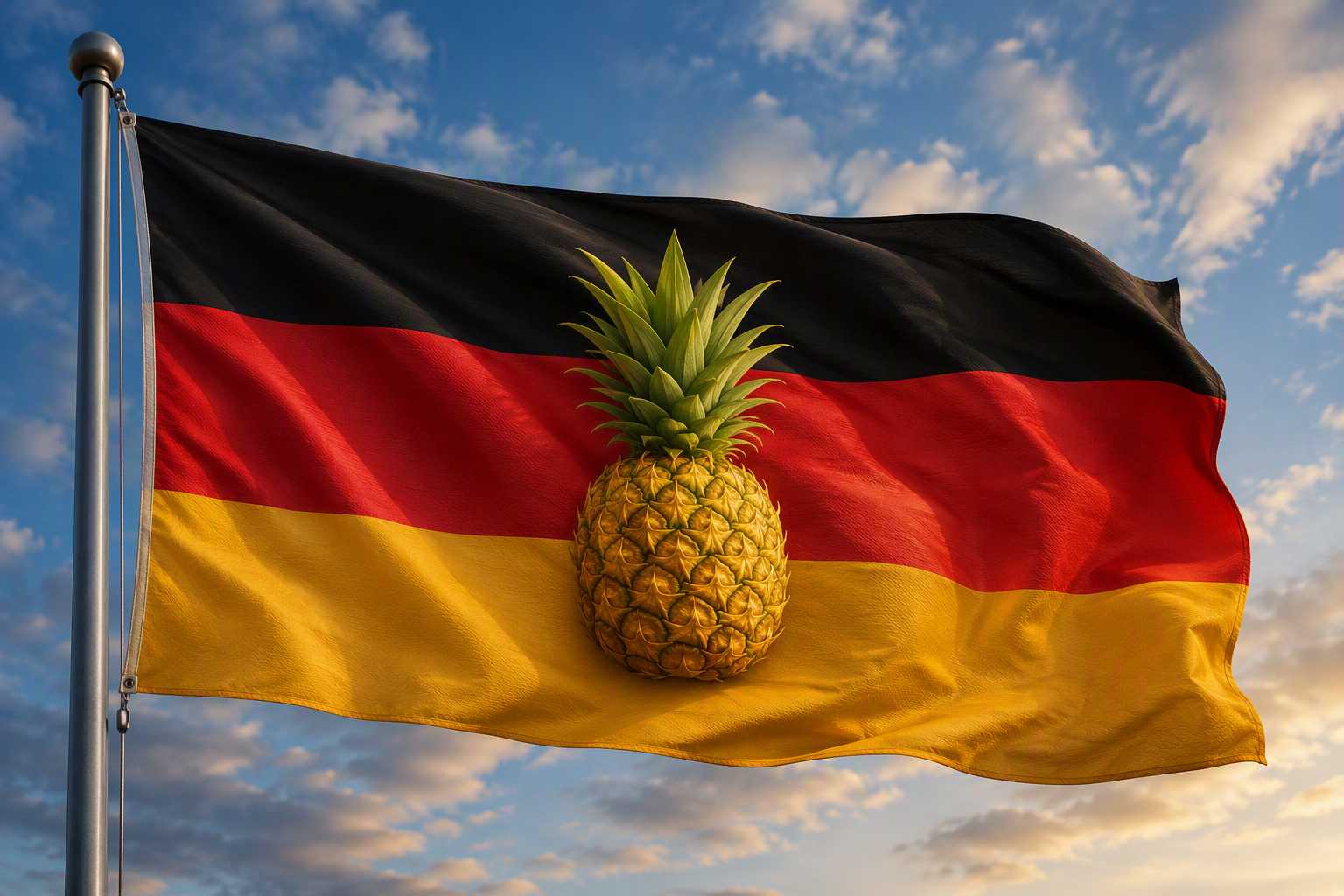
Someone once described Germans to me as pineapples: rough on the outside and sweet on the inside. Strangely enough, that simple comparison helped me make sense of many experiences that had previously felt confusing. For years, people had tried to explain German culture to me, telling me how Germans think, what to expect, and how to interpret certain behaviors. I listened, but I never fully understood. Then I heard the pineapple analogy, and suddenly everything clicked into place.
Until then, I had mostly noticed the distance, the reserve, and the fact that people did not open up easily. I had seen the outer shell without understanding what might exist beneath it. It is also important to acknowledge that not everyone is happy that you are here, and there are situations where you feel that quite clearly. I do not want to look at Germany through rose-colored glasses or pretend that integration is always smooth and welcoming. It is not. Yet if you stay long enough, another layer gradually begins to appear.
The Sound of Silence
One of the things that surprised me most was the silence. Not dramatic silence, but the kind that exists almost unnoticed until you come from somewhere else. On public transport, on the streets, and in everyday situations where conversation would start automatically back home, there is often a sense of calm that feels almost physical.
At first, I found it uncomfortable. I came from an environment where communication fills space, where talking is often a way of showing connection, friendliness, and presence. When nobody spoke, it felt as if something was missing. It took me a long time to realize that nothing was actually wrong.
Eventually, I began to experience silence differently. It no longer felt like emptiness. It felt like space. Space where nobody expected me to perform socially, where I did not have to react to everything, explain myself constantly, or prove my presence through words. As I became accustomed to it, I started noticing how this silence influences other aspects of life. There is often more thoughtfulness in conversations, more consideration before responding, and a more deliberate approach to work and decision-making. There seems to be a small gap between action and reaction, and within that space things often unfold differently.
Over time, what had initially felt uncomfortable started to feel like trust.
Returning to What Feels Familiar
Our connection to Germany did not come out of nowhere. On my side of the family, there are Danube Swabian roots, and my husband also has German ancestry, although that is a story in itself. These connections were never something we consciously focused on. They were not identities we actively carried. Instead, they existed as habits, values, and ways of approaching life.
When we moved here, I often experienced a strange sense of familiarity. Certain things did not feel entirely foreign. The relationship with order, the desire for predictability, the respect for work, the emphasis on responsibility, and especially punctuality all felt surprisingly familiar.
One of the things that seemed completely natural to me from the beginning was the German understanding of punctuality. Not the kind where something starts at ten and you arrive at ten, but the kind where something starts at ten and you are already there at quarter to because you have planned for the possibility that the train might be late, the bus might not arrive, or some other obstacle could appear. This kind of worst-case-scenario thinking is deeply embedded in everyday life.
For me, that mindset was not unfamiliar. In my family, especially through my Swabian grandparents, punctuality was never optional. It was considered a basic value. They used to say that punctuality is the virtue of kings, and that expression stayed with me. Perhaps this is one reason why so many things here often feel as though they simply work. It is not because everything is perfect, but because so much effort goes into preparing for what could potentially go wrong.
Arriving in a System
What is important to say is that this is not a story about arriving somewhere and immediately feeling welcomed. That was not our experience. We did not arrive to an overwhelming sense of Willkommenskultur. Instead, it felt as though we had entered a functioning system and needed to learn how that system worked.
The responsibility seemed to be on us to understand the rules, expectations, and cultural codes that already existed. There were moments when I felt visibly foreign and situations where I sensed that not everyone was enthusiastic about newcomers. Those experiences are real, and they deserve to be acknowledged. At the same time, they are only one part of a much larger story.
One of the biggest lessons for me has been learning not to interpret everything through the expectations I brought with me. A neighbor who does not stop for conversation is not necessarily unfriendly. A colleague who gives direct feedback is not necessarily rude. A person who takes months to open up is not necessarily rejecting you.
The longer I live here, the more I realize that many of these behaviors follow a different social logic than the one I grew up with. Trust often develops slowly. Relationships can take longer to build. Warmth may be shown less frequently, but when it appears, it often feels genuine.
Looking back, I think many of my early frustrations came from assuming I already understood what I was seeing. In reality, I was often interpreting German behavior through Hungarian expectations. As time passed, I realized that many things I took personally were not personal at all. They were simply expressions of a culture operating according to different rules than the ones I knew.
I am still learning to read those rules. But understanding that they exist has made a difference. It has allowed me to see beyond first impressions and to appreciate qualities that are easy to miss at the beginning: reliability, honesty, commitment, and a form of loyalty that reveals itself slowly but often lasts a long time.
Community That Isn’t Loud
One thing I have been observing since moving here is the nature of community in Germany. Even after three years, I would not claim to fully understand it. In many ways, I am still learning.
What has struck me is that community here often does not look the way I expected it to. It is not particularly loud, visible, or expressive, yet it can be remarkably strong. Coming from a culture where community is often built through constant interaction and frequent social exchange, this took time to notice.
What I have observed so far is that community here often seems to be built through participation rather than conversation. People organize things together, volunteer together, serve on committees, join associations, coach children’s sports teams, help run local events, support schools, serve in volunteer fire brigades, participate in church communities, or contribute to local politics and neighborhood initiatives.
The scale of this involvement is remarkable. Germany has a population of around 83 million people, and nearly 27 million people engage in voluntary work. In other words, roughly one in three people contributes time and energy to something beyond their job and family life. Germany’s civic life is supported by hundreds of thousands of associations and clubs that form the backbone of civil society.
Sport alone offers a glimpse into how deeply participation is woven into everyday life. Germany has around 86,000 sports clubs with more than 29 million memberships, making organized sport one of the largest civic movements in the country. Behind those numbers are countless volunteer coaches, organizers, referees, committee members, and parents who keep these clubs running.
The longer I live here, the more I notice that many social connections seem to grow out of shared responsibility, shared projects, and long-term participation rather than immediate familiarity.
Belonging is often built not by talking about community, but by contributing to it.
I am still learning how this works. Some parts of it have become clearer over time, while others remain difficult to fully grasp. But one thing that stands out is that many of the structures people rely on every day exist because ordinary citizens choose to invest their time in them.
One image that has stayed with me since moving here is the Kleingärten, the small garden plots that stretch alongside railway lines and on the edges of cities. They are often located in places that, elsewhere, might simply be neglected spaces filled with rubbish or left abandoned.
Instead, these areas are full of life. Every small plot has someone looking after it. Some people grow vegetables, other flowers. There are little garden houses where families spend weekends, and people sit outside, work on their plots, talk to neighbors, exchange advice, and help one another when needed.
What struck me was that these gardens represent something larger. They are not grand community projects, and they are not particularly visible from the outside. Yet they create connections between people. They demonstrate a quiet form of belonging that seems characteristic of many aspects of German society. It is not community as performance. It is community as participation.
Language Changes Everything
Language became a major turning point in my experience. The moment you begin speaking German, people often interact with you differently. It feels as though you move from standing completely outside the system to standing somewhere near the entrance. You are not entirely inside, but neither are you at the same distance as before.
The change is subtle, yet significant. Conversations become easier, assumptions disappear, and interactions often feel more relaxed.
For me, another important shift came when I began volunteering with Oxfam. That experience allowed me to move from observing German society to actively participating in it. For the first time, I was contributing to something rather than simply trying to understand it from the outside.
Through volunteering, I gained a much deeper appreciation for how community functions here. It reinforced the idea that belonging is rarely automatic. You have to show up, invest time, participate, and sometimes knock on doors repeatedly before they begin to open.
A Bicycle and a Different View of the City
Another unexpected turning point came when I bought a bicycle.
At first, it was simply a practical decision. Munich is an exceptionally bike-friendly city, and having a bicycle makes it easier to get around. What I did not expect was how much it would change my relationship with the city itself.
Until then, I often experienced Munich as someone moving between destinations. There was home, work, appointments, paperwork, and errands. The bicycle changed that. Suddenly, I started noticing the spaces in between.
I discovered neighborhoods I would probably never have seen from a car or the S-Bahn. I found new routes along the Isar, quiet residential streets, local cafés, community gardens, and corners of the city that had previously been invisible to me. Distances felt different. The city felt smaller, more accessible, and somehow more personal.
What makes this possible is the scale of Munich’s cycling infrastructure. The city has a cycling network of more than 1,200 kilometers spread across an urban area of approximately 310 square kilometers. Cycling is deeply embedded in everyday life, and around 80 percent of Munich residents own a bicycle.
More importantly, cycling made me feel less like a visitor and more like a participant. I was no longer simply moving through Munich. I was experiencing it. The bicycle connected me to the rhythm of everyday life in a way I had not expected.
Perhaps that is why buying a bicycle feels, in retrospect, like a small act of integration. It opened another layer of Germany for me. Not through language courses, paperwork, or official processes, but through daily experience. Every ride revealed another corner of the city, and with every kilometer, Munich felt a little less like a place I lived in and a little more like home.
Integration Beyond Numbers
Germany today is far more diverse than many people imagine. Around 16 to 17 percent of the population are not German citizens, while close to 30 percent have a migration background. In large cities, these figures are often even higher. In Munich, foreign nationals make up roughly 30 percent of the population, while in Hamburg and Berlin international communities are an everyday part of urban life.
The numbers tell one story. Lived experience tells another.
Employment statistics, migration figures, and language qualifications can tell us something about integration, but they cannot fully explain what integration actually feels like. Behind the data are questions that are much harder to measure. How comfortable do you feel at work? How easily do you build relationships? At what point do you stop feeling like a guest? When does a city become more than just the place where you live and start to feel like home?
These experiences do not fit neatly into statistics. Integration is both a social process and a personal journey. It is both measurable and deeply emotional. Often the data and the personal experience tell different stories, and both are true at the same time.
Still Standing on the Threshold
After three years, there is still part of me that feels as though I am standing on the threshold. I understand much more than I did when I first arrived. I feel more connected, more involved, and more at home than before. Yet I am also aware of how much there is still to learn.
In two years, I will be able to apply for German citizenship. For me, that is more than a legal process. My family’s story began in the German-speaking world, continued through the Danube Swabian communities of Hungary, and now, almost 300 years later, has brought me back. Not to the same place and not to the same Germany, but back, nonetheless.
Perhaps that is what integration really is. Not becoming someone else and not abandoning who you were before. It is learning how to belong while carrying your own history with you.
The Pineapple Effect is not about becoming German. It is about recognizing that what appears hard and inaccessible from the outside often contains something very different underneath. Sometimes understanding takes longer than expected. Sometimes belonging develops quietly. And sometimes, after nearly three centuries, a journey comes unexpectedly full circle.
Cover photo credit: Judit Szilos-Zongor

Judit Szilos-Zongor is a Hungarian professional, born and raised in Pécs, who also lived in London for two years and spent 22 years in Budapest. Following Hungary’s 2022 elections, she and her family decided to move to Munich, where they have been living since 2023. With over 20 years of experience in international roles, she is interested in education, AI, and lifelong learning.
Support independent analysis and journalism at CEA Magazine: https://centraleuropeanaffairs.com/donation
For more insights on Central European political risk, EU institutional developments, and transatlantic relations, follow CEA Magazine and the CEA Talk podcast.

Beautifully written! Thank you, Judit!