
Hungary is preparing to elect a new President of the Republic, but the debate is not merely about filling a constitutional office. It is also about whether we understand the nation as a shared political community or as a club belonging to the winners of the latest election.
“The nomination of old-opposition politicians cannot even arise for a position whose purpose is to create national unity.”
Péter Magyar, Prime Minister of Hungary, Facebook comment, 20 July 2026
Author: Olga Nádra
On 12 April, we received something more than a change of government. We received hope. Not hope placed in one politician or inspired by one party, but hope for a country. For the first time in many years, I allowed myself to believe that Hungary might genuinely become a place where what matters is not whom you voted for yesterday, but what you want to build tomorrow.
.
The scale of the change was indeed historic. TISZA secured a two-thirds parliamentary majority, while 156 of the 199 members of the new National Assembly began their first parliamentary term. In his speech on 9 May, Prime Minister Péter Magyar said that the Hungarian state must finally approach every person with the same respect, dignity and sense of responsibility. One of the simplest and most powerful lines of the speech was: “The homeland is not a privilege. The homeland is our shared home.”
Perhaps that is precisely why the statement made in July was so painful.
Not because candidates for the presidency should be beyond debate. Not because every former opposition politician would automatically be suitable to serve as head of state. It was painful because, for a moment, I once again felt that there were Hungarians whose political past did not fit within this imagined unity.
And I am one of them.
For sixteen years, I was an opposition voter. Not because opposition politics was my identity, but because voting for the opposition was the only decision I believed I could responsibly make at the time. If I must now feel that this past excludes me from the community whose unity was promised, then I have to ask the question: whom does that frequently invoked “nation” actually include?
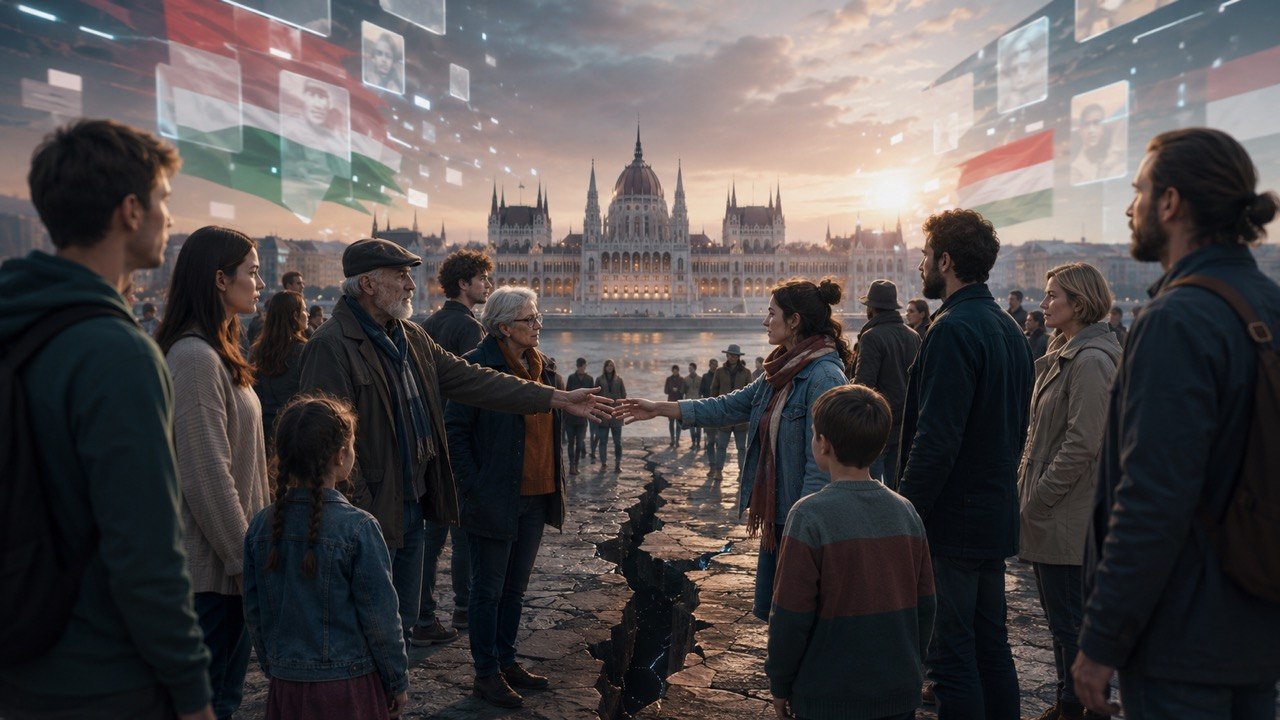
Unity Is Not Uniformity
A society draws its strength precisely from the fact that it is composed of people who are not all the same. Democracy does not mean that everyone thinks alike. It means the exact opposite. It means that people with different worldviews, different political histories and different experiences are able to sit at the same table and search for common ground.
Unity is not uniformity. Unity exists when we accept that another person’s past does not make them less Hungarian. As a professional, I have always been taught that diversity is not a problem but a resource. The purpose of a well-functioning community is not to make everyone think in the same way, but to allow everyone to contribute something to the common good. Different life paths, experiences, generations and worldviews together create the knowledge from which a country can build.
When a society begins excluding its own people because they once placed their cross next to a different party, it is not building unity. It is simply drawing new front lines.
I was never afraid that there would be political disputes. There is no democracy without disagreement. I was afraid that we would once again reach a point at which someone decided who belonged among the “good” Hungarians and whose past first had to be denied or renounced before they could finally be accepted.
That was not the Hungary in which I placed my hopes.
I believed in a country where the nation would not contract but expand. A country in which we would not take something away from each other but add something to one another. A country in which our shared future would matter more than the history of our political tribes. A nation does not become strong because everyone says the same thing. It becomes strong when people who did not vote for the same side yesterday are nevertheless capable of building something together today.
When the Excluded Become the Excluders
It is worth recalling what László Kövér, then Speaker of the Hungarian National Assembly, said in an interview published on 29 April 2020:
“The Hungarian liberal-left opposition is part of a globalist, anti-national network. This opposition is not part of the Hungarian nation, but the comprador formation of this global elite.”
László Kövér, Speaker of the Hungarian National Assembly, interview with Demokrata, 29 April 2020
Contemporary reporting reproduced Kövér’s assertion that the opposition was “not part of the Hungarian nation”, but instead served as the domestic agent of a global elite.
It hurt then, too. Not because I was offended as a politician. I have never been a politician. It hurt because, as a citizen and voter, I recognised myself among the people who were being told that they were not part of the Hungarian nation.
For sixteen years, many of us felt that we had no other responsible political alternative. One may like or dislike the opposition parties of that period. Their decisions may be disputed, and they can be subjected to entirely legitimate criticism. Nevertheless, millions of Hungarian citizens voted for them because, at that particular moment, they believed that doing so was the best way to serve Hungary’s future.
That is why it is dangerous when politics no longer merely argues with its opponent, but questions that opponent’s place within the nation. From that point onwards, the debate is no longer about policies, programmes or visions of the future. It becomes a debate about who counts as a “real” Hungarian and who does not. That is a boundary no democratic public sphere should cross.
If it hurt me so deeply to hear that the people for whom I had voted were not part of the Hungarian nation, how could I wish the same experience upon anyone else? On what moral basis could I expect today’s opposition politicians, or even their voters, to endure the same feeling that I once endured?
No. That will not create a better country.
Justice is not achieved simply by reversing the roles. A nation is not rebuilt when yesterday’s excluded become today’s excluders. Exclusion does not become right because it is practised by different people. If I rejected this mentality yesterday, I cannot accept it today, even when it comes from those from whom I once expected change.
Social Media and the Rise of Digital Tribes
Hungary’s political tribes were not born on social media. Social media has, however, enlarged them to an industrial scale, made them permanent and transformed them into part of everyday identity.
Traditional political debate was, at least in principle, concerned with which programme, policy or vision of the future was better. The logic of social media demands continuous identification instead. It is no longer enough to agree with a politician on a particular issue. One must follow, like, share and defend. It is no longer enough to disagree with an opponent. The opponent must be morally classified, labelled and excluded.
The Reuters Institute’s 2025 report on Hungary concluded that social media had played a leading role in the transformation of the country’s political landscape from 2024 onwards. Péter Magyar’s breakthrough interview with the independent YouTube channel Partizán attracted more than 2.7 million views in a country of approximately ten million people. He subsequently used Facebook and YouTube to reach hundreds of thousands of people directly. During the same period, the pro-government side spent approximately €1 million over five months promoting Facebook posts intended to discredit Magyar, while spending a similar amount on narratives alleging that “pro-war” European politicians wanted to begin a third world war.
The Reuters Institute’s 2026 report described TISZA’s election campaign as heavily dependent on organic social-media content and face-to-face encounters with voters. The Fidesz campaign, meanwhile, combined escalating rhetoric, social-media and billboard campaigns, state resources and AI-generated deepfakes. The report estimated Hungary’s internet penetration at 94 per cent and noted that AI-generated videos attacking Magyar had been viewed an estimated 650 million times across Facebook and YouTube.
Social media is therefore no longer a secondary channel for political communication. It has become the space in which a significant proportion of voters first encounter political figures, interpretations of events and images of the enemy.
The problem is not merely that different people see different content. The problem is that the commercial logic of the platforms rewards strong reactions. A 2026 report by the European Commission’s Joint Research Centre warned that heavily curated, attention-grabbing content, conflictual echo chambers and ideologically segregated information environments can divide societies into opposing camps. The resulting loss of common ground produces what the report describes as “fractured realities”, in which citizens increasingly cease to share even a basic understanding of what is true.
Social media does not simply reflect social division. It continuously rewards its sharpest manifestations. An angry statement produces more engagement than a calm policy explanation. An image of an enemy spreads more easily than an analysis of a complex social problem. Binary categories such as the “good Hungarian” and the “bad Hungarian”, the “old opposition” and the “true agents of regime change”, the “traitor” and the “patriot” fit perfectly into the logic of the algorithm.
Research also warns us that not every platform and not every algorithm has precisely the same effect. A seven-week randomised experiment involving actual users of X found that switching from a chronological to an algorithmic feed changed exposure, account-following behaviour and certain political opinions, shifting some views in a more conservative direction. It did not, however, produce a statistically significant increase in affective polarisation or self-reported partisanship.
This means that social media does not create political tribes on its own. It can, however, determine which voices receive attention, which opinions become visible and in which direction political thought begins to move.
The most accurate conclusion is therefore that social media did not create an exclusionary conception of the nation, but accelerated, amplified and normalised it. It demands new content, a new conflict and a new distinction from the politician every day. For the voter, it transforms politics into a permanent obligation to choose a tribe.
The nation, however, is not a hashtag. It is not a following. It is not a comments section. Nor is it a community assembled by an algorithm.
The Presidency Is Not a Political Reward
The question of the presidency is particularly important because Article 9(1) of Hungary’s Fundamental Law states that the President of the Republic “shall embody the unity of the nation and safeguard the democratic functioning of the state organisation”. This is not a campaign slogan. It is a constitutional responsibility.
The mandate of President Tamás Sulyok ended on 20 July 2026. Until the newly elected president takes office, the powers and responsibilities of the head of state are being exercised in full by Ágnes Forsthoffer, Speaker of the National Assembly.
It therefore matters how potential presidential candidates are discussed. If the constitutional task of the president is to embody national unity, the selection process cannot begin by excluding entire political groups on the basis of their past.
Naturally, not every politician is suitable for the presidency. It is entirely legitimate to argue that a particular candidate is too divisive, lacks sufficient constitutional experience or has pursued a political career that makes it impossible for them to represent unity. These are legitimate arguments.
The fact that someone belongs to the “old opposition”, however, is not in itself a professional, moral or constitutional argument. It is a category of political origin. It suggests that certain political pasts are inherently less valuable, certain life paths are inherently less legitimate and the political experiences of certain voters are less worthy of inclusion in the new Hungary.
This is precisely the mentality we wanted to leave behind.
The presidency is not a political reward for the victorious side. Nor can it become an instrument for purifying the past. A prime minister, a parliamentary speaker or a president does not represent only those who voted for them. They also serve those who never supported them.
If national unity is genuinely the objective, its first condition cannot be deciding who may belong among us. Its first condition must be that we never again declare of anyone: that person is no longer part of the nation.
What Are We Teaching the Next Generation?
What are we telling those eighteen-year-olds who voted for the first time in their lives?
Are we telling them that they should first ask their parents and grandparents how they voted in the past, and use the answer to decide whether those people deserve their respect? Is this really the political culture we wish to leave behind?
What are we teaching them? That a political opponent is not an opponent but an enemy? That one should not debate with such a person, but exclude them morally? That a human being’s value is determined by a vote cast years earlier?
If this is what we teach, we should not be surprised that we trust each other less and less.
Social trust is not created exclusively within the economy, Parliament or election results. It is also created within everyday human relationships, in our ability to say: I disagree with you, but we remain members of the same community.
Modern democracies do not require complete consensus on every question. They require mutual legitimacy. They require us to accept that another person has the same right to think differently and vote for a different party, while remaining an equal member of the political community.
If we lose this capacity, we do not merely lose political arguments. We lose the foundations of a shared national consciousness.
The Weight of a Leader’s Words
In the age of social media, it has become almost compulsory to react immediately to every event. Leadership appears to be measured by who can post more quickly, express an opinion sooner or use stronger language.
But leadership is not a race. Governing a country is not a permanent election campaign.
A Facebook comment written by a prime minister is not simply the rapid response of a private individual. It is a statement by the country’s most powerful political leader. It draws a boundary, legitimises particular concepts and demonstrates to supporters how they may speak about those who do not belong to their group.
The logic of social media encourages politicians to communicate faster, more forcefully and more aggressively. The responsibility of a leader should be to resist that pressure. Being louder does not make someone right. Speaking with greater certainty does not necessarily mean deciding more wisely.
Indeed, excessive, rapid and emotionally charged communication eventually loses its effect. People become exhausted by it. Not because they have ceased to care about public affairs, but because they have grown tired of permanent political noise.
Sometimes the greatest virtue of a leader is not the ability to speak, but the ability to recognise when speaking is unnecessary.
Society does not need continuous excitement. It needs predictability. It does not need a daily political rollercoaster, but leaders capable of weighing their words calmly, listening to others and deciding only afterwards.
Silence is not a sign of weakness. It is often a sign of wisdom.
What History Will Remember
Finally, I would like to address every present and future politician.
History is a curious thing. In a few decades, most people will no longer remember which television debate a politician won, how many likes a Facebook post received or which clever sentence was used to defeat an opponent.
They will remember how that politician treated their own nation.
They will remember whether the politician connected people or dug new trenches between them. They will remember whether power was used to build social trust or to divide the community even more deeply.
We do not truly know the historical figures of the past. Only a fraction of their thoughts survives. Their actions, however, are preserved across generations. We learn from those actions, quote them and use them to decide whether someone should be remembered as an example to follow or as a warning.
The responsibility of voters is to cast their ballots. The responsibility of politicians is to decide what they will do with the trust they receive. Will they leave behind a country in which future generations learn to live and think together, or one in which inherited division continues indefinitely?
History will not ultimately ask how many elections someone won.
It will ask who contributed something to the nation.
And who took something away from it.
Sources and References
- Gauthier, G., Hodler, R., Widmer, P., & Zhuravskaya, E. (2026). The political effects of X’s feed algorithm. Nature, 652, 416–423. https://doi.org/10.1038/s41586-026-10098-2
- Government of Hungary. (2026, May 9). Magyar Péter Magyarország miniszterelnöke [Péter Magyar is the Prime Minister of Hungary]. https://kormany.hu/hirek/magyar-peter-magyarorszag-miniszterelnoke
- Magyarország Alaptörvénye [The Fundamental Law of Hungary], Article 9(1) (2011, consolidated version). Nemzeti Jogszabálytár [National Legislation Database]. https://njt.jog.gov.hu/jogszabaly/2011-4301-02-00
- Reuters. (2026, April 18). Magyar’s parliamentary majority in Hungary increases after final count. https://www.reuters.com/world/magyars-parliamentary-majority-hungary-increases-after-final-count-2026-04-18/
- Sándor Palace. (2026, July 21). Tájékoztatás a köztársasági elnök feladat- és hatásköreinek gyakorlásáról [Information on the exercise of the responsibilities and powers of the President of the Republic]. https://www.sandorpalota.hu/hu/tajekoztatas-koztarsasagi-elnok-feladat-es-hataskoreinek-gyakorlasarol
- Scharfbillig, M., Lewandowsky, S., Altay, S., Van Alstyne, M., Kozyreva, A., Hertwig, R., Lorenz-Spreen, P., DiResta, R., Valenzuela, S., Egidy, S., Quattrociocchi, W., & Orben, A. (2026). Fractured reality: How democracy can win the global struggle over the information space (JRC144603; EUR 40652). Publications Office of the European Union. https://doi.org/10.2760/9358883
- Szakács, J. (2025, June 17). Hungary. Reuters Institute Digital News Report 2025. Reuters Institute for the Study of Journalism, University of Oxford. https://reutersinstitute.politics.ox.ac.uk/digital-news-report/2025/hungary
- Szakács, J. (2026, June 16). Hungary. Reuters Institute Digital News Report 2026. Reuters Institute for the Study of Journalism, University of Oxford. https://reutersinstitute.politics.ox.ac.uk/digital-news-report/2026/hungary
- Szentesi Zöldi, L. (2020, April 28). Bunkerben várják a csodafegyvert [Waiting for the wonder weapon in the bunker]. Demokrata. https://demokrata.hu/magyarorszag/bunkerben-varjak-a-csodafegyvert-2-237021/
- Varga, Z. (2026, July 19). Az Ügyvédkör Bárándy Pétert ajánlja államfőnek, Magyar Péter szerint óellenzéki politikusok jelölése fel sem merülhet [The Lawyers’ Circle recommends Péter Bárándy for president; Péter Magyar says the nomination of old-opposition politicians cannot arise]. 24.hu. https://24.hu/belfold/2026/07/19/ugyvedkor-dr-barandy-peter-koztarsasagi-elnok-magyar-peter/
Cover photo credit: CEA Magazine. Edited with AI assistance using ChatGPT

Olga Nádra is a social worker and a specialist in gerontology and mental health. She completed her studies at Kodolányi János University. She has more than fifteen years of practical experience in elderly care as well as in supporting people with psychiatric conditions. Her work is grounded in empirical insights gained in the field, through which she engages with questions related to mental health, care systems and the social welfare system. She believes strongly in lifelong learning and therefore continues to deepen her professional knowledge through ongoing training and research.
Support independent analysis and journalism at CEA Magazine: https://centraleuropeanaffairs.com/donation
For more insights on Central European political risk, EU institutional developments, and transatlantic relations, follow CEA Magazine and the CEA Talk podcast.

Relevant post. Local visibility and reputation do most of the work for small service businesses.