
The 24 Hours of Le Mans is far more than a motorsport event. It is a technology laboratory, a brand building stage, an industrial stress test and a strategic message to the market. A manufacturer that lines up at Le Mans is not simply trying to win a race. It is trying to prove that its brand is fast, durable, innovative and capable of surviving one of the toughest tests in the automotive world.
Author: Szilárd Szélpál
The Race That Is Not Only About Speed
Few events in motorsport carry the weight of the 24 Hours of Le Mans. Formula 1 is the pinnacle of speed, driver brilliance, political influence and technological precision. Le Mans measures something different. It is not about who is fastest over one lap. Nor is it about who can extract the maximum from a ninety minute or two hour race. Le Mans asks a more brutal question: who can last? Who can remain fast, reliable, efficient and strategically disciplined through an entire day and night?
That is what makes the race unique. Over 24 hours, not only the drivers are tested. The cars, engineers, mechanics, tyres, brakes, hybrid systems, powertrains, fuel strategies and the entire corporate mindset are also under examination. Speed alone is not enough. The car must survive the night, the rain or the heat, changing temperatures, traffic, safety car periods, strategic uncertainty and constant mechanical stress.
This is why Le Mans is one of the clearest industrial metaphors in motorsport. A manufacturer is not merely saying that it can build a fast car. It is saying that it can create durable, efficient, advanced and reliable technology. In the automotive industry, that matters at least as much as top speed.
A Century Old Technology Laboratory
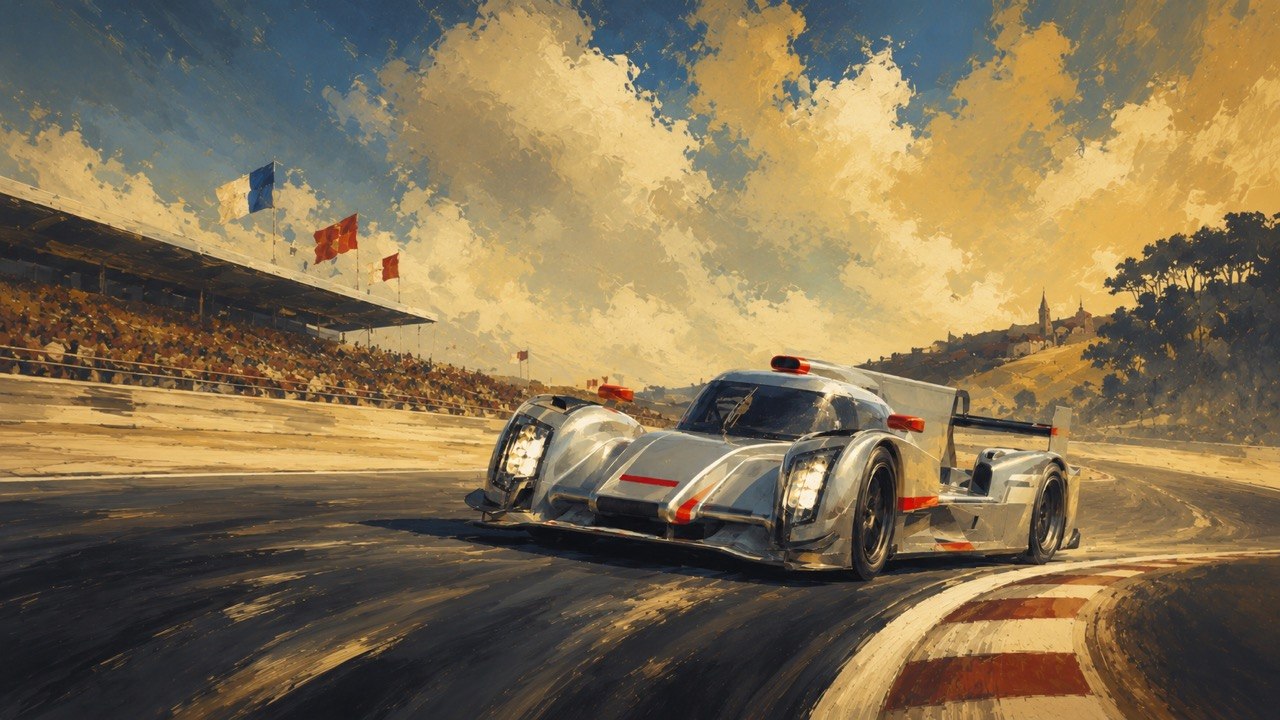
The 24 Hours of Le Mans was first held in 1923 on public roads in the Sarthe region of France. Its original purpose was not simply to create a spectacular race, but to test the reliability, durability and usability of cars. Le Mans quickly became an open air laboratory for the automotive industry, where manufacturers could test their technology not in sterile development centres, but under real and extreme conditions.
That laboratory function has remained central to the race ever since. The history of Le Mans is full of developments that mattered not only on the track, but later in road cars as well. Better braking systems, lighting technology, aerodynamic solutions, fuel efficiency strategies, diesel experiments, hybrid powertrains and energy management systems all belong to the long story of how competitive pressure in motorsport accelerated industrial innovation.
The race is also special because it has always reflected the major turning points of the automotive industry. Between the two world wars, it was a contest of national industrial pride and mechanical reliability. In the 1950s and 1960s, it became one of the great stages of the golden age of sports car engineering. Later, Porsche and then Audi dominance signalled the rise of modern engineering discipline, efficiency and technological control. Today’s Hypercar era shows an industry trying to balance electrification, sustainability, brand identity and global visibility.
Why Le Mans Matters to Manufacturers
For any car manufacturer, entering Le Mans is expensive, risky and resource intensive. Brands return or stay in the race only when participation has a clear strategic purpose. That value appears on several levels.
First, Le Mans is a technology test bed. During a 24 hour race, a car is exposed to stress that can be equivalent to months or even years of ordinary use. If a powertrain, hybrid system, brake package, battery management strategy or aerodynamic concept works at Le Mans, it gives the manufacturer serious engineering credibility. At Le Mans, technology does not prove itself in a presentation. It proves itself at racing speed.
Second, Le Mans is a brand building tool. Victory, or even a competitive presence, can change how a brand is perceived. A manufacturer does not communicate only a sporting result. It communicates character: endurance, precision, courage, innovation and international ambition. At a time when technological differences between car brands are becoming harder for many consumers to see, motorsport can restore emotional meaning to a brand.
Third, Le Mans is also a geopolitical and industrial stage. The participating brands represent not only cars, but national industrial cultures, supplier networks and technological ecosystems. When Toyota, Ferrari, Porsche, Peugeot, Cadillac, BMW, Alpine, Aston Martin or Genesis appears in the top class, industrial identities are also competing. Le Mans becomes not only a sporting event, but a living exhibition of the global automotive industry.
Ferrari: Reviving the Legend After 2023, 2024 and 2025
For Ferrari, Le Mans has always been more than just another race. Motorsport sits at the centre of the brand’s identity, although in the modern era Ferrari’s image has often been tied most strongly to Formula 1. Yet the company’s Le Mans history is exceptionally rich. Ferrari first won the race in 1949, then became one of its defining forces in the 1950s and 1960s. Its most emblematic period came between 1960 and 1965, when Ferrari won Le Mans six times in a row.
A long gap then followed in terms of overall victories. That is why Ferrari’s return to the top category with the 499P carried such weight. In 2023, the number 51 car driven by Alessandro Pier Guidi, James Calado and Antonio Giovinazzi won the centenary edition of Le Mans. It was not just a victory. It was a symbolic return. Ferrari had come back to the top prototype class as a factory effort after five decades and won the most important modern edition of the race immediately.
The story continued in 2024, when the number 50 Ferrari 499P won with Antonio Fuoco, Miguel Molina and Nicklas Nielsen. In 2025, the AF Corse entered number 83 Ferrari 499P won with Robert Kubica, Phil Hanson and Ye Yifei. A third consecutive Ferrari victory was no longer simply a comeback story. It became the beginning of a new dominance narrative. Ferrari was able to turn the 2023 centenary triumph, the 2024 confirmation and the 2025 Kubica story into a media narrative about tradition, emotion, international driver stories and modern technology.
Robert Kubica’s 2025 victory had particular communication value. After his severe rally accident in 2011, his career had become one of the most dramatic stories in modern motorsport. His Le Mans win was therefore not only a Ferrari success, but also a human comeback story. Ye Yifei’s victory added another layer for Chinese automotive and motorsport audiences, as he became the first Chinese driver to win Le Mans overall. Ferrari therefore achieved more than a technical and sporting result. It found a way to speak to several global audiences at once.
The 2026 race ended Ferrari’s winning streak, but the brand could still communicate from a position of strength. After three consecutive Le Mans victories, a fifth place was not a collapse. It was another chapter in an extremely competitive era. After 2023, 2024 and 2025, Ferrari remained one of the central reference points of the modern Le Mans conversation.
Ford: 1966 and the Prestige War That Built a Myth
Ford’s Le Mans story is perhaps the best known example of motorsport reshaping brand identity and corporate self belief. In the 1960s, Ford did not simply want to race. It wanted to beat Ferrari. The GT40 programme was born from that prestige battle, and when Ford took its historic Le Mans victory in 1966 with Bruce McLaren and Chris Amon, the result went far beyond motorsport.
The 1966 Ford victory became legendary because an American mass manufacturer defeated the European sports car aristocracy on its own territory. It was not a one off success either. The Ford GT40 won again in 1967, 1968 and 1969. In doing so, Ford did not only win races. It built a new brand image: American industrial force, engineering ambition and sporting confidence.
Ford shows that Le Mans can sometimes be less about direct product marketing and more about corporate mythmaking. The GT40 is not important because it became a high volume market product. It is important because it permanently changed the way performance was associated with Ford. The story remains so powerful that, decades later, films, documentaries, collector models and brand campaigns still return to it. For Ford, Le Mans became a piece of brand heritage that can be used again and again whenever the company wants to speak about sportiness, courage or engineering character.
Porsche: Since 1970, the Constant Proof of a Sports Car Identity
Porsche and Le Mans are almost inseparable. Porsche took its first overall Le Mans victory in 1970 with the 917K, driven by Hans Herrmann and Richard Attwood. That victory helped define the company’s sports car identity. The 1971 success with the 917, the 956 and 962 prototypes of the 1980s, and later the modern 919 Hybrid era all added to the legend.
For Porsche, Le Mans is not a secondary marketing tool. It is part of the brand’s core. Porsche’s sports car identity is built on the belief that technology, performance and driving pleasure are not separate worlds, but parts of a single engineering culture. A Porsche customer may not want to drive a race car, but they want to feel that real racing culture stands behind the car they drive.
The Porsche 919 Hybrid victory sequence from 2015 to 2017 was especially important because it proved that the brand still had a technological present, not only a glorious past. Porsche was not simply selling nostalgia. It was showing that hybrid technology could also be performance focused, exciting and competitive.
This is one of Porsche’s strongest market advantages. Motorsport success feeds directly into everyday brand perception. Porsche can credibly claim to build sports cars because it has repeatedly proved itself in the toughest racing environments.
Audi: 2000, 2006 and 2012, When Le Mans Made a Premium Brand More Technological
Few manufacturers have used Le Mans for brand building as deliberately as Audi. Its dominance in the 2000s and 2010s was not only a sporting achievement. It was also a strategic communication project. Through Le Mans, Audi presented itself as precise, technologically advanced, efficient and future oriented.
Audi first won Le Mans in 2000 with the R8 prototype. That victory marked the beginning of an era. In the early 2000s, the Audi R8 programme became a symbol of reliability, teamwork and engineering discipline. For the brand, it was especially important that Le Mans allowed Audi to position itself not merely as sporty, but as technologically superior.
The next major milestone came in 2006, when the Audi R10 TDI became the first diesel powered car to win Le Mans overall. This was not just an engineering breakthrough. It was a powerful market message: diesel could be not only economical, but fast, refined and competitive. This fitted perfectly with Audi’s road car communication at the time, especially during the TDI era.
In 2012, Audi reached another historic point when the R18 e tron quattro won with hybrid technology. The combination of diesel and hybrid power allowed Audi to tell a persuasive story not only about the present, but also about the future of powertrains. Le Mans became a moving technology exhibition for the brand.
At the same time, Audi also shows how fragile a motorsport narrative can be. After the diesel scandal, part of the earlier technology message was seen in a different light. This does not erase the sporting value of the Le Mans victories, but it does show that a brand story built in racing works best when it remains consistent with the company’s wider credibility. Le Mans can elevate a technology narrative, but it cannot protect it forever if the market or regulatory context undermines its foundations.
The Japanese Road to Le Mans: Endurance, Prestige and Technological Self Proof
The history of Japanese manufacturers at Le Mans deserves its own chapter because it followed a different logic from that of the European brands. For Ferrari, Porsche or Aston Martin, Le Mans was a natural part of their sports car heritage. For Japanese manufacturers, Le Mans long functioned as a kind of international industrial examination. It was a chance to prove that Japan could build not only reliable and practical cars, but also machines capable of beating Europe and America at the highest level of motorsport.
This ambition became stronger from the 1970s and 1980s onwards. Mazda, Toyota and Nissan each used Le Mans in different ways. Mazda appeared as a brand of alternative technology, rotary engines and engineering courage. Toyota built a narrative around hybrid technology, reliability and long term persistence. Nissan repeatedly tried to break through with radical or ambitious programmes, with mixed results.
For Japanese manufacturers, Le Mans was not simply export marketing. It was a global credibility platform. They had to prove that they belonged in the sacred space of European sports car culture. Victory, or even competitive performance, became a symbol of the Japanese car industry’s technological coming of age.
Mazda 1991: The Outsider Victory and the Rotary Myth
Mazda’s 1991 Le Mans victory remains one of the most distinctive moments in the race’s history. The number 55 Mazda 787B, driven by Johnny Herbert, Volker Weidler and Bertrand Gachot, not only gave Japanese manufacturers their first overall Le Mans win. It also remains famous as the only car to win the race with a rotary Wankel engine rather than a conventional piston engine.
The victory became legendary because Mazda did not arrive at Le Mans as the biggest, richest or most dominant manufacturer. The 787B was more outsider than favourite. Its engine sound, unusual technology, orange and green Renown livery and reliability created a cult status that Mazda has been able to use ever since.
In market terms, the victory did not produce an immediate global sales breakthrough. It was not the case that everyone suddenly wanted to buy a Mazda after the 787B won. The impact was more subtle, but longer lasting. The win strengthened Mazda’s image as a brave, innovative and technically unconventional brand. The RX 7, and later the RX 8, also benefited from the credibility Mazda gained by proving rotary technology at the world’s toughest endurance race.
For Mazda, Le Mans became more than a sporting achievement. It became brand identity capital. The company still returns to the 1991 victory in anniversary campaigns, museum displays, communication material and motorsport storytelling. The 787B is not just an old racing car. For Mazda, it is proof that the brand once did something no one else had done.
Toyota: From Painful Near Misses to the 2026 Return
Toyota’s Le Mans story has a very different character from Mazda’s. If Mazda’s 1991 victory was the outsider miracle, Toyota’s story is about long term persistence, painful failure and industrial determination that eventually paid off.
Toyota tried to break through at Le Mans in the 1980s and 1990s. The Toyota GT One of 1998 and 1999 remains especially memorable: fast, striking and technically ambitious, but ultimately unable to claim victory. One of the most dramatic moments in Toyota’s Le Mans history came in 2016, when the number 5 Toyota TS050 Hybrid looked set to win, only to lose the race in the final minutes because of a technical failure. That moment became part of Le Mans memory. Toyota did not simply lose a race. It saw an almost completed myth collapse.
That is why the 2018 victory mattered so much. Toyota finally took its first overall Le Mans win and became the second Japanese manufacturer after Mazda to win the race. From 2018 to 2022, Toyota won five consecutive editions. These victories fitted perfectly with the company’s hybrid technology strategy. Toyota had been one of the world’s most recognisable advocates of hybrid power for decades, and Le Mans gave that technological direction extreme racing credibility.
The 2026 race opened another important chapter. After Ferrari’s run of victories in 2023, 2024 and 2025, Toyota returned to the top. The number 7 Toyota GR010 Hybrid, driven by Mike Conway, Kamui Kobayashi and Nyck de Vries, won the 94th running of the 24 Hours of Le Mans. The victory was especially valuable because it did not come from simple domination, but from a tight Hypercar fight. BMW and Cadillac were serious challengers. Cadillac led for long stretches, while BMW finished directly behind Toyota.
From a communication perspective, Toyota’s 2026 victory is extremely useful. The brand can say not only that it has now won Le Mans six times, but also that it was able to reclaim the crown after the Ferrari period. Kamui Kobayashi’s presence in the winning car adds further value. As a Japanese driver, Toyota figurehead and previous winner, he embodies the continuity of the company’s Le Mans story.
Toyota does not use Le Mans in the same way as Ferrari or Porsche. It is not primarily building an exclusive sports car myth. It is communicating hybrid technology, reliability, energy management and system level engineering discipline. This links directly to Toyota’s road car positioning. The Prius, Corolla Hybrid, RAV4 Hybrid and Lexus hybrid models are not Le Mans cars, but they belong to the same wider brand story: efficient, durable and complex systems that work over time.
Nissan: Ambition and the Risk to Reputation
Nissan’s Le Mans story is an important counterexample. The Japanese manufacturer tried several times to break through, but never achieved an overall victory like Mazda or Toyota. In the 1990s, the Nissan R90CK and later the R390 GT1 programme showed that the brand took the prestige of Le Mans and sports car racing seriously. The third place achieved by the Nissan R390 GT1 in 1998 remains an important result and is still connected to Japanese sports car culture.
The best known modern example, however, is the 2015 Nissan GT R LM Nismo programme. Its front engine, front wheel drive concept was radical, striking and bold. It was exactly the kind of unconventional engineering idea that could have become a Le Mans legend. But the performance did not match the promise. The car was not competitive, and the programme was withdrawn quickly.
This example shows the risk of Le Mans. Boldness alone is not enough. A manufacturer can use the race to appear innovative, brave and unconventional, but if the car is not competitive, the story can turn against it. Nissan’s 2015 programme became a warning: Le Mans does not forgive communication that runs ahead of technological reality.
Honda and Acura: Absence Can Also Be a Strategic Choice
Honda occupies a special place in this discussion. The Japanese brand has a strong motorsport identity, but it is tied mainly to Formula 1, motorcycle racing, IndyCar and Acura programmes in North America, rather than to Le Mans. This shows that Le Mans matters, but not in the same way for every manufacturer.
Honda and Acura have achieved significant technological and sporting results in endurance racing, particularly in North America, but the overall Le Mans victory narrative has not become as central to their brand building as it has for Toyota or Mazda. This is not necessarily a weakness. It is a matter of strategic focus. Honda has built its message of high performance, advanced and reliable technology through other motorsport platforms.
At the same time, the current Hypercar and LMDh era may reopen the question. As global endurance racing gains new momentum, more manufacturers are considering what a Le Mans presence could do for premium positioning, electrification narratives and global brand building.

The Next Step for Chinese Manufacturers: Motorsport as a Global Credibility Platform
The arrival of Japanese manufacturers at Le Mans once signalled that the automotive world order was changing. Mazda, Toyota and Nissan did not simply want to race. They wanted to prove that Japan could enter the highest level of European sports car culture. Today, a similar question surrounds Chinese manufacturers. The difference is that China is entering more forcefully not at the end of the classic internal combustion era, but in the middle of electrification, software driven vehicles and a new phase of global automotive competition.
For Chinese brands, Le Mans and international motorsport more broadly are not just spectacular marketing surfaces. They are reputation accelerators. The Chinese car industry has made enormous progress in technology, production capacity and price competitiveness, but global perception remains a major challenge. For many Western consumers, Chinese cars have long been associated with cheaper alternatives rather than technological or emotional premium products. Advertising alone cannot easily change that perception. Motorsport speaks a different language. There, a car does not merely claim something. It must prove it.
This is why Chery Group’s partnership with the Automobile Club de l’Ouest, the organiser of Le Mans, is strategically important. The partnership is not only about motorsport presence. It also concerns technology research and development, the transfer of experience from race environments back into engineering, and the promotion of motorsport culture. That is precisely the logic that has made Le Mans special for a century. The track is not only a communication stage. It is an extreme technology validation environment.
In Chery’s case, it is particularly interesting that the group places iCAUR within this framework. As a premium new energy brand, iCAUR is not simply trying to sell an electric or electrified lifestyle. It needs to build credibility around it. Classic design, intelligent technology, a sustainable ecosystem, urban usability and long distance exploration become stronger promises when they are supported not only by catalogue figures, but also by technical learning from a racing environment.
Le Mans is especially valuable because it tests exactly the qualities that matter to a new Chinese global brand: durability, energy efficiency, reliability, team coordination and system level engineering. For a Chinese manufacturer, even simple presence can carry a message. It says: we are not here only to compete on price, equipment levels or battery capacity. We also want to be measured where the elite of the global automotive industry has proved itself for more than a hundred years.
This matters particularly in Europe. For Chinese brands, the European market is not simply a sales target. It is a space of legitimacy. Any manufacturer that wants to be taken seriously in Europe must offer more than good value for money. It must build trust. It must convince customers, journalists, fleet operators, dealers and regulators that it will be present for the long term, with service infrastructure, technological reliability and a coherent brand identity. Motorsport can accelerate that trust building.
Successful performance would naturally have an even stronger effect. If a Chinese manufacturer, or a brand linked to a Chinese group, becomes competitive at Le Mans or in another major international racing series, it can lift perception to a new level. The consumer view may move from “affordable Chinese alternative” toward “technologically ambitious global player”. This is especially important for premium and lifestyle oriented brands, where emotional credibility matters as much as technical content.
At the same time, participation itself is already useful. For Chinese manufacturers, international motorsport is not only a chance to win. It is a media space, a relationship building platform and a cultural entry point. A Le Mans partnership or motorsport programme creates press coverage, visual content, a technology narrative and opportunities to connect with global events. In the case of Chery and iCAUR, this wider logic is clear: racing, technology, user experience, sport culture and global brand building are being linked together.
This strategy can work because Chinese brands are no longer competing only with products. They are competing with stories. For BYD, Geely Group, SAIC, Chery or Great Wall, the next phase of global expansion requires more than saying that their cars are modern, well equipped and competitively priced. They also need to explain who they are as brands. What kind of technology culture do they represent? Why should a European or Middle Eastern buyer trust them? Why are they more than fast growing exporters?
Motorsport can help answer those questions. Not completely, but powerfully. A brand that enters Le Mans or another major international series is saying that it is not afraid of comparison. It wants to be visible not only in its home market, not only in price competition and not only within a protected industrial environment, but alongside the biggest automotive brands in the world. That alone creates reputational capital.
This is why the Chery Group example matters. A Le Mans related partnership does not necessarily mean that the brand will immediately fight for overall victory. The strategic value is broader. It allows the company to build motorsport competence gradually, develop technical learning processes and strengthen international brand presence. This is especially valuable for a group that uses several brands to speak to different global audiences.
For iCAUR, the connection has an even more specific meaning. A new premium new energy brand needs credibility points that go beyond launch campaigns. If, in the future, the brand can say that its product development has benefited from Le Mans environment learning in areas such as energy management, powertrain behaviour or reliability, that gives it a stronger technology narrative. Not because an urban electric SUV is a racing car, but because the same brand can connect everyday use with extreme engineering validation.
The risk is also real. Motorsport does not forgive empty communication. If a Chinese brand makes claims that are too big too early, but performance, reliability or technological depth do not follow, participation can backfire. Nissan’s 2015 Le Mans programme has already shown that bold concepts are not enough. For Chinese manufacturers, the best path is probably not an immediate prestige assault, but gradual construction: partnerships, technical learning, smaller series, supplier and engineering experience, and only then full factory ambition.
If this succeeds, the reward could be significant. International motorsport can help Chinese brands move out of pure price competition and into the world of technological prestige, brand heritage and emotional identification. In Europe, this may be the next major step. Automotive success depends not only on who can build a good car. It also depends on who can build a story around it that customers, media and the industry can believe.
Le Mans is a special gateway in that story. For Japanese manufacturers, it once became a symbol of technological adulthood. For Chinese manufacturers, it may now become a stage for global credibility, premium positioning and technological self proof. If Chery Group and iCAUR use it well, participation will not merely be a motorsport adventure. It will be a long term brand building investment.
Cadillac, BMW and the 2026 Media Effect: Building a Story Without Winning
One of the most important lessons of Le Mans 2026 is that the winner is not the only brand that can build communication value. Toyota won, but BMW and Cadillac also gained significant attention. In the days before the race, Cadillac positioned itself with strong pace, visible presence and serious ambition. The Cadillac V Series R programme is especially important for the American luxury brand because it helps communicate, in Europe and globally, that Cadillac is not only about comfort and design, but also about high level performance technology.
For Cadillac, Le Mans is a strategic brand building arena. An American premium manufacturer fighting seriously for overall victory at the heart of European endurance racing sends a strong message in itself. Even though victory did not come in 2026, Cadillac’s time at the front, its pace and the surrounding media attention helped present the brand not only as an American luxury name, but also as a global performance brand.
For BMW, second place in 2026 was also valuable. The BMW M identity is built around driving pleasure, sportiness and engineering precision. A close second place at Le Mans, especially in a fight against Toyota, is useful communication evidence that the brand can be taken seriously in top class endurance racing. For BMW, this is not necessarily about immediate sales results. It is about M brand building, technological prestige and a global sporting identity.
The 2026 race therefore showed that Le Mans media space does not belong only to the winner. Toyota reclaimed the crown. BMW proved competitiveness. Cadillac made American premium ambition visible. Ferrari, after three previous victories, remained one of the reference points of the era. Each manufacturer was able to use the media attention before and after the race in a different way.
Peugeot, Aston Martin and Genesis: When Participation Is the Message
Le Mans participation is not always about short term victory. Peugeot’s return shows how a manufacturer can communicate engineering courage, even when results do not arrive immediately. The 9X8’s radical aerodynamic concept, especially its original wingless design, received major attention. At the same time, Peugeot also showed that bold design and engineering ideas become legendary at Le Mans only when they are matched by performance.
Aston Martin is taking a different path with the Valkyrie programme. Here, British prestige, luxury sports car image and extreme performance are closely linked. The presence of the Valkyrie at Le Mans is a strong message in itself: Aston Martin is not only an elegant GT brand, but also a manufacturer that wants to place hypercar culture on the racetrack. The risk is high, however, because weak performance in such a prestige programme could damage precisely the technological aura the brand wants to strengthen.
Genesis represents another new chapter in the story of Asian manufacturers. As the premium brand of Hyundai Group, Genesis does not come to Le Mans to revive an old racing past. It comes as a new entrant seeking a place in global premium car culture. For a new premium brand, endurance racing is especially attractive because it offers technological credibility, European prestige and global media visibility at the same time. If Genesis can become competitive over time, Le Mans may help the brand be perceived as premium not only through design and equipment, but also through performance culture.
When Participation Does Not Bring Immediate Market Results
It is important to understand that Le Mans success does not always translate directly into sales. A manufacturer can win the race without creating a short term sales surge. The impact of motorsport is often slow, indirect and layered. It builds brand value, reputation, engineering credibility and cultural presence, rather than immediate market growth.
Mazda’s 1991 victory did not turn the company into a global sports car superpower, but it gave the brand a story that still separates it from competitors. Audi’s Le Mans success strengthened its premium technology position, but the diesel scandal later showed how vulnerable a brand narrative can be. Toyota’s victories did not primarily sell sports cars, but strengthened the message of hybrid technology and reliability. For Ferrari, Le Mans refreshed the myth. For Cadillac and Genesis, participation itself is a form of global reputational investment.
The same logic applies to Chinese manufacturers. For Chery, iCAUR or another Chinese brand, appearing in international motorsport will not necessarily bring an immediate sales breakthrough. Over time, however, it can change the question that consumers and industry observers ask about them. The question may shift from “Is it cheaper?” to “How advanced, credible and serious is this global brand?” From a reputation perspective, that is a major change.
That is why it is dangerous to see Le Mans merely as a marketing cost. The race is better understood as a strategic reputational investment. It is a platform that can build or strengthen, over years, the idea that a manufacturer can truly innovate, compete and perform. But the negative effect works in a similar way. An unsuccessful, unreliable or poorly communicated programme may not create immediate market damage, but it can weaken technological credibility.
Manufacturers therefore need to build not only a car at Le Mans, but also a story. Their participation must make sense. Why is the brand there? What does it want to prove? How does the racing programme connect to road cars, technology direction, electrification or premium strategy? If there is no convincing answer, participation risks becoming an expensive spectacle without real strategic value.
The Hypercar Era: A New Golden Age for Le Mans
In recent years, Le Mans has gained fresh momentum through the Hypercar rules. The top class has become attractive again to major manufacturers, partly because costs, technical freedom and global usability have reached a more workable balance. The LMH and LMDh rules allow brands with different business and engineering philosophies to compete in the same field. Some seek greater freedom in their own development, while others build around a more cost efficient and standardised platform.
This is especially important during the current transformation of the automotive industry. Electrification, software driven vehicles, stricter environmental rules, the rise of Chinese manufacturers and the reshaping of the premium segment have put traditional car brands under pressure. In this context, Le Mans offers a platform where brands can explain who they are again.
Ferrari can be a sports car legend once more. Toyota can be the giant of hybrid efficiency. Porsche can remain the eternal racing brand. Cadillac can become a global technology challenger. BMW can prove that the M identity also makes sense in prototype racing. Peugeot can show that it is still capable of bold engineering thought. Aston Martin can link luxury with extreme performance. Genesis can try to enter the highest level of global premium car culture. For Chinese brands, the same era may offer a chance to be seen not merely as new exporters, but as global players with technological and brand building ambition.
The Hypercar era is therefore not only a sporting or technical shift. It is a brand political opportunity. Manufacturers are not only measuring lap times. They are racing visions of the future.
The Real Stakes of Le Mans
The importance of Le Mans cannot be measured through a single victory or defeat. The race has remained important for more than a century because it has always meant more than itself. It is about speed and endurance, innovation and tradition, engineering discipline and human drama. For a manufacturer, it is one of the rare places where technology, brand identity and global public attention meet at the same time.
The brand that wins at Le Mans does not only take a trophy. It writes a story. The brand that performs well builds credibility. Even the brand that fails can learn, if it can turn failure into development value and communication capital.
The 2026 race showed exactly this. Toyota’s sixth victory became another chapter in Japanese persistence and hybrid technology credibility. BMW’s second place delivered a sporting premium message. Cadillac’s strong pace and leading laps reinforced the global ambition of an American luxury brand. Ferrari’s fifth place, after three consecutive victories, still showed that the brand remains one of the central forces of the modern Le Mans era.
At the same time, Chery Group and iCAUR suggest that the next major reputational story at Le Mans may come from China. Not necessarily through immediate victory. Not necessarily through a quick triumph. More likely through gradual entry, partnerships, technical learning and deliberate brand building. Just as Mazda and Toyota once proved that the Japanese automotive industry belonged at the toughest races in the world, Chinese brands may use Le Mans to move beyond price competition and build technological credibility, emotional brand value and global prestige.
In a world where the automotive industry is struggling with identity, electrification, new competitors and changing consumer expectations, Le Mans has acquired renewed significance. Here, brands prove not only that they are fast. They prove that they still have a story, still have technological faith, and still have the courage to stand at the start of one of the most unforgiving automotive tests in the world.
Cover photo: CEA Magazine. Edited with AI assistance using ChatGPT

Szilárd Szélpál served as an environmental expert in the European Parliament from 2014, where he utilized his expertise to influence policy-making and promote sustainable practices across Europe. In addition to his environmental work, Szilárd has a deep understanding of foreign affairs, offering strategic advice and contributing to the development of policy initiatives in this field.
Support independent analysis and journalism at CEA Magazine: https://centraleuropeanaffairs.com/donation
For more insights on Central European political risk, EU institutional developments, and transatlantic relations, follow CEA Magazine and the CEA Talk podcast.
