
How polarisation, permanent campaign rhetoric, and the logic of political warfare have transformed Hungary’s shared civic rituals
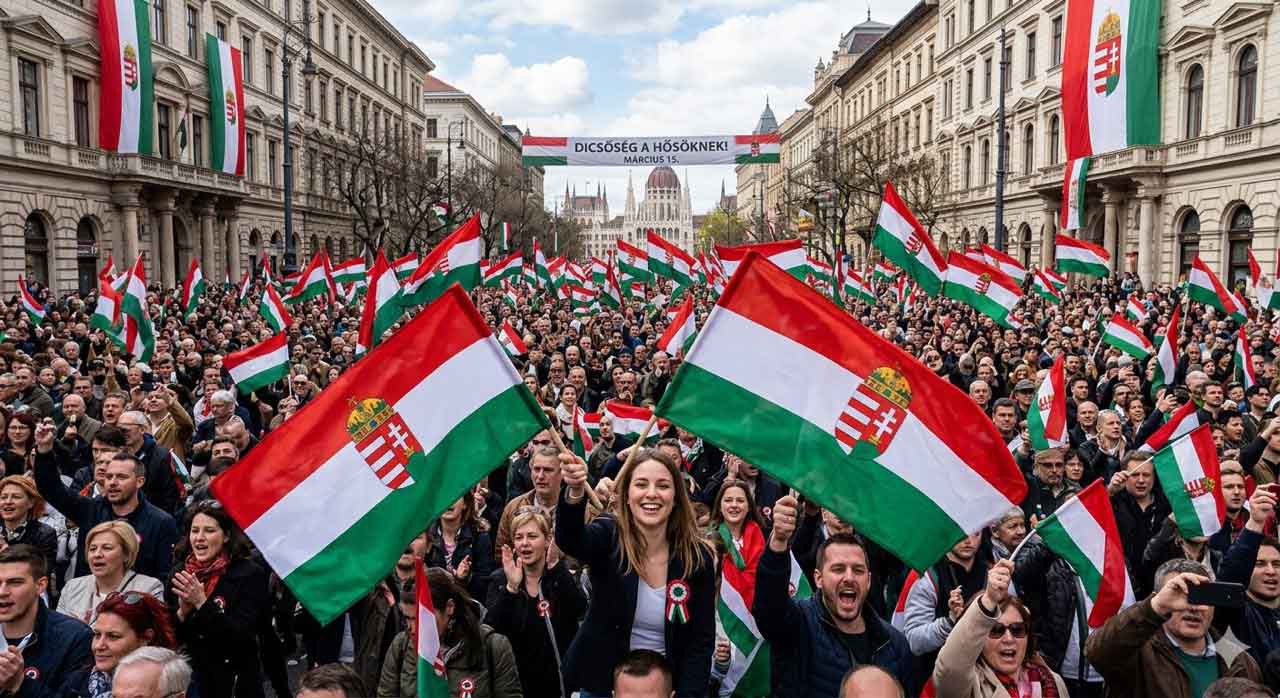
Several holidays are approaching. March 15 marks Hungary’s national holiday, followed by Easter at the beginning of April, and, a week later, parliamentary elections. According to the governing party, Fidesz, the latter is also a “celebration of democracy.” A holiday is, by definition, a special day. It is a moment when we remember something important to an individual, a community, or a nation, or when we commemorate a person who played a significant role in the life of that community or achieved something meaningful.
Author: Gabor Gulyas
In the case of a birthday, this happens in a fairly simple way. People gather to celebrate the person whose birthday it is, to spend time together and enjoy each other’s company in a cheerful, relaxed atmosphere. These are the occasions when family stories emerge from the “tulip chests” of family legend: stories about how the birthday father, as a little boy, once kissed a frog because he believed it would turn into a princess, or how the mother, at the age of five, tried to surprise the family with a homemade breakfast, which ultimately required repainting the kitchen, and part of the apartment as well.
We laugh about these stories, or we reflect on how life has changed since then. Above all, we enjoy the time spent together and the shared moments that, ten or fifteen years later, will be remembered in exactly the same way, alongside those earlier stories.
One thing is certain: nobody is stressed about what will happen the next day, unless it involves a wine-stained carpet or a coffee-stained tablecloth.
When Holidays Become Battlefields
Our national holidays, however, have been very different for at least the past two decades. Instead of offering opportunities for remembrance and reflection, they have increasingly become occasions for accusations, threats, and attempts to reinterpret past events through the lens of current political conflicts. Symbolic knives are thrown at political opponents who are no longer portrayed merely as rivals, but as enemies.
Then comes Easter, when it is almost guaranteed that paid loyalists of the ruling party, Fidesz-KDNP, will use the pulpit not to preach the Gospel but to repeat political propaganda, portraying opposition candidates as villains or even embodiments of evil, and stigmatizing those who do not support the governing coalition or who may not be believers at all.
All of this, of course, under the banner of twenty-first-century secularization.
Then come the elections. Even now, we are witnessing situations in which people chase one another with axes, fire alarm pistols, or spit on the baby of an opposition member of parliament while verbally abusing her.
One may reflect on how we arrived at this point and who bears responsibility, but it is difficult to overlook how long this process has been unfolding. Twenty-four years ago, the Slovak-Hungarian politician Miklós Duray declared at a Fidesz election rally of “two million supporters” that now “the filth will separate from the water.”
At another event, the sitting prime minister said:
“I can smell the gunpowder. I feel what is in the air, and believe me, great things are being prepared. The winds of spring will bring great changes. Everyone would do well to mobilize their dreams.”
Since then, Viktor Orbán has consistently framed politics as a struggle, or a battle. His speeches are filled with the imagery of conflict, because in his own words he is not a traditional politician but a “street fighter.”
The Cost of Permanent Political Warfare
The direct consequence of this rhetoric is the hysterical political climate we see today. On March 15, at Easter, or even when casting our votes, we no longer celebrate. Instead, we retreat into political camps, grow to hate our fellow citizens and even our friends, and sometimes refuse to speak with our own relatives.
Yet it should not be this way. More precisely, it should never have become this way.
Life has taken me to several different countries, and nowhere else have I experienced such deep divisions caused by politics.
A Different Political Culture Elsewhere
In Germany, one of my very dear friends in Munich, a Green Party representative, had no problem with the fact that I was a socialist. In fact, I was even a “Rote,” a supporter of Bayern Munich, while he was both “Grüne” and “Blaue”: a Green politician and a supporter of TSV 1860 Munich.
For readers less familiar with football, this rivalry is roughly comparable to that between Ferencváros and Újpest in Hungary, or Manchester City and Manchester United in England. Yet the best man at his wedding was a childhood friend who also happened to be a member of parliament for the Christian Democratic Union (CDU).
Here in England, people often do not even know who their local member of parliament is, yet they openly and proudly acknowledge their political preferences. When we moved here, I was surprised to see that one of my neighbours placed a Labour Party sign next to his fence, while the neighbour on the other side displayed a Conservative sign. After the election, however, they still went to the pub together and chatted, just as people do in civilized societies.
Nobody cares about another person’s political views, religious beliefs, or sexual orientation. What matters is what kind of person someone is and how well they fit into the community.
And in both Germany and the United Kingdom, governments are not preoccupied with polishing their own image or labeling and dividing citizens. Instead, their focus is on governing in the interest of the entire nation.
Cover photo credit: Gemini

dr. Gábor Gulyás is a lawyer who served as a local government representative for sixteen years, from 1994 to 2010, and as a member of the Public Order Committee of the Budapest General Assembly between 1998 and 2010. He has also worked as a lyricist and has been involved in several music projects. He is the father of three adult children, a football enthusiast, a Bayern Munich supporter, and, as he puts it, “half-officially” a journalist. After living in Germany and Canada, he has spent the past eleven years in England.
Support independent analysis and journalism at CEA Magazine: https://centraleuropeanaffairs.com/donation
For more insights on Central European political risk, EU institutional developments, and transatlantic relations, follow CEA Magazine and the CEA Talk podcast.

Ha netán először magyarul készül(né)nek el a cikkek, bizonyára rajtam kívül mások is szeretnék azokat (is) elolvasni.
Üdvözlettel: endre