
Hungary’s foreign minister travels the world – and his staff travel after his whims
In most foreign ministries, diplomatic travel is a logistical exercise. In Hungary’s, it has become a lifestyle genre. For years, insiders on Budapest’s Bem rakpart have whispered about the increasingly operatic travel requirements of the country’s foreign minister, Péter Szijjártó. Now, fresh accounts confirm that what masquerades as protocol is in fact the curated comfort regime of a man who behaves less like a public servant and more like a monarch in tracksuit diplomacy.
Author: Dr. Georges Suha & Szilárd Szélpál
Mr Szijjártó has not boarded a commercial flight in ten years. According to ministry data, he logs the equivalent of the Earth–Moon distance annually, and spends more than half of all working days abroad. The Hungarian taxpayer provides appropriate transport options: an Airbus A330 cargo plane bought for 17bn forints (though the minister must not be seen arriving in a flying warehouse), a military Airbus, a Dassault Falcon or, when the mood or destination requires it, a long-range luxury jet leased from the Middle East for a price tag large enough to make even Gulf oligarchs blush.
On touchdown, the minister prefers the sort of security escort normally reserved for visiting presidents or minor royalty. In places where such displays are banned – Brussels, for example – his staff despair. Diplomacy, after all, is about adapting to local norms; Mr Szijjártó’s approach is about local norms adapting to him.
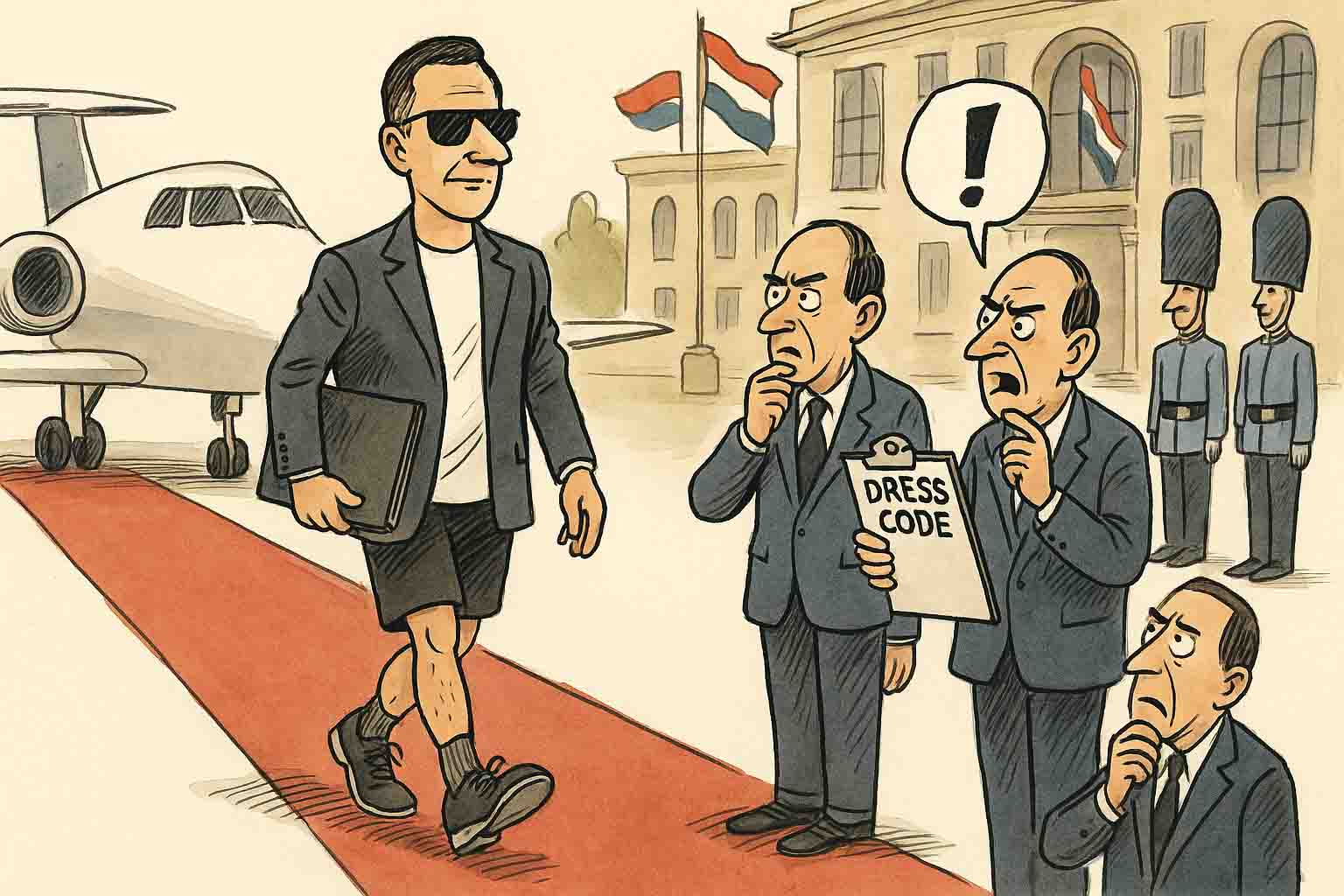
Protocol, Hungarian-style
Travel arrangements extend far beyond motors and metal. The ministerial ecosystem revolves around a strict triad of acceptable in-flight and in-car nourishment: whole-hazelnut Ritter Sport, approved muesli bars and half-litre Perrier. The one-litre version is verboten, allegedly because it “tastes different.” In this system, there are no small details – only potential catastrophes.
Hotels pose their own dangers. The gym must be open 24/7 and, crucially, have ceilings of at least four metres. On a Scandinavian trip, a hotel was scrapped at the eleventh hour because the fitness room ceiling was too low. Physical conditioning is not treated as a personal preference but as a vital pillar of Hungarian diplomacy, up there with bilateral meetings and strategic partnerships.
Advance teams, sometimes several people are deployed days ahead to inspect every imaginable variable. They test the bed, audit the minibar, check whether the window opens and, most impressively, run the jogging route to measure it themselves. Local diplomats, it seems, cannot be entrusted to count chocolate bars or understand the geopolitical significance of the correct dumbbell weight.
In one European capital, officials selected a public park for an evening run – only to learn it closed at 10pm. The city agreed to open it specially if Hungary footed the bills for lighting and security. Tens of thousands of euros later, the minister enjoyed his midnight jog. One must prioritise: national budget constraints are no match for cardiovascular needs.
Breakfast of champions
More quirks follow. Mr Szijjártó consumes no coffee, no alcohol and no seafood. These are manageable. What is less so is his morning reading ritual: a colour-printed, fresh copy of Nemzeti Sport – a Hungarian sports daily – must be placed in his hotel room every morning, anywhere on Earth. At dawn, an embassy staffer receives the PDF from Budapest, prints it and delivers it to the minister’s breakfast. This, too, is diplomacy.
Foreign hosts have learned to smile politely at these demands, though not all succeed. What Hungarian officials call “routine protocol” often looks, to outsiders, like pure farce.
Respect, but make it casual
Diplomatic protocol is built on respect from attire to tone. Mr Szijjártó often proclaims that “Hungarians must be given respect.” Yet he has been photographed stepping off private jets in shorts and a T-shirt, greeting impeccably dressed officials who were expecting a minister, not a man arriving from a beach holiday. The contrast between his rhetoric and appearance is not lost on anyone.
A court, not a ministry
Defenders may dismiss these as harmless idiosyncrasies. But to those within the system, they reveal a deeper drift: a ministry whose energies are consumed by one man’s comforts rather than one nation’s interests. The trivial has eclipsed the strategic. Less is said about the policy outcomes of Mr Szijjártó’s globe-trotting than about his favourite chocolate brand or the approved gym ceiling height.
Hungary’s foreign policy challenges – from regional instability to global economic shifts – deserve professional focus. Instead, staff are left choreographing a travel routine that owes more to Versailles than to Vienna. When an elected politician starts being treated like royalty, it is not his status that has risen, it is the institution that has shrunk.
In diplomacy, symbolism matters. And nothing symbolises the state of Hungary’s foreign ministry more clearly than this: at dawn in distant capitals, exhausted embassy staff are printing a sports newspaper so that the minister can begin his day as he prefers. The rest of the world may be discussing trade, war, energy and alliances. But for Hungarian diplomacy, it seems the first order of business remains ensuring that the colour printer has enough ink.
Support independent analysis and journalism at CEA Magazine: https://centraleuropeanaffairs.com/donation
Cover photo credit: ChatGPT

Dr. Georges Suha is an international relations specialist, former ambassador, and expert in consular affairs with deep expertise in Sub-Saharan Africa. He has held senior diplomatic positions and continues to contribute to academic and policy discourse as a university lecturer. With extensive political networks and first-hand regional experience, he offers a nuanced perspective on African affairs, diplomacy, and consular practice. A dual citizen of Hungary and France, he engages fluently across European and African contexts.

Szilárd Szélpál served as an environmental expert in the European Parliament from 2014, where he utilized his expertise to influence policy-making and promote sustainable practices across Europe. In addition to his environmental work, Szilárd has a deep understanding of foreign affairs, offering strategic advice and contributing to the development of policy initiatives in this field.