
Meeting someone online can hardly be considered unusual these days. Almost every age group has some presence in the digital world, and while a love story once needed a workplace, a circle of friends, a night out, a chance encounter or at least a shared geographical location, today it can sometimes begin with a single message.
Author: Olga Nádra
Not necessarily on a dating app, either. Something begins on social media, beneath a comment, through a shared interest or without any particular intention at all. Two people start talking. At first, perhaps neither is looking for anything in the other. There is no plan, no story, and no particular significance even in the fact that they continue the next day. Then the day after that. Eventually, what stands out is no longer that they talk, but how strange it would feel if they did not.
When a Name Becomes Someone
Perhaps this is one of the most interesting things about meeting someone online. Often, the relationship has no clearly identifiable beginning. It is not always possible to pinpoint the sentence after which the other person stopped being merely a name on a screen and became someone. Suddenly, we notice that something happens during the day and we think: I must tell them about this. A song brings them to mind. A morning message becomes a familiar part of life. We no longer simply recognise their voice; it feels familiar. Meanwhile, the two people may be a hundred, five hundred or a thousand kilometres apart.
It is a strange contradiction. Throughout history, distance has been one of the most tangible obstacles to human relationships. Someone far away was truly far away. Letters took weeks to arrive, a phone call was an occasion in itself, and we could only imagine ourselves in the other person’s everyday life. Today, someone can wake up in another country and still be there with us in the morning, accompany us on our way to work, let us hear their voice in the afternoon and, in the evening, see what we are looking at. Technology has not abolished the kilometres. It has done something stranger: at times, it has convinced us that they do not matter.
Perhaps this is why an online relationship can deepen surprisingly quickly. When we meet in person, so much can draw our attention away from the person themselves. We notice their appearance, movements, clothes and behaviour, while also keeping an eye on ourselves. Do we look all right? Have we said something foolish? What should we do with the silence? When is it polite to leave? A meeting in person has an entire choreography of its own. On either side of a screen, particularly when exchanging messages, much of this falls away. What remains is words. And words can sometimes travel surprisingly far.
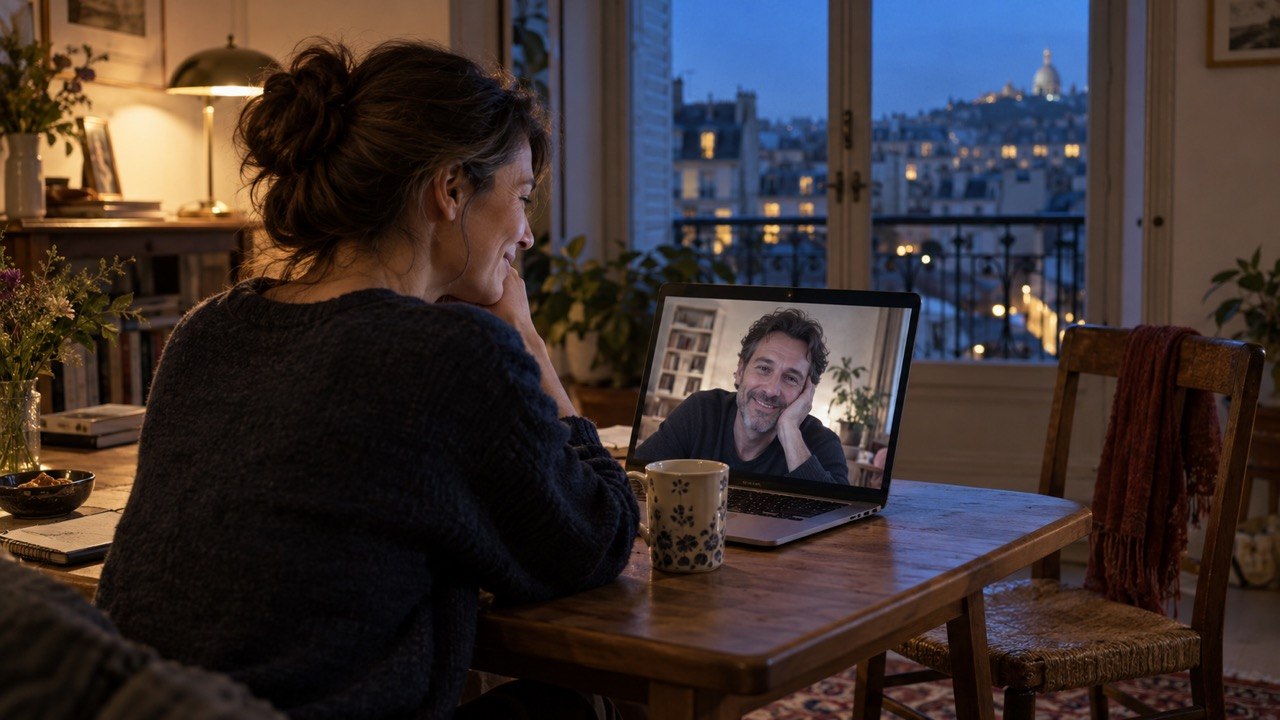
Especially in conversations that begin late in the evening and slip unnoticed into the night. Somehow, these are the moments when stories emerge that we might not tell in daylight. Fears, failures, childhood memories, desires, thoughts we are ashamed of, old wounds and seemingly insignificant details mingle together. One moment, two people are laughing about something ridiculous; a few minutes later, they are telling each other something that perhaps only a handful of people in their lives know about them.
At such times, distance is strangely no obstacle; sometimes, it is part of what makes us feel safe. The other person is not physically there. In writing, they cannot immediately see our embarrassment, silence is not necessarily awkward, and there is time to put a thought into words. The screen both separates us and lets us draw close.
Then a language of our own develops. Private jokes, half-finished sentences, songs, pictures, nicknames and small references that would mean nothing to an outsider. Even a missing full stop or emoji can become noticeable. We begin to hear tiredness in the other person’s voice. Behind a brief “I’m fine”, we can sense when things are not quite right. At this point, it becomes difficult to keep calling what is happening an “online acquaintance”. The relationship may still exist through a device, but the feelings attached to it have long since moved beyond the screen.
The Person We Know and the One We Imagine
This is where the question of what makes us fall for someone becomes particularly interesting. When we meet in more traditional ways, appearance often comes first. We see someone, find them attractive and gradually discover the person behind the face. Online, that order can be reversed. We may come to know someone’s thinking, humour, fears and outlook on life before we know what it feels like to walk down a street beside them. Attraction seems to develop in the opposite direction. Rather than moving from the body towards the person, it moves from the person towards the body.
A voice that was initially just a voice suddenly becomes beautiful. A face we might once have viewed dispassionately is no longer merely a collection of features. Everything we have learnt about its owner becomes attached to it. There are stories behind the eyes and memories associated with the smile. We no longer simply see what someone looks like, but who it is looking back at us.
Of course, there is another side to all this. Distance gives us room to get to know someone, but it also leaves gaps. We do not see the other person in every everyday situation. We do not know what they are like when they have to wait three hours for something, when they have barely slept, when they argue with someone, when they do not feel like talking, when they are having a bad day or when they are simply boring. The human mind is not particularly fond of missing details. It tends to fill them in. So, alongside genuine understanding, idealisation can easily become part of an online attachment.
This does not automatically mean that the feeling itself is an illusion. Rather, it means we are talking about two different things. It is possible to feel a real attachment to someone while still having an incomplete picture of them. Indeed, something similar probably happens whenever we fall in love. The online world simply leaves more blank canvas for the imagination.
Meanwhile, a digital presence gradually becomes woven into everyday life. One name on the phone screen carries a different weight from all the other notifications. We wait for it. Sometimes a little too much. Modern technology has made closeness more continuous, but it has also made absence visible. The “seen” indicator, the “last seen” timestamp and the message left unanswered for hours give us information we never previously had to deal with. This has created one of the peculiar conditions of our time: someone is not physically beside us, yet we are almost constantly aware of their presence—and, precisely because of that, their absence too.
When the Kilometres Return
Sooner or later, the kilometres reclaim what technology temporarily took from them. We can talk for hours, see and hear each other, and laugh together on either side of a screen, but there is one thing even the best internet connection cannot transmit: physical presence.
We cannot touch the other person. We cannot sit beside them without either of us having to say a word. We cannot smell their scent or discover what those few centimetres between two people feel like when they meet in person. Suddenly, the hundred, five hundred or thousand kilometres that had seemed almost insignificant become exactly what they are again.
The thought of meeting in person can therefore be both deeply desired and frightening. By then, something already exists. There is a shared past, even if it can be measured in messages. There are stories, habits, expectations and an image of who the other person is. At the meeting, all of this has to find its place in physical reality.
There is no longer time to rephrase a sentence before sending it. Body language, scent, spontaneous silences, awkward moments and that elusive chemistry all enter the picture—things no video call can fully predict. Two people who could talk for hours from opposite sides of a screen may discover that being together in the same room feels just as natural. Or they may discover the opposite.
Perhaps this is both the greatest risk and the most beautiful possibility of meeting someone online. By the time two people first touch, they may have long ceased to be strangers emotionally. Behind that first physical encounter may lie hundreds of hours of conversation, countless spoken words and a closeness that takes a long time to develop in other relationships.
An Embrace We Have Never Known
But there are stories in which such a meeting remains impossible for a long time. Countries, continents, work, money or simply life itself stand between two people. The online relationship remains in a strange space in between. It may keep deepening, with nowhere to arrive.
Perhaps this is where one of the hardest feelings to put into words comes from. We can miss someone who has never sat beside us. We can long for an embrace of which we have no memory. A voice can be familiar while a touch remains unknown. Someone can be part of our everyday life without ever having entered the same room.
At first, all of this seems thoroughly modern, yet the feeling itself is hardly new. People have loved from a distance for centuries. Letters preserve love stories in which, for months or years, words were almost the only way to give love a physical form. Wars, journeys and emigration have always separated people who then tried, on sheets of paper, to bridge the world between them.
The internet, then, probably did not teach us how to love from afar. It simply removed much of the waiting. Instead of a letter, a message arrives instantly. We see a photograph not weeks later, but the moment it is taken. The other person no longer enters our life only occasionally; they can be present from morning until night. Perhaps technology has changed not the nature of love, but what it means to be present.
This makes it increasingly difficult to give a simple answer to the question of what counts as a real relationship. Perhaps the number of kilometres is not what decides it. Nor is the number of times two people have sat opposite each other. The digital world forces us to reconsider what it means to grow close to someone.
Distance has become a strange thing. It can be measured in kilometres, flight hours and motorway journeys. Yet human closeness has never really been measurable in any of these ways. Someone can be right beside us and still feel impossibly far away. And someone can be in another country, yet their words take only a few seconds to reach us.
Perhaps, then, the most interesting question is not whether we can fall for someone online. It is how two people with half of Europe between them can reach a point where they no longer feel the kilometres at all. Instead, they feel those few centimetres that technology still cannot bridge.
This article is the first in a series exploring how the online world shapes our relationships and everyday lives.
Cover photo credit: CEA Magazine. AI-generated illustration created with OpenAI for CEA Magazine.

Olga Nádra is a social worker and a specialist in gerontology and mental health. She completed her studies at Kodolányi János University. She has more than fifteen years of practical experience in elderly care as well as in supporting people with psychiatric conditions. Her work is grounded in empirical insights gained in the field, through which she engages with questions related to mental health, care systems and the social welfare system. She believes strongly in lifelong learning and therefore continues to deepen her professional knowledge through ongoing training and research.
Support independent analysis and journalism at CEA Magazine: https://centraleuropeanaffairs.com/donation
For more insights on Central European political risk, EU institutional developments, and transatlantic relations, follow CEA Magazine and the CEA Talk podcast.

